Table of Contents
ToggleYoga Mastery: What It Really Means and How to Actually Build It
Yoga mastery is not about performing the most demanding poses. Patanjali’s Yoga Sutra 2.47 defines it as sthira sukham asanam: the meeting point of steadiness and ease in the body, breath, and mind simultaneously. A practitioner who has reached yoga mastery no longer strains toward the practice. The practice unfolds from within, on its own.
What Yoga Mastery Really Means
I have been teaching yoga since 2009. I have personally guided more than 15,000 students across every level imaginable, from people who could not sit cross-legged without a bolster to experienced practitioners with two decades of daily practice behind them.
The single most common misunderstanding I encounter is this: people believe yoga mastery means performing the most impressive poses in the room.
It does not.
The Flexibility Trap Nobody Warns You About
Here is something I learned from watching thousands of students over 16 years. The most hypermobile people in any training room are often the furthest from genuine yoga mastery.
Extreme flexibility frequently masks the complete absence of sthira, the stability that keeps the body safe and aware. When a student drops into a deep backbend without muscular engagement, they are riding passive tissue stretch. They are not cultivating intelligence in the body.
In my experience, hypermobile practitioners often need to stop stretching entirely and start building structural support around their joints. True mastery requires steadiness and ease living in the body at exactly the same time, not one at the cost of the other.
What Patanjali Actually Wrote
Yoga Sutra 2.47 contains three Sanskrit words: sthira sukham asanam. Steadiness, ease, seat. That is the entire classical definition of a mastered posture.
Alistair Shearer translates it as mastered when all effort is relaxed and the mind is absorbed in the Infinite. Swami Venkatesananda describes it as the abandonment of effort and the non-use of will. Barbara Stoler Miller calls it resting like the cosmic serpent on the waters of Infinity.
Every translation arrives at the same destination. Releasing the grip is the mechanism of mastery. You do not force your way into yoga mastery. You release your way in.
Sthira and Sukha Cannot Live Apart
Most practitioners I meet are chasing one quality while quietly sabotaging the other. They either brace, grip, and force their way into stability, or they collapse into looseness and call it relaxation.
Genuine yoga mastery lives exactly between those two states. Sthira is the steadiness that keeps you present and protected. Sukha is the ease that keeps the body open and the mind receptive.
Practicing one without the other will plateau the practice. It always does.
The Eight Limbs of Yoga as a Mastery Roadmap
Patanjali did not design yoga as a fitness system. He gave us an eight-stage path toward liberation, and physical posture is only the third stage.
The outer four limbs build the foundation: Yamas (ethical principles), Niyamas (personal disciplines), Asana (physical posture), and Pranayama (breath mastery that bridges the gross body and the inner world). These four work primarily on the surface mind and the physical sheath.
The inner four limbs move toward freedom: Pratyahara (withdrawal of the senses from external input), Dharana (single-pointed concentration), Dhyana (sustained meditative awareness), and Samadhi (complete absorption in awareness). Most people practicing yoga in the West today never reach this territory, and that is simply what happens when the curriculum stops at Asana.
Why Asana Is Only the Beginning
I tell students at Yoga New Vision that asana is the front door of the practice. It is how you enter the house. Spending years standing in the doorway, thinking that is yoga, is an easy mistake to make because the doorway is genuinely beautiful.
The Pancha Kosha model describes five layers of your being: the physical body (Annamaya Kosha), the energy body (Pranamaya Kosha), the mental body (Manomaya Kosha), the intellect body (Vijnanamaya Kosha), and the bliss body (Anandamaya Kosha).
A practice that only touches the physical sheath has reached one of five layers. Yoga mastery means the practice has found all five.
The Four Classical Stages of Yoga Mastery
Classical Hatha Yoga texts describe four sequential stages of mastery. These are not modern inventions. They come from the original texts and they describe something that does not change across centuries.
- Arambha: The beginning. Physical and breath awareness first develop here. The student can follow instructions and hold basic poses with some consistency.
- Ghata: Integration. Body, breath, and mind begin moving as one system instead of three separate things working against each other.
- Parichaya: Purification. The subtle body becomes the primary field of practice. Emotional patterns stored in the body as chronic tension begin to surface and release.
- Nishpatti: Completion. Effort dissolves. Awareness becomes continuous and unforced. Samadhi becomes accessible.
After working with 15,000-plus graduates across four schools including Siddhi Yoga, Deep Yoga Academy, East+West Yoga, and now Yoga New Vision in Bali, I have found the single most reliable reason practitioners stall in Arambha. It is not a lack of flexibility. It is the inability to maintain a slow, quiet nasal breath during sustained physical effort. The moment the mouth opens and the breath shortens, the nervous system leaves the parasympathetic state and the deeper stages become structurally unreachable. Rajat Thakur, our movement anatomy specialist, works directly with students on this in every cohort. His approach is clinical, specific, and grounded in both Western physiology and classical yogic principles.
What Actually Accelerates the Path to Yoga Mastery
Why Yoga Apps Keep You in Stage 1
I will say something that might be uncomfortable. Yoga apps are genuinely useful for building a physical habit. They are largely unable to move you through Stages 2, 3, or 4.
The reason is structural. An algorithm cannot observe your energetic holding patterns. A screen cannot correct the subtle breath misalignment that keeps your nervous system in a state of low-grade chronic arousal. No amount of video content transmits what a lineage teacher carries into a room simply by being present in it.
This is the Guru-Shishya principle. The teacher-student relationship in classical yoga is the actual mechanism of transmission, not a formality or a ceremony. What the great yoga masters of India understood intuitively is increasingly supported by neuroscience: the co-regulation of nervous systems requires physical presence and cannot happen through a screen.
How 22 Days of Immersion Compresses Years of Progress
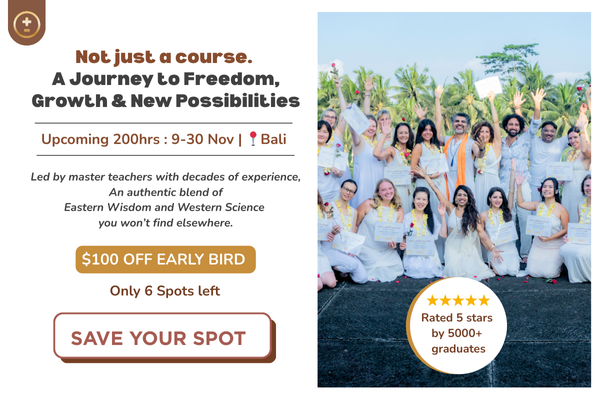
When Sadhana Om and I designed the 200-Hour Yoga Teacher Training in Bali curriculum at Yoga New Vision, we built it around what I call total environmental alignment. For 22 days, every variable that normally stalls a home practice is deliberately removed.
Students begin at 6am at Omham Retreats in Kedewatan, Ubud. The food is Sattvic, vegetarian, and prepared for mental clarity rather than stimulation. Pranayama happens before asana every single morning without exception. Philosophy study with Swami Atma happens in the afternoon. Anatomy and movement work with Rajat Thakur grounds the intelligence of the practice in the physical body.
Within that container, most students move from Arambha into early Ghata within the first ten days. That same transition normally takes years of unsupported solo practice. London’s OM Yoga Magazine recognized us as World’s Most Authentic Yoga Teacher Training for exactly this reason.
If you are ready to stop practicing at the surface, I personally teach every cohort. Spaces are limited to 25 students by design. Book a free 15-minute discovery call with Sadhana Om at yoganewvision.com/200-hrs-ytt-bali/.
The YNV Method: Where Western Science Meets Eastern Wisdom
We integrate three Western somatic systems directly into our classical yoga curriculum at Yoga New Vision. No other school in Bali uses this specific combination.
Frederick Matthias Alexander’s technique teaches practitioners to identify and release unconscious postural habits that generate chronic tension in the body. These patterns are largely invisible to the practitioner but obvious to a trained observer. Resolving them is foundational work for any real asana mastery.
Alexander Lowen’s Bioenergetics established a rigorous model for understanding how unresolved emotional material is held as chronic muscular bracing. This is why genuine emotional releases happen during our trainings. That is the practice working exactly as the ancient texts described it would.
Konstantin Buteyko’s research showed that carbon dioxide tolerance is the primary physiological regulator of nervous system arousal. What Buteyko measured in a laboratory is exactly what the ancient yogis understood through Kumbhaka, the practice of breath retention. Training your nervous system to tolerate higher CO2 levels through slow, light nasal breathing is the modern physiological equivalent of classical pranayama mastery. This is the science behind why our pranayama curriculum leads with Nadi Shodhana, Bhramari, and Bhastrika before any advanced retention work.
The Signs You Are Growing Toward Yoga Mastery
True yoga mastery is inherently unimpressive to anyone watching from the outside. I mean that without any irony whatsoever.
When a student at our Bali training finally reaches genuine stillness in Tadasana, the most basic standing pose that exists, there is nothing visible happening. The body is upright. The breath is quiet. The face is relaxed. It looks like nothing at all. The Instagram photo would bore everyone.
But inside that student, the vritti (mental fluctuations described by Patanjali) have slowed. Prana is moving cleanly through the nadis (energy channels). The practice has reached Pranamaya Kosha. The inner experience is profound and the outer appearance is completely ordinary.
Here are the markers I watch for. The breath begins to lead movement rather than following it. Drishti (inner gaze) becomes natural rather than effortful. The practice becomes less dramatic across weeks and months, not more dramatic. The student stops asking when they will reach the next level. Philosophy enters daily life without any conscious decision to apply it.
The moment a student tells me their kitchen has started to feel like a meditation space, I know they have crossed from Arambha into Ghata. It always happens without announcement. It always surprises them.
Building Your Daily Practice Toward Mastery
Svadhyaya, the Niyama of self-study, is where mastery is built in the small hours of ordinary days. Reading the Yoga Sutras for ten minutes after your morning practice matters more than most people expect. Journaling after practice, even briefly, accelerates the integration of what the body is quietly learning.
The Sattvic lifestyle is the container that allows the practice to land at depth. Consistent sleep, food prepared with awareness, and an environment designed for stillness are the three variables that most practitioners underestimate or skip entirely.
Find a teacher who carries lineage. A teacher without lineage transmits technique, and technique is genuinely valuable. A lineage teacher transmits something the technique alone cannot carry across the gap. That difference is felt in the first session and remembered for years afterward.
Frequently Asked Questions About Yoga Mastery
-
What is yoga mastery?
Yoga mastery is the state in which effort dissolves and practice becomes effortless awareness. Patanjali defines it in Yoga Sutra 2.47 as sthira sukham asanam: the union of steadiness and ease in the body and mind. Most people misunderstand mastery as physical achievement. It is a quality of attention that eventually transforms every layer of your being.
-
Is yoga mastery only about physical poses?
No. Physical poses are the third of eight limbs in Patanjali’s system. Asana builds the foundation, but yoga mastery includes breath control, sense withdrawal, concentration, meditation, and ultimately Samadhi. A practitioner who can hold any pose but cannot sit in stillness for ten minutes has significant distance still to travel.
-
What does Yoga Sutra 2.47 say about asana mastery?
Yoga Sutra 2.47 states sthira sukham asanam: the posture is mastered when it combines steadiness and ease simultaneously. Three respected translators all arrive at the same core teaching: mastery comes through the relaxation of effort, not through increased striving. This is the most consistently misunderstood concept in modern yoga culture.
-
What are the four classical stages of yoga mastery?
The four stages are Arambha (beginning awareness), Ghata (integration of body, breath, and mind), Parichaya (purification of the subtle body), and Nishpatti (effortless completion where Samadhi becomes accessible). Most practitioners remain in Arambha for years without realising it. Moving through the stages requires consistent daily sadhana under qualified, lineage-trained guidance.
-
How long does it take to master yoga?
Yoga mastery has no fixed timeline. A solid physical foundation typically develops within one to three years of consistent practice. Breath mastery and genuine meditation take five to ten years under daily discipline. The fastest progress I have witnessed always happens in immersive environments under a teacher who carries a living lineage.
-
Can I reach yoga mastery without a teacher?
You can build physical proficiency without a teacher. Reaching Stages 2, 3, and 4 without one is significantly harder. An algorithm cannot observe your energetic holding patterns. A screen cannot transmit the co-regulatory quality of a skilled teacher’s presence. At some point, every serious practitioner needs a living guide.
-
What role does pranayama play in yoga mastery?
Pranayama is the direct bridge between the outer and inner limbs of yoga. Training carbon dioxide tolerance through slow nasal breath directly regulates the nervous system, the modern physiological equivalent of what ancient yogis achieved through Kumbhaka. Without pranayama, most practitioners plateau at the surface level of asana indefinitely.
-
Can total beginners work toward yoga mastery?
Yes, from the very first class. Yoga mastery is a quality of attention you can begin cultivating immediately, not a level reached after years of practice. A beginner who breathes slowly, observes sensations without reaction, and releases unnecessary tension is already practicing in the direction of genuine mastery.
-
How does yoga teacher training accelerate mastery?
An immersive teacher training removes every variable that normally stalls solo practice. Daily sadhana, Sattvic diet, philosophy study, and direct feedback from a lineage teacher create conditions the mind cannot manufacture alone. In our 22-day program in Bali, most students cross from Arambha into early Ghata within the first ten days.
-
What is sthira sukham asanam and why does it define yoga mastery?
Sthira sukham asanam is Yoga Sutra 2.47. Sthira means steadiness, sukham means ease, and asanam means posture. Together they define mastery as the simultaneous presence of stability and comfort in body and mind. The pose is mastered when effort dissolves, not when the body goes deeper. This distinction separates classical yoga from modern fitness yoga.