10 Best Yoga Teacher Training in Sydney (2026): An Honest Guide
By the Editorial Team at Yoga New Vision | Last Updated: April 2026
At Yoga New Vision, we evaluate yoga teacher training programs using a consistent framework: syllabus depth, lead trainer credentials, class size, verified graduate outcomes, and total cost including the extras schools never mention upfront. No school paid for placement on this list.
If you search for yoga teacher training in Sydney right now, you get a wall of booking aggregators and school sales pages that all say the same three things. Yoga Alliance accredited. Transformational journey. Welcoming community.
This guide is different because we did the actual work. We audited syllabuses, spoke to recent graduates, and compared what schools promise against what students walk away with.
Before You Pick Any Program: The Accreditation Reality
Most schools lead with “Yoga Alliance accredited” as if that settles everything. It does not. Yoga Alliance is a US-based registry that any school can list on after paying annual fees and meeting basic paperwork requirements. That is not a quality guarantee, and you should stop treating it like one.
Yoga Australia requires 350 verified hours for standard membership, which is a meaningfully higher bar. If your goal is teaching in NSW’s allied health space, including trauma-sensitive yoga for clinical practice or NDIS-adjacent yoga therapy programs, local Yoga Australia recognition matters far more in real hiring conversations.
We note both accreditations in each listing. Where a school holds only Yoga Alliance registration, that is flagged.
How Yoga New Vision Evaluated These Programs
We weighted two factors most heavily: lead trainer experience and class size. Those two things predict your actual learning outcome better than any brochure ever will. We also looked at total cost with mandatory extras, post-graduation hiring pipeline, format flexibility, and commute practicality because Sydney traffic is real.
| School Name | Primary Style | Course Format | Estimated Cost | Accreditation |
| 1. Yoga New Vision (Ubud, Bali) | Hatha, Vinyasa, Pranayama | 22-Day Full Immersion | From $1,999 USD (Inc. Accommodation & Meals) | Yoga Alliance |
| 2. Body Mind Life | Vinyasa, Hatha, Yin | Part-time | From $3,200 AUD | Yoga Alliance, Yoga Australia |
| 3. Byron Yoga Centre Sydney | Purna Yoga | 6 Weekends (Part-time) | $4,060 AUD | Yoga Alliance, Yoga Australia |
| 4. PowerLiving | Multi-style Vinyasa | Hybrid (Online/In-person) | From $2,800 AUD | Yoga Alliance, Yoga Australia |
| 5. HUM Studio | Tantric Hatha | Part-time Weekends | Check Website | Yoga Alliance |
| 6. Yoga School of India | Hatha, Ashtanga | Intensive | Check Website | Yoga Alliance |
| 7. Nin Yoga | Multi-style | Alternating Weekly Hybrid | Check Website | Yoga Alliance (RYS) |
| 8. Balance Yoga Sydney | Multi-style, Therapeutic | Flexible Weekends | $2,700 – $3,000 AUD | Yoga Alliance |
| 9. One Hot Yoga and Pilates | Hot Yoga | Hybrid | Check Website | Yoga Alliance |
| 10. Dharma Yoga Sydney | Multi-style | Standard Intensive | From $2,495 AUD | Yoga Alliance International |
The 10 Best Yoga Teacher Training Programs in Sydney
1. Yoga New Vision: Best Destination Alternative for Sydney Professionals
Location: Ubud, Bali (Destination Alternative for Sydney Students) | Style: Hatha, Vinyasa, Pranayama, Yoga Nidra | Format: 22-Day Full Immersion | Cost: From $1,999 USD (accommodation and meals included) | Accreditation: Yoga Alliance (RYS 200)
Editorial transparency: Yoga New Vision publishes this guide and runs this program. We are saying that at the top of this entry because we think hiding it would be a cheap move. Read what follows and judge it on the numbers and the curriculum, not the placement.
Here is the cost reality that no Sydney school wants you to calculate. A part-time Sydney YTT runs 4 to 6 months. During those months you are paying Sydney rent, Sydney grocery prices, Sydney commuting costs, and Sydney cafe prices on the weekends you train. Add that to a $3,200 to $4,060 AUD tuition fee and your real total climbs well above $5,000 AUD before you have bought a single textbook.
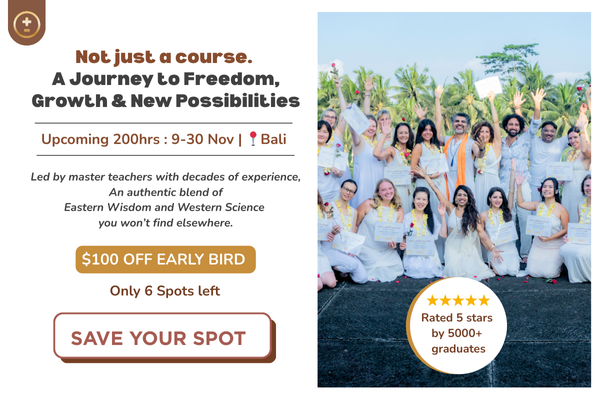
The Yoga New Vision 22-day immersion starts at $1,999 USD. That price includes 21 nights of accommodation and three meals a day at our Ubud campus. You fly in, you train, you eat, you sleep, and you fly home certified. For many Sydney professionals, once flights are factored in, the total cost lands at the same figure or below what a local part-time program costs when lived honestly.
The curriculum is where this program genuinely earns its place on a best-of list. We built it around a specific philosophical framework: Ancient Wisdom taught by Master Indian yoga teachers and monks alongside Modern Science delivered by qualified physiotherapists. You learn the Hatha Yoga Pradipika and the Yoga Sutras from teachers who have lived the tradition. You learn anatomy, injury prevention, and biomechanics from practitioners who work with bodies clinically. Those two bodies of knowledge are rarely in the same room. At Yoga New Vision they teach on the same schedule, to the same students, in the same 22 days.
Cohort sizes are kept small to maintain direct access to lead teachers throughout the immersion. The Ubud campus provides the focused environment that Sydney, with its traffic, social obligations, and work interruptions, structurally cannot.
Logistics note: Ubud, Bali is a direct or one-stop flight from Sydney, typically 6 to 9 hours depending on routing. Bali visa on arrival is straightforward for Australian passport holders. Your 22 days are self-contained. No commute. No parking. No cooking. That is not a lifestyle pitch, it is a genuine time and energy calculation worth making before you commit 6 months of Sydney weekends to a local program.
Best for: Burnt-out Sydney professionals who want to complete their 200-hour certification in one focused block rather than across 6 fragmented months, who value a curriculum that integrates classical Indian lineage with modern physiotherapy science, and who are willing to do the cost math before assuming local is cheaper.
Website – https://yoganewvision.com/200-hrs-ytt-bali/
2. Body Mind Life : Best Overall for Vinyasa
Location: Surry Hills | Style: Vinyasa, Hatha, Yin | Cost: From $3,200 AUD | Accreditation: Yoga Alliance, Yoga Australia
Body Mind Life is the most recognizable name in Sydney yoga and the reputation is mostly earned. Their Surry Hills studio was designed around sacred geometry principles and the curriculum goes well beyond asana into alignment mechanics and real teaching methodology. Capped cohort sizes and a genuine alumni community make this one of the safest long-term investments on this list.
Commute note: 5-minute walk from Central Station. Street parking is a real ordeal. Come by train.
Best for: Urban professionals who want Vinyasa as their primary style.
Website – https://www.bodymindlife.com
3. Byron Yoga Centre Sydney : Best for Philosophical Depth
Location: Roseville | Style: Purna Yoga | Format: 6 weekends | Cost: $4,060 AUD (earlybird from $3,760) | Accreditation: Yoga Alliance, Yoga Australia
Byron Yoga Centre has trained teachers for over 30 years. Their Sydney part-time offering runs across 6 non-residential weekends in Roseville under senior teacher Judy Krupp. The Purna Yoga approach covers yogic philosophy at a depth most 200-hour programs skip entirely. Fortnightly payment plans are available with a $600 deposit to secure your spot.
Best for: Working adults who need weekend scheduling and want serious philosophical grounding.
Website – https://www.byronyoga.com
4. PowerLiving : Best for Hybrid Flexibility
Location: Manly | Style: Multi-style Vinyasa | Format: Online and in-person | Cost: From $2,800 AUD | Accreditation: Yoga Alliance, Yoga Australia
Running since 2007, PowerLiving’s hybrid model is genuinely useful for students outside the city center or with irregular shift schedules. One honest note: their core content uses pre-recorded weekly modules. If you need live cohort energy to stay motivated, that format may test your discipline.
Best for: Students outside central Sydney or anyone needing maximum schedule flexibility.
Website – https://www.powerliving.com
5. HUM Studio : Best for Traditional Tantric Hatha
Location: Inner Sydney | Style: Tantric Hatha | Format: Part-time weekends | Accreditation: Yoga Alliance
HUM Studio keeps cohort sizes deliberately small, which is exactly right for the depth of lineage they teach. Co-founder Andrea integrates Trauma-Informed Yoga credentials directly into the curriculum. Pranayama, Tantric philosophy, anatomy, and embodiment practice are taught as connected subjects, not separate tick-boxes.
Best for: Students drawn to classical yogic philosophy and feminine embodiment frameworks.
Website – https://humstudio.com
6. Yoga School of India : Best for Authentic Indian Lineage
Location: Sydney CBD area | Style: Hatha, Ashtanga | Format: Intensive | Accreditation: Yoga Alliance
This school brings Indian teachers to Sydney with a curriculum built around the Hatha Yoga Pradipika and the Yoga Sutras. If you want your 200 hours rooted in classical Indian tradition rather than a modern studio brand identity, this is one of the very few Sydney programs that actually delivers that authentically.
Best for: Students seeking direct study in a traditional philosophical lineage.
Website – https://yogaschoolofindia.com
7. Nin Yoga : Best for Western Sydney Students
Location: Penrith | Style: Multi-style | Format: Alternating weekly in-person and online | Accreditation: Yoga Alliance (RYS)
Nin Yoga is the only program built specifically for Western Sydney students. Sessions alternate weekly between Penrith in-person (9am to 4pm) and online (9am to 12pm). Founder Annika Saigi completed her original 500 hours in India, which shows in how the program handles Sanskrit, pranayama, and teaching methodology.
Best for: Students in Penrith, Parramatta, and the Western suburbs.
Website – https://ninyoga.com
8. Balance Yoga Sydney : Best for Anatomy Depth
Location: Sydney | Style: Multi-style, therapeutic | Format: Flexible weekends | Accreditation: Yoga Alliance
Lead teacher Kylie Hennessy brings 20 years of experience as both a yoga teacher and massage therapist. That dual background produces anatomy and physiology content taught at a body-work level most yoga trainings simply cannot match. The flexible weekend format was designed around the reality that Sydney professionals cannot take a month off work.
Best for: Students who want serious anatomy education integrated into their yoga training.
Website – https://balanceyogasydney.com
9. One Hot Yoga and Pilates : Best for Hot Yoga Specialization
Location: Sydney | Style: Hot Yoga | Format: Hybrid | Accreditation: Yoga Alliance
One Hot Yoga runs a 200-hour program that explicitly includes professional development covering communication and career planning. The anatomy curriculum is designed and delivered by Kirby Cameron, a Physiotherapist and senior Pilates teacher. That level of credentials behind the anatomy content is genuinely unusual in this space.
Best for: Students who want to specialize in hot yoga with genuine physiology teaching behind the methodology.
Website – https://www.onehotyoga.com
10. Fire Shaper : Best for Hot Yoga with Career Prep
Location: Sydney | Style: Hot Yoga | Format: Intensive | Accreditation: Yoga Alliance
Fire Shaper frames their training as career preparation from day one, covering deep alignment, injury-prevention specifics for heated environments, and the actual business of running a yoga practice. The injury-prevention content for hot yoga environments is thorough in a way that matters when you are teaching in a 38-degree room.
Best for: Hot yoga specialists who want business fundamentals built into their certification.
Best for: Students who want to specialize in hot yoga with genuine physiology teaching behind the methodology.
Website – https://fireshaper.com/
The Honest Truth About 200-Hour Certificates in Sydney
A fresh 200-hour certificate rarely gets you hired at an established Sydney studio on its own. Most premium studios want either a mentorship placement, a 300-hour upgrade, or direct experience in their specific style before putting you on the teaching roster. That is not a criticism of the 200-hour programs. It is the current market reality in this city.
Frame your 200 hours as the beginning of your development, not the credential that immediately lands you the job. Programs on this list that include post-graduation support and alumni hiring pipelines are worth paying extra for if full-time teaching is your actual goal.
How to Spot a YTT Factory Before You Enroll
Some programs in Sydney prioritize marketing over actual teaching quality. Cohort sizes above 40 students for a 200-hour program are a red flag. If the lead trainer does not personally teach the majority of contact hours, that matters. Ask for a full syllabus with contact hours broken down by subject. If anatomy and teaching methodology together get fewer than 40 combined contact hours, the program is light where it counts most.
If a school is heavy on aesthetic branding but vague about instructor credentials and syllabus structure, the vagueness is the answer.
FAQs: Yoga Teacher Training in Sydney
- How much does yoga teacher training cost in Sydney?
Sydney programs typically run from $2,495 AUD to $5,980 AUD depending on format and what is included. Residential intensives cost more because accommodation and meals are bundled into the fee. Part-time weekend programs are the most affordable entry point. Always ask for the total cost including mandatory books, studio memberships, or retreat components before committing to anything.
- How long does a 200-hour yoga teacher training take in Sydney?
A 200-hour program runs anywhere from 3 weeks for a residential intensive to 6 months for a part-time weekend format. The hours are fixed by Yoga Alliance requirements but schools control the schedule structure. Most working professionals in Sydney choose the 4 to 6 month weekend format because it allows time to genuinely integrate the content without extended leave from work.
- Do I need prior experience to start a yoga teacher training in Sydney?
Most programs ask for 1 to 2 years of regular personal practice. This is a practical recommendation rather than a strict entry rule. Students who have a solid existing practice absorb teaching methodology content significantly faster. Spending 12 months building a consistent personal practice first will make your actual training more productive and far less overwhelming.
- Is Yoga Alliance or Yoga Australia more important for teaching in Sydney?
For international teaching flexibility, Yoga Alliance registration gives you global portability. For building a career specifically in Sydney and NSW, including allied health yoga pathways and trauma-sensitive yoga for clinical practice, Yoga Australia recognition carries more weight. Yoga Australia requires 350 verified training hours for standard membership, which sets a meaningfully higher bar than Yoga Alliance’s 200-hour minimum.
- Can I teach internationally after completing training in Sydney?
Yes, if your school is a registered Yoga Alliance RYS. After graduation you apply to Yoga Alliance directly for your RYT 200 designation, which studios in Bali, Europe, the US, and the UK all recognize. The certificate belongs to you regardless of your training country, as long as the school holds current RYS registration at the time you enrolled.
- How much does a yoga teacher earn in Sydney?
The current industry average sits around $24 AUD net per hour, though experienced teachers at premium studios can earn up to $60 per hour for specialized classes. Full-time income from class rates alone is genuinely difficult to sustain. Most full-time teachers in Sydney supplement class income with private sessions, workshops, retreats, or assistant teaching roles at their home studio.
- Is yoga teacher training tax deductible in Australia?
In many cases yes, but this depends entirely on your individual tax situation. If you are already working as a yoga teacher and the training maintains or improves skills used in your current income-generating work, you may be eligible to claim. Do not assume deductibility. Speak with your accountant before counting on it. Schools that actively direct graduates to ask this question tend to be the more transparent operators.
- What is the difference between a 200-hour and 300-hour yoga teacher training?
A 200-hour training is the foundational certification that Yoga Alliance and most studios recognize as the minimum teaching qualification. A 300-hour training builds on that base with advanced asana, deeper philosophy, and often a teaching specialization. Completing both gives you a 500-hour designation. In Sydney’s competitive market, the 300-hour qualification noticeably improves your hiring prospects at established studios.
- What yoga style is best for beginners starting teacher training?
Hatha-based programs are the most accessible starting point because the slower pace allows time to understand alignment, cueing, and sequencing without feeling rushed. Vinyasa programs move faster and demand a stronger personal practice base coming in. A Hatha or multi-style program with dedicated hours for teaching methodology and live practice teaching sessions is the most practical choice for newer practitioners.
- Are there trauma-informed or specialty yoga teacher training programs in Sydney?
Yes, and this area is expanding. HUM Studio integrates Trauma-Informed Yoga credentials directly into their Hatha training. Byron Yoga Centre offers a therapeutic approach through Judy Krupp’s program. For NDIS-adjacent yoga therapy and allied health yoga pathways in NSW, a standard 200-hour program is typically a prerequisite rather than the full qualification. Specialized certifications built for clinical contexts sit on top of your foundational training.