Hatha Yoga vs Power Yoga: A Yoga Teacher’s Honest Guide to Choosing Your Practice
By Deep Kumar | Founder & Lead Teacher, Yoga New Vision, Ubud, Bali E-RYT 500 | Teaching Since 2009 | Reviewed & Updated: April 2026
Expert Reviewed by the Academic Faculty at Yoga New Vision: a Yoga Alliance Registered School (RYS 200 & 300)
Quick Comparison: Hatha Yoga vs Power Yoga
- Hatha Yoga is a slow, alignment focused practice rooted in ancient Indian tradition. It holds postures for 30 seconds to several minutes, emphasising breath control (pranayama), correct alignment, and mind body awareness. This is best for beginners, stress relief, and building strong foundations.
- Power Yoga is a modern, fast paced style derived from Ashtanga Vinyasa. It links dynamic movement with breath in a continuous flow, building cardiovascular fitness, muscle strength, and core endurance. This is best for experienced practitioners and fitness oriented goals.
- The bottom line: Neither is better. They serve different purposes. Hatha builds the roots. Power Yoga builds the fire. Most students and teachers find that they eventually need a balance of both styles.
I have been teaching yoga in Ubud, Bali, since 2009. In that time, I have worked with thousands of students from Australia, the UK, the United States, and across Europe.One question comes up in nearly every intake conversation.“Should I be doing Hatha or Power Yoga?”I understand why it is confusing. Both styles use familiar postures like Downward Dog, Warrior, and Trikonasana. Both improve flexibility and reduce stress. Both are called “yoga.”But the experience inside a Hatha class versus a Power Yoga class feels worlds apart.One will ask you to slow down, breathe, and feel. The other will push your heart rate up, test your willpower, and leave you drenched in sweat.This guide will give you the honest, clear answer that most online articles are afraid to give you.
What Is Hatha Yoga? Origins, Philosophy, and What Happens in a Class
The word Hatha comes from two Sanskrit roots: Ha (sun) and Tha (moon). It represents the union of opposing energies: solar and lunar, active and passive, strength and surrender.
This is not just poetic language. It is the foundational operating principle of the practice.
Hatha Yoga is described in the Hatha Yoga Pradipika, written by the sage Swatmarama in the 15th century. It is one of the oldest existing texts on physical yoga practice, and it lays out asana, pranayama, mudra, and bandha as tools for purifying the body and preparing it for meditation.
When most people use the word “yoga,” they are unknowingly describing Hatha.
What Happens in a Traditional Hatha Yoga Class
A Hatha class moves slowly and deliberately. You will move into a pose and hold it, sometimes for 30 seconds, sometimes for two full minutes. That time in the pose is the practice.
You are not rushing to the next shape. You are learning to breathe inside discomfort. You are observing how your body responds, where tension lives, and where space can be created.
A typical Hatha session includes:
- Centering and breath awareness (Pranayama)
- Warm up and gentle mobilisation
- Standing postures: Tadasana, Virabhadrasana, Trikonasana
- Balancing postures: Vrksasana, Garudasana
- Seated and floor based stretches
- Supine postures and spinal twists
- Savasana (final relaxation)
The class ends in stillness, not exhaustion.
The Core Elements That Define Hatha
Asana (Posture): Each pose is explored for alignment, not speed. You learn exactly where your feet should be, how your pelvis tilts, and how your breath changes the depth of a stretch.
Pranayama (Breath Control): Breath is the primary tool, not an afterthought. You might practise Nadi Shodhana (alternate nostril breathing) to balance the nervous system, or Ujjayi breath to generate internal heat.
Drishti (Focused Gaze): Every pose has a specific point of focus. This trains concentration and connects internal awareness with external stillness.
Meditation and Philosophy: Traditional Hatha teachers, including myself, weave in moments of silence, self inquiry, and yogic philosophy. Yoga is not a workout; it is a process of understanding yourself.
At Yoga New Vision, we place significant emphasis on the why behind each posture. Understanding the biomechanics of a pose is just as important as executing it. That is the YNV difference.
What Is Power Yoga? Origins, Philosophy, and What Happens in a Class
Power Yoga was born in the 1990s in the United States. Teachers like Bryan Kest and Beryl Bender Birch wanted to make Ashtanga Vinyasa more accessible and flexible for Western fitness audiences.
They kept the core structure of Ashtanga: breath linked movement, continuous sequences, and physical intensity, but removed the fixed series format. The result was something dynamic, adaptable, and enormously popular with people who wanted a real workout from their yoga practice.
Power Yoga is sometimes called Vinyasa Flow or Dynamic Yoga. The terms are used interchangeably in many studios, though there are technical differences.
What Happens in a Power Yoga Class
You rarely stop moving.
The class opens with Sun Salutations (Surya Namaskar), which immediately elevate your heart rate. From there, sequences build in difficulty. You transition between Plank, Chaturanga Dandasana, Upward Dog, and Downward Dog repeatedly. Warrior sequences come faster. Your muscles are working constantly.
A typical Power Yoga session includes:
- Active warm up: Sun Salutation A and B
- Standing flow sequences: Warriors, Lunges, and Balances
- Core intensive sequences: Boat Pose and Plank variations
- Arm balances and inversions (in more advanced classes)
- Short cool down
- Brief Savasana
The class ends with your heart pounding and your muscles spent.
The Core Elements That Define Power Yoga
Dynamic Flow: Each movement is matched to an inhale or exhale. The breath is the engine. If your breath breaks, your form breaks next.
Strength and Endurance Focus: Poses like Chaturanga Dandasana engage fast twitch muscle fibres across the chest, triceps, and core. Held Warriors build slow twitch endurance in the glutes and quadriceps.
Cardiovascular Output: Power Yoga keeps your heart rate elevated across the session. This turns the practice into a cardiovascular workout, whereas classical Hatha focuses more on stillness and alignment.
Instructor Creativity: Unlike Ashtanga’s fixed sequence, Power Yoga classes vary by teacher. Each session can be completely different.
Hatha Yoga vs Power Yoga: The Core Differences at a Glance
| Feature | Hatha Yoga | Power Yoga |
| Pace | Slow, deliberate | Fast, continuous |
| Pose Duration | 30 sec – 2+ minutes | Brief holds, constant flow |
| Primary Focus | Alignment, breath, awareness | Strength, endurance, calorie burn |
| Intensity | Low to moderate | Moderate to high |
| Breath Style | Pranayama, extended techniques | Ujjayi breath linked to movement |
| Origins | 15th century India (Hatha Yoga Pradipika) | 1990s USA (Ashtanga derivative) |
| Best For | Beginners, stress relief, injury recovery | Experienced practitioners, fitness goals |
| Calorie Burn | ~150–200 per hour | ~300–500 per hour |
| Spiritual Depth | High: meditation integrated | Moderate: mindfulness in motion |
| Class Predictability | More structured | Varies by teacher |
Pace and Intensity
This is where most people feel the difference first.
In a Hatha class, silence is part of the practice. You might spend four full breaths settling into Trikonasana. In a Power class, you are already in the next pose.
Neither pace is wrong. They train completely different qualities in the body and mind.
Poses and Sequencing
Both styles use the same foundational postures. The difference is how those postures are approached.
Hatha treats each pose as a destination. Power Yoga treats each pose as a transition.
Breath and Mindfulness Focus
Hatha yoga activates the parasympathetic nervous system, which is responsible for the body’s “rest and digest” response. Slow, extended exhales lower cortisol, calm the heart rate, and shift the body away from fight or flight mode.
Power Yoga keeps the sympathetic nervous system engaged. This is why it feels like exercise. It is designed to build heat, challenge the body, and build mental resilience through discomfort.
The Real Benefits of Hatha Yoga
I want to be specific here, because most articles write in generalities. After teaching Hatha for over 15 years, these are the changes I watch happen in real students, in real time.
Physical Goals: Flexibility, Posture, and Recovery
Hatha yoga builds flexibility through long holds and consistent repetition. When you hold Paschimottanasana for 90 seconds, your nervous system gradually releases its grip on the hamstrings. This is called autogenic inhibition, which means the muscle surrenders because the stretch signal outlasts the protective reflex.
I have watched students arrive with severe lumbar tightness and see measurable improvement within three to four weeks of consistent Hatha practice.
Postural alignment improves significantly. Long holds train proprioception: your body’s sense of where it is in space. When a student holds Tadasana (Mountain Pose) with awareness for two minutes, they begin to understand what “standing straight” actually feels like in their own body. Many realise they have never truly felt it before.
Hatha is also the clearest path for injury recovery. Because there is no rush and no ego driven pace, practitioners can explore a safe range of motion without pressure.
Mental Goals: Stress, Focus, and the Nervous System
This is where Hatha yoga’s power becomes undeniable.
Extended Pranayama practice directly stimulates the vagus nerve. This is measurable physiology. Vagal tone improves, heart rate variability increases, and the body’s stress response becomes less reactive over time.
I have seen students arrive at YNV carrying what I can only describe as the weight of a decade of cortisol. Corporate burnout, relationship breakdown, identity confusion. Within two weeks of daily Hatha practice and pranayama, the change in their eyes is visible.
One student from the United States a healthcare professional in her late 30s told me she had not slept more than five hours in three years. By week two of our 200 hour training, she was sleeping eight. Not from the physical exertion. From the nervous system reset that consistent breathwork creates.
That is what Hatha yoga does. It teaches your body to be safe again.
The Real Benefits of Power Yoga
Power Yoga earns its place. Here is what it genuinely delivers when practised correctly.
Physical Goals: Strength, Cardiovascular Health, and Body Composition
Power Yoga is one of the most efficient bodyweight strength training methods available.
Chaturanga Dandasana holds, when performed correctly, are the equivalent of a tricep push up. A full Power Yoga class will hit your triceps, pectorals, deltoids, core, glutes, and quadriceps often in ways that targeted gym training does not. The compound, full body nature of the movements is what makes it effective.
Calorie burn is real and significant. Depending on body weight, a one hour Power Yoga session burns between 300 and 500 calories. That is comparable to a moderate cycling session or brisk jogging pace.
For cardiovascular health, the continuous movement keeps the heart rate elevated across the session, which supports aerobic fitness, improved circulation, and long term cardiovascular function.
Mental Goals: Focus, Discipline, and Resilience
If Hatha teaches you to be still, Power Yoga teaches you to be strong while moving.
Holding Warrior III for ten breaths when your legs are already burning is an exercise in willpower. The practice trains mental focus not through silence, but through sustained effort under physical pressure.
This is why athletes, military professionals, and high performance executives are often drawn to Power Yoga. It mirrors their working mode high output, high focus, constant demand while adding breathwork and body awareness they would never get in a gym.
From Practitioner to Teacher: Why Your Practice Style Shapes Your Teaching
Here is something most comparison articles will not tell you.
If you ever plan to teach yoga even casually, even just to friends this distinction matters enormously.
Power Yoga practitioners who skip Hatha foundations often become dangerous teachers. I say this not to be dramatic, but because I have seen it happen. A student who spends three years in fast flow classes develops body awareness, yes. But they often have no idea why each pose is cued the way it is. They do not understand the biomechanical reasoning behind alignment cues. They have never held a pose long enough to explore what changes when the pelvis shifts five degrees.
When these students try to guide others, they replicate the performance of a class without the understanding underneath it.
In our recent 200 hour training batches at Yoga New Vision, I have noticed a consistent pattern. Students arriving from Australia and the United States often come with strong Power Yoga backgrounds. They flow beautifully. Their body awareness and strength are impressive. But when asked to describe what is happening in a student’s hip in Trikonasana and how to correct it safely, many are lost.
The students who arrive with Hatha foundations understand the architecture of each pose. They can teach from knowledge, not just demonstration.
This is why our 200 Hour Yoga Teacher Training in Bali is rooted in Hatha.
We teach you how to build a pose from the ground up. How to read a student’s body. How to give safe, specific adjustments. How to understand what pranayama technique belongs in which context, and why.
Power Yoga gives you a love for movement. Hatha gives you the ability to teach it responsibly.
A complete yoga teacher and a complete practitioner knows both.
Hatha Yoga vs Power Yoga for Your Specific Goals
Physical Goals: Strength, Weight, and Recovery
For weight loss, Power Yoga wins on calorie burn per session. A consistent Power Yoga practice, combined with mindful eating, can absolutely support weight management.
But here is the honest truth: Hatha yoga supports weight loss too just through a different pathway. The parasympathetic nervous system activation that Hatha generates reduces cortisol. High cortisol is one of the primary drivers of abdominal fat retention. By regulating your stress response, Hatha yoga removes one of the most common hidden barriers to weight loss.
For muscle strength and endurance, Power Yoga is more efficient. The continuous engagement of major muscle groups particularly the core, upper body, and legs builds functional strength rapidly.
For injury recovery and chronic pain, Hatha is almost always the better choice. The slow pace allows healing. There is no pressure to keep up, no momentum that could push a vulnerable joint beyond its limit.
Mental Goals: Stress, Focus, and the Nervous System
For anxiety, stress, and sleep problems, Hatha yoga is clinically more supportive. The extended pranayama, long pose holds, and parasympathetic activation directly address the physiological drivers of anxiety.
For mental focus and discipline under pressure, Power Yoga builds a different kind of mental strength. It trains the ability to sustain concentration while the body is fatigued a skill that translates directly to high performance professional environments.
The practical answer is this: if your cortisol is already high, piling on a vigorous Power Yoga class may do more harm than good on any given week. On those weeks, Hatha is medicine. On the weeks where you need energy, motivation, and physical output, Power Yoga is the right tool.
Can You Practice Both? The Case for a Combined Approach
Yes, and I would argue that the best practitioners eventually do.
Think of it this way: Hatha builds the roots, and Power Yoga builds the branches.
A sustainable weekly practice might look like:
- Practice Hatha two or three times a week to focus on your alignment, breathing, and recovery.
- Add one or two Power Yoga sessions to challenge your strength and get your heart rate up.
- Include one restorative or Yin session to help your deep tissues recover and reset your nervous system.
This combination gives you flexibility and strength, stillness and fire, restoration and challenge. Your body adapts more fully because it is being trained across multiple systems simultaneously.
At Yoga New Vision, our teacher training programme does exactly this. Students begin their mornings with Hatha grounding, precise, awareness focused. Afternoons include dynamic flow work and methodology sessions. The contrast is intentional. You cannot fully appreciate the stillness of Hatha until you have felt the demand of Power Yoga, and vice versa.
Which Style Is Taught in Yoga Teacher Training Programmes?
If you are considering a 200 hour yoga teacher training, this is the question that matters most.
Most internationally accredited YTT programmes are rooted in Hatha Yoga. Yoga Alliance the global standard for yoga teacher certification requires that 200 hour trainings cover asana, pranayama, anatomy, and teaching methodology. All of these subjects are most deeply explored through a Hatha lens.
This does not mean Power Yoga is absent from teacher training. At Yoga New Vision, we include dynamic flow sessions, sequencing for Power style classes, and methodology for teaching vinyasa based formats. But the foundation is Hatha, because Hatha contains the complete system.
What to Expect at a Hatha Based YTT in Bali
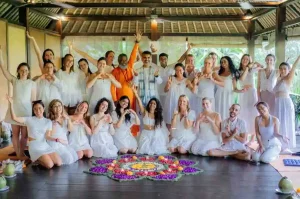
Our 200 Hour Yoga Teacher Training in Ubud runs across multiple dates throughout the year.
Students spend their mornings in practice Hatha asana, pranayama, meditation. Afternoons move into anatomy and physiology, teaching methodology, yoga philosophy (including study of the Yoga Sutras), and hands on adjustment workshops.
Ubud is not incidental to the training. The environment here the rice terraces, the temple sounds, the jungle air is part of the practice. Bali has been a centre for spiritual learning for centuries. The setting naturally supports the inward focus that Hatha training demands.
Students from Power Yoga backgrounds consistently tell me this: the month they spent slowing down in Hatha training was the month they finally understood yoga.
Not as a fitness format. As a complete system for living.
Frequently Asked Questions
1. What is the main difference between Hatha Yoga and Power Yoga?
Hatha Yoga is a slow, alignment based practice rooted in ancient Indian tradition. It holds poses for extended periods, focusing on breath control, correct posture, and nervous system regulation. Power Yoga is a fast paced, dynamic style derived from Ashtanga Vinyasa, designed to build cardiovascular fitness and muscular strength through continuous flow.
2. Is Hatha Yoga good for beginners?
Yes. Hatha Yoga is widely considered the best starting point for beginners. The slower pace gives new practitioners time to learn correct alignment, understand breath awareness, and build body confidence without the pressure of a fast flow. Most certified 200 hour teacher training programmes are built on a Hatha foundation for exactly this reason.
3. Can Power Yoga help with weight loss?
Yes, Power Yoga can support weight loss. A one hour session burns roughly 300 to 500 calories depending on body weight and intensity comparable to moderate cardio exercise. However, Hatha Yoga also supports weight management indirectly by lowering cortisol, which is a key driver of abdominal fat retention in stressed individuals.
4. Which is better for stress and anxiety Hatha or Power Yoga?
Hatha Yoga is more effective for stress and anxiety. Long pose holds and extended pranayama techniques such as Nadi Shodhana and Brahmari stimulate the vagus nerve and activate the parasympathetic nervous system. This reduces cortisol, slows heart rate, and directly addresses the physiological roots of anxiety.
5. Is Power Yoga the same as Vinyasa Yoga?
They are closely related but not identical. Power Yoga evolved from Ashtanga Vinyasa and shares its emphasis on breath linked flow and physical intensity. Vinyasa Yoga is broader and can range from moderate to vigorous pace. Power Yoga typically implies higher intensity and a stronger focus on strength and cardiovascular output.
6. Which yoga style burns more calories Hatha or Power?
Power Yoga burns significantly more calories. A one hour Power Yoga session burns approximately 300 to 500 calories. A Hatha Yoga session of the same length burns around 150 to 200 calories. The difference is due to Power Yoga’s continuous movement, elevated heart rate, and sustained muscular engagement throughout the class.
7. Can beginners do Power Yoga?
Beginners can try Power Yoga, but it requires caution. The fast pace leaves little time for alignment instruction, which increases the risk of incorrect form and potential injury. Most experienced yoga teachers recommend that beginners spend at least two to three months in Hatha classes first, building postural awareness and breathwork foundations before entering a dynamic flow environment.
8. Which yoga style is taught in 200 hour teacher training?
Most internationally accredited 200 hour yoga teacher training programmes including Yoga Alliance registered schools are rooted in Hatha Yoga. Hatha provides the complete framework: asana, pranayama, anatomy, philosophy, and teaching methodology. Dynamic flow and Power Yoga sequencing are often included as complementary modules, but Hatha forms the essential foundation.
9. Is Hatha Yoga good for back pain?
Yes. Hatha Yoga is one of the most recommended practices for chronic back pain and recovery. The slow pace, emphasis on spinal alignment, and deliberate breathwork allow practitioners to safely explore a therapeutic range of motion. Poses like Cat Cow, Sphinx, Supta Matsyendrasana, and Balasana specifically target the lumbar and thoracic spine without high impact stress.
10. How often should I do Hatha or Power Yoga each week?
For balanced results, a combination works best. Practise Hatha Yoga two to three times per week for alignment, breath, and nervous system health. Add one to two Power Yoga sessions for strength and cardiovascular fitness. Include at least one fully restorative session weekly for recovery. Consistency over months produces deeper, lasting results than intensity over days.
A Final Word from Deep Kumar
I started this school in 2009 with one belief: that yoga is not a fitness product. It is a complete system for human development physical, mental, emotional, and spiritual.
Hatha Yoga and Power Yoga are both expressions of that system. Neither is superior. Both deserve your respect and your time.
If you are new to yoga, start with Hatha. Build slowly. Learn the language of your body before you try to fluently speak it.
If you are experienced and physically ready, bring Power Yoga into your week. Let it challenge your limits and build your strength.
And if you want to teach truly teach, with the safety and depth that students deserve come and learn with us in Bali.
Our 200 Hour Yoga Teacher Training programme in Ubud is built on everything I have described in this article. Ancient wisdom, modern anatomy, real practice, real understanding. Enroll in Our 200 Hour YTT in Bali
The rice terraces are waiting. Your practice is waiting.
The question is whether you are ready to start.
Deep Kumar is the Founder and Lead Teacher at Yoga New Vision, Ubud, Bali. He holds an E-RYT 500 designation with Yoga Alliance and has taught yoga teacher training programmes since 2009. Yoga New Vision is rated among the most authentic YTT schools in Bali by Global Gallivanting and holds 5 star ratings on Google, Yoga Alliance, and Facebook.