By Deep Kumar | Founder and Lead Teacher, Yoga New Vision, Ubud Bali
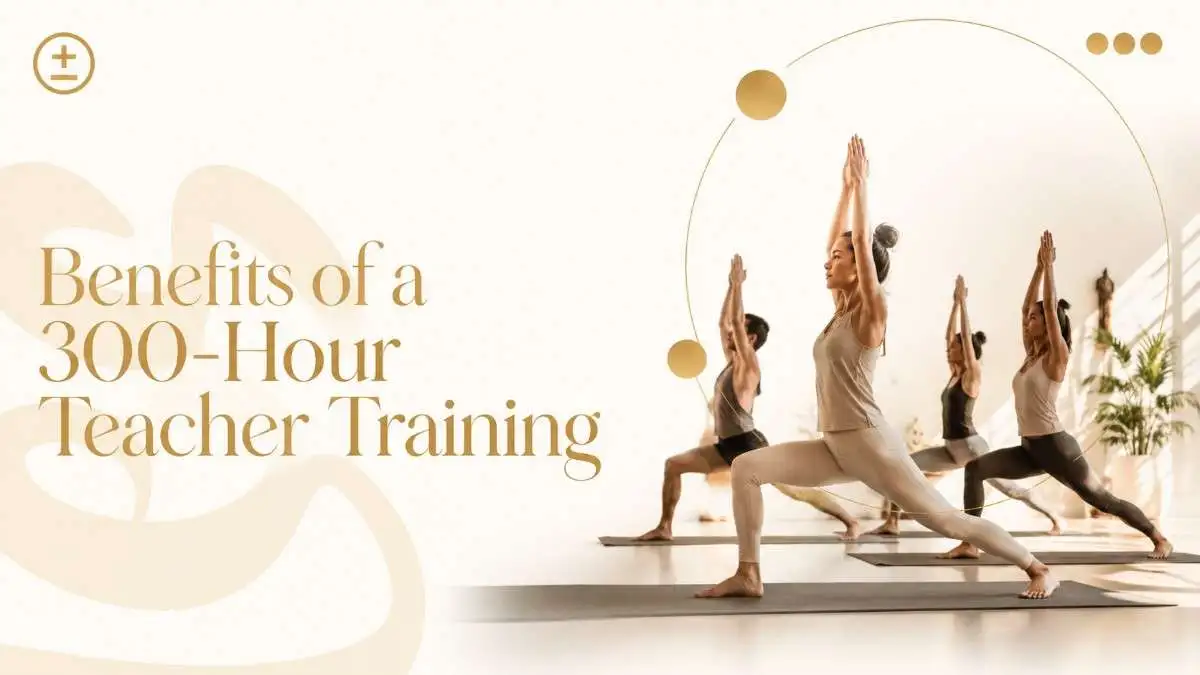
A 300-hour yoga teacher training builds on your 200-hour foundation to qualify you as an RYT-500 with Yoga Alliance, the highest international teaching credential available. It goes beyond advanced postures to develop your mastery of pranayama, yoga philosophy, the subtle body, and the professional skills needed to lead retreats, workshops, and your own teacher trainings. For serious teachers, it is the most important step they will ever take.
What a 300-Hour Yoga Teacher Training Actually Is
Let me be clear about something most schools leave buried in their FAQ sections. A 300-hour yoga teacher training is not simply 300 more hours of the same thing you did in your 200-hour program.
It is a different category of learning entirely.
Your 200-hour training gave you the language of yoga. It taught you the poses, the cues, the sequencing structure, and the philosophical framework to stand at the front of a room and lead. The 300-hour training teaches you what to do when that language reaches its limits.
The Pathway to RYT-500
Here is the technical piece that every teacher needs to understand clearly. When you combine a completed 200-hour YTT from a Yoga Alliance registered school with a 300-hour advanced program, plus 100 hours of teaching experience, you become eligible to register as an RYT-500.
The RYT-500 is the highest certification level Yoga Alliance offers. It is the credential required to officially lead your own yoga teacher trainings and be recognized as an advanced registered teacher internationally.
The RYT-300 designation is awarded upon completing the 300-hour program itself. The combined RYT-500 comes when you register both credentials with Yoga Alliance.
200-Hour YTT vs 300-Hour YTT: The Core Differences
| Dimension | 200-Hour YTT | 300-Hour YTT |
| Certification | RYT-200 | RYT-500 (combined) |
| Who it is for | Aspiring and new teachers | Practicing teachers ready for depth |
| Core focus | Foundations: asana, anatomy, teaching basics | Advanced: subtle body, philosophy, specialized teaching |
| Career outcomes | Studio teaching, wellness centers, group classes | Retreats, your own YTT, corporate wellness, yoga therapy |
| Duration at YNV | 22 days (Ubud, Bali) | 28 days (Ubud, Bali) |
| Prerequisite | Open to all levels | Completed 200-hour YTT |
The 200-Hour Is the Alphabet. The 300-Hour Is Poetry.
I have been teaching yoga for over two decades. I founded four schools: Siddhi Yoga, Deep Yoga Academy, East+West Yoga, and now Yoga New Vision, which is my most personal creation. In all those years, I have noticed the same pattern repeat in every teacher who walks through our doors.
After completing their 200-hour training, they can teach a class. They know the names of the poses. They can cue alignment, build a sequence, and manage a room. But there is something that still makes them nervous, and it is not lack of knowledge.
It is that they are still performing yoga rather than transmitting it.
The 300-hour training is where that changes. This is where you stop asking “what pose comes next?” and start asking “what does this student actually need right now?” The difference sounds small. The lived experience of it is enormous.
I often say to our students: understand your body, understand your mind, and in that very understanding, you are already transformed. The 300-hour program is where that understanding goes from concept to lived reality.
The Seven Benefits of a 300-Hour Yoga Teacher Training
1. You Qualify for the RYT-500 Designation
The RYT-500 is not just a badge. It is a door. Once you hold this credential from Yoga Alliance, you are permitted to lead your own Registered Yoga School programs, which means you can certify other teachers.
Studios and wellness organizations worldwide use the RYT-500 as their benchmark for senior teaching appointments. International retreat centres, corporate wellness programs, and specialist yoga therapy roles require it. Without it, those doors stay closed regardless of how skilled you are.
2. You Stop Teaching Poses and Start Teaching People
This is the shift that no 200-hour training can fully prepare you for. Advanced yoga training is not about learning harder postures. At the 300-hour level, you study how to teach yoga to people with chronic pain, nervous system dysregulation, hormonal imbalance, and emotional trauma.
At Yoga New Vision, our faculty includes Vijeth, who specializes in Yogic Sciences and Human Consciousness, and Anurag Acharya, whose mastery is in Therapeutic Yoga and Yoga Anatomy. These are not generalists. They are specialists who bring years of clinical and yogic experience into the training room.
The skill you leave with is the ability to look at a student and know what they need, not guess.
3. Pranayama Becomes Your Most Powerful Teaching Tool
Most yoga teachers treat pranayama as a warmup or a cooldown. That is a waste of one of yoga’s most precise instruments.
In the 300-hour program at YNV, we study the energetic mechanics of breath in a way that very few trainings address. You learn to use pranayama to guide students through anxiety, restlessness, grief, and trauma. You learn to sequence breathwork intelligently, the way you would sequence a physical practice.
This is grounded in evidence-based methodology. Our YNV Method integrates the Buteyko Breathing Technique, developed by Konstantin Buteyko, which addresses the science of oxygen use, nervous system regulation, and how the quality of breath directly affects the quality of practice. Combined with the traditional Pranayama framework from, this becomes one of the most practically transferable skills you can carry into your teaching.
4. You Learn the Business Side That No One Talks About
Here is something I want to say plainly, because most yoga schools avoid the subject entirely. Teaching 20 group studio classes a week at $30 per class is not a yoga career. It is yoga-flavored exhaustion.
The RYT-500 credential is what allows you to shift from volume to value. A specialized workshop commands $150 to $300 per person. An international yoga retreat with 12 participants at $2,000 per head generates $24,000 in a single week. A private corporate wellness contract in a city like London or New York can run $5,000 to $15,000 per month.
None of those income streams are accessible without the advanced knowledge, teaching credibility, and professional positioning that a 300-hour training provides. Co-founder Sadhana Om teaches the Soul-Led Business of Yoga module in our program. She spent six years in the corporate world before walking away from it entirely to follow her calling in yoga. She did not just study this transition theoretically. She lived it. The module she teaches is built from direct experience, not from a business school textbook.
5. Your Career Options Multiply Significantly
The gap between what an RYT-200 teacher can professionally offer and what an RYT-500 teacher can offer is significant. Here is a grounded breakdown:
RYT-200 certified teachers typically teach at yoga studios, wellness centers, gyms, and community centers. They can offer private sessions and run beginner-friendly workshops.
RYT-500 certified teachers can lead yoga retreats domestically and internationally, facilitate corporate wellness programs, apply for senior teaching and mentorship roles, establish yoga therapy practices for specialized populations, and run their own Registered Yoga Teacher Training programs that certify other teachers.
Among our300-hour graduates, a growing number transition from studio teaching into retreat facilitation and specialized workshops within twelve months of completing the program.
6. You Receive a Transmission, Not Just a Curriculum
This is where I ask you to think carefully about the difference between an online 300-hour program and an in-person immersion.
I want to be direct about this. There are online programs that cover the material adequately on paper. But yoga is not information. Yoga is an energetic transmission that requires presence, proximity, and time.
You cannot learn to hold a room through a screen. You cannot develop the felt sense of how to respond to a student in distress by watching a video module. You cannot experience the depth of community that forms over 28 days of shared living, practice, and inquiry through a Zoom call.
At Yoga New Vision, we have been Yoga Alliance registered since 2011. London’s OM Yoga Magazine called YNV the “World’s Most Authentic Yoga Teacher Training.” More than 15,000 graduates have trained with us since 2009, and every single cohort has received a five-star rating. Not most cohorts. Every cohort. I say this not to brag, but because it tells you something about what happens inside a 28-day immersive training when the teachers are fully present and the environment is designed to hold transformation.
I teach personally in every single training. Not as a guest lecturer. As your primary guide from day one to the last morning.
7. Bali Does Half the Teaching
Ubud is not just a location. It is a spiritual environment that has been hosting seekers and practitioners for decades, and the effect of being there is real.
The open-air yoga shalas at Omham Retreats are surrounded by rice paddies. The food is vegetarian and freshly prepared each day. The pace slows down in a way that city life physically prevents. The Balinese culture, which treats ceremony, offering, and spiritual practice as an ordinary part of daily life, seeps into everything.
I have watched students arrive on day one of the 300-hour program carrying ten years of accumulated teaching tension in their bodies. By day seven, something has shifted. The environment deserves a significant amount of credit for that shift.
You can learn the theory of the subtle body anywhere. You can feel it unfolding in you most easily in a place that was built for exactly that.
What You Study: Inside the YNV 300-Hour Curriculum
The Yoga New Vision 300-hour program runs for 28 days and is structured across three integrated modules. Each module is a complete area of study in its own right, and together they form a coherent arc from advanced practice to full professional readiness.
Module 1: Hatha Yoga, Pranayama, and the Yoga Sutras
The first module takes your asana practice to an advanced level. This is not about achieving extreme postures. It is about understanding the intelligence behind every shape: the biomechanics, the fascial lines, the nervous system response, and the subtle body mechanics that most 200-hour trainings barely touch.
You study Patanjali’s Yoga Sutras in applied depth, not as philosophy trivia but as a living operating system for your teaching and daily life. Selected Vedic texts are also covered here, taught by Swami Atma, whose mastery spans Philosophy, Meditation, and Mantra Yoga.
The pranayama work in this module teaches you to use the breath as a precision tool for mental healing. You learn to guide students into deeper presence through breathwork, and to help them navigate anxiety, trauma, and restlessness through the power of Prana.
Module 2: Advanced Vinyasa, Emotions, and Movement as Medicine
Movement is not neutral. Every sequence holds an emotional logic, and the best teachers understand this. Module 2 expands your understanding of advanced Vinyasa sequencing in a way that is intelligent, intuitive, and energetically grounded.
You explore the connection between movement and emotional release, studying how traditional and contemporary flow practices affect the nervous system and the emotional body. The influence of Alexander Lowen’s Bioenergetics runs through this module, bringing the science of how emotions are stored in the body into direct conversation with yoga practice.
This is where somatic practice, trauma-informed teaching, and therapeutic yoga adjustments come together as a coherent teaching approach rather than separate electives.
Module 3: Professional Development and the Soul-Led Business of Yoga
The third module is where everything becomes professional reality. You study how to build a yoga teaching life that is financially sustainable and personally meaningful, which are two things that rarely appear in the same sentence in yoga school marketing.
Sadhana Om leads this module. She teaches Space Holding for Safety and Trust, the art of building an Abundance Mindset that releases limiting beliefs around money and worth, and the practical mechanics of establishing a Soul-Led Business of Yoga that aligns with your values and serves your purpose.
The group work and co-creation exercises in this module are some of the most powerful parts of the entire 28-day program. Past graduates frequently cite them as the week that changed their professional direction entirely.
The Financial Reality: What the RYT-500 Actually Changes
I want to ground this conversation in numbers, because teachers deserve honest information.
An RYT-200 teacher working full-time at a studio typically earns between $30 and $60 per group class. At 15 classes per week, that is $450 to $900 weekly before expenses. It is sustainable for a season but rarely for a career.
An RYT-500 teacher who moves into specialized offerings operates in a different financial bracket. A weekend workshop on therapeutic yoga for chronic pain at $150 per participant and 20 participants earns $3,000 in two days. An international yoga retreat of 10 participants at $2,500 per person generates $25,000 per retreat. A corporate wellness contract in a major city typically begins at $3,000 per month and scales with scope.
These are realistic figures based on what our graduates report. They are not guarantees. They are the range of what becomes structurally possible when you carry the credential, the knowledge, and the professional positioning that the 300-hour training builds.
The investment in the program at Yoga New Vision starts from $3,250. Most graduates recoup that within two or three specialized offerings.
Who This Training Is For
You are ready for this training if you have completed a 200-hour yoga teacher training from a Yoga Alliance registered school, have been teaching or practicing seriously for at least six to twelve months since then, and feel a genuine pull toward going deeper rather than just wider.
You do not need to be able to do advanced arm balances. You do not need prior teaching experience, though it helps. You need to be genuinely curious about the internal dimensions of yoga and willing to commit fully to 28 days of immersive study.
This training is not for people looking for a qualification to hang on a wall. It is for teachers who feel that their current knowledge has limits, and who want to move past those limits with people who have spent decades doing exactly that.
300-Hour Yoga Teacher Training in Bali vs Other Locations
The short version is this: any accredited 300-hour program will earn you the credential. Location determines what you can feel, absorb, and integrate during the learning process.
Ubud sits at the spiritual heart of Bali. The culture treats daily ceremony, offering, and meditation as unremarkable features of ordinary life. That cultural container has a measurable effect on the quality of inner work that students can access during a residential training.
City-based programs happen between commutes, errands, and the pressure of daily life. In Ubud, the training is the daily life. The open-air shala, the shared vegetarian meals, the rice paddies, the early morning silence before practice: these are not luxury extras. They are the conditions that allow the deeper work to happen.
Our next 300-hour training at Yoga New Vision runs from November 2 to 30, 2026, at Omham Retreats in Ubud. Limited places are available. If you want to speak with someone before committing, Sadhana Om personally holds every discovery call. She is not a sales representative. She is the co-founder of this school, and she will give you an honest answer to every question you bring to that conversation.
Frequently Asked Questions
1. What exactly is a 300-hour yoga teacher training?
A 300-hour yoga teacher training is an advanced certification program designed for teachers who have already completed a 200-hour YTT. It deepens your study across advanced asana, pranayama, yoga philosophy, anatomy, and professional teaching skills. Combined with your 200-hour credential and 100 hours of teaching experience, it qualifies you for the RYT-500 designation with Yoga Alliance.
2. Is RYT-500 the same as completing a 300-hour program?
Not exactly. Completing a 300-hour program earns you the RYT-300 designation. The RYT-500 is the combined credential you receive when you register both your 200-hour and 300-hour certifications with Yoga Alliance, after also logging 100 hours of teaching experience. Both trainings must be from Yoga Alliance registered schools.
3. Can I teach internationally with a 300-hour certificate?
Yes. The RYT-500 credential is internationally recognized by Yoga Alliance, the global standard for yoga teacher certification. Studios, retreat centres, and wellness organizations in the US, UK, Australia, Europe, and Southeast Asia reference this designation when hiring advanced teachers. It opens teaching opportunities that the RYT-200 credential alone does not.
4. What is the salary difference between an RYT-200 and an RYT-500 teacher?
RYT-200 teachers typically earn $30 to $60 per group studio class. RYT-500 teachers who move into specialized offerings such as retreats, corporate wellness, or private therapeutic work can earn $3,000 to $25,000 per event or contract. The financial shift depends not just on the credential but on the specialized skills and professional positioning the training builds.
5. Do I need teaching experience before joining a 300-hour program?
The formal requirement is a completed 200-hour YTT from a Yoga Alliance registered school. Teaching experience is strongly recommended but not always mandatory. At Yoga New Vision, we ask that students have at least six to twelve months of serious practice or teaching after their 200-hour before joining the 300-hour. This ensures you have the experiential foundation to absorb advanced material effectively.
6. How long does the 300-hour yoga teacher training at Yoga New Vision take?
The Yoga New Vision 300-hour program is a 28-day full residential immersion in Ubud, Bali. The next training dates are November 2 to 30, 2026, at Omham Retreats. This is an in-person, live-in program. It is not offered in an online or part-time format, as the immersive residential environment is integral to the quality of the learning.
7. Can I lead my own yoga teacher training after completing 300 hours?
Yes, but with one clarification. To officially register as a Yoga Alliance Registered Yoga School and certify other teachers, you need the full RYT-500 credential plus meeting additional Yoga Alliance school registration requirements. The 300-hour training gives you the advanced knowledge, the credential pathway, and the professional preparation to move toward that goal.
8. What is the difference between a 300-hour YTT and a 500-hour YTT?
A 500-hour YTT is typically a single program that bundles 200-hour and 300-hour content together. A 300-hour YTT is the advanced second-stage program completed after your 200-hour. Both lead to RYT-500 eligibility. The phased approach, completing 200 hours and then 300 hours separately, allows you to teach and gain experience between trainings, which most experts consider the more educationally sound path.
9. Is the Yoga New Vision 300-hour training suitable for someone who graduated recently?
If you completed your 200-hour YTT within the past few months, we recommend spending at least six months teaching or practicing before applying for the 300-hour. Advanced training delivers its deepest value when you arrive with real questions formed from real teaching experience. The sooner you try to compress the journey, the less you tend to absorb from it.
10. What are the Yoga Alliance continuing education requirements for RYT-500 teachers?
After earning your RYT-500, Yoga Alliance requires 75 hours of continuing education every three years to maintain your registration, with at least 45 of those hours coming from YACEP-approved providers. At Yoga New Vision, all 300-hour graduates receive access to ongoing education resources and our graduate community to support continued learning and credential maintenance.
Author: Deep Kumar Title: Founder and Lead Teacher, Yoga New Vision Training Since: 2009 | 15,000+ Graduates | Yoga Alliance Registered Since 2011 Named “World’s Most Authentic Yoga Teacher Training” by OM Yoga Magazine, London
Next Training: November 2 to 30, 2026 | Omham Retreats, Ubud, Bali Starting from $3,250 | Book your free 15-minute call with Sadhana Om