Author: Deep Kumar, Founder and Program Director, Yoga New Vision, Ubud, Bali
Published: 2026 | Reading Time: 8 minutes
The five best places to learn yoga for a genuinely immersive experience are Bali, India, Costa Rica, New York, and Cape Town. Each destination offers a different kind of depth. Bali and India, particularly Rishikesh, consistently produce the deepest transformations because they embed the student within a living yoga culture, not just a training program.
What Makes a Yoga Training Genuinely Immersive
Most people use this word to describe a beautiful location. That is not what immersion means.
Real immersion happens when you cannot separate the learning from the living. The philosophy you study at 10 AM gets tested by the conversation at lunch, and the quality of stillness from your evening pranayama follows you into sleep.
At Yoga New Vision, we work with the Pancha Kosha model, which comes from the Taittiriya Upanishad and maps five distinct layers of the human being: the physical body, the energetic body, the mental body, the intellectual body, and the bliss body. A training is genuinely immersive only when all five layers receive attention, not just the one visible in a yoga pose.
What Separates an Immersive Yoga Training from a Yoga Holiday
This is worth being clear about before choosing a destination.
A yoga retreat is typically four to seven days of guided practice. A yoga teacher training is a structured, residential, certification-level program, usually 200 hours spread across 21 to 22 days. You live within the practice for its entire duration.
The four markers of a genuinely immersive training are: a curriculum covering the full scope of yoga including pranayama, philosophy, anatomy, and meditation; a Yoga Alliance certified school with verified independent reviews; teachers who carry actual lineage and years of direct practice; and a residential format where daily life reinforces what you are studying.
1. Bali, Indonesia: Where the Environment Does Half the Work
I have been leading yoga teacher trainings since 2009. I started with Siddhi Yoga, then founded Deep Yoga Academy, then East and West Yoga. Yoga New Vision in Ubud, Bali is my fourth school, and the one I built when I finally had the clarity to share yoga in the most direct, most embodied form I know.
Out of every place I have ever taught, Ubud produces the most consistent inner shifts. Students arrive carrying the full weight of their regular lives. Within four or five days, something lets go. The Balinese Hindu culture, the rice paddy terraces in Kedewatan, the temple offerings at every corner: the environment holds a quality of attention that the student absorbs before they even realize it is happening.
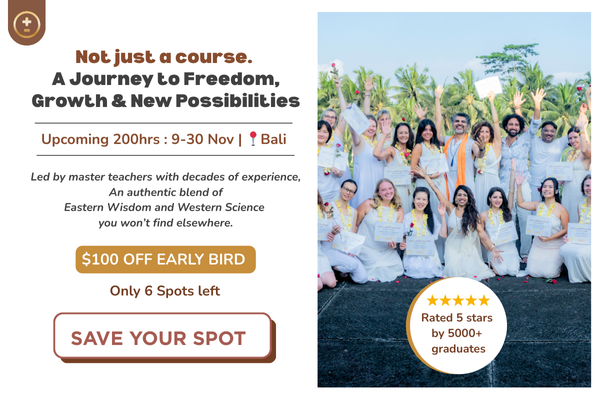
Our 22-day, 200-hour yoga teacher training at Omham Retreats and Resort in Kedewatan, Ubud takes in a maximum of 25 students per cohort by design. The curriculum covers Hatha and Vinyasa asana, full alignment methodology, pranayama practices including Kapalabhati, Bhastrika, Nadi Shodhan, and Bhramari, Patanjali’s Yoga Sutras, the 8 Limbs of Yoga, the 7 Chakras for emotional healing, the 5 Elements, yoga anatomy taught by physiotherapists and doctors from India, and complete teaching methodology including space holding, voice development, and hands-on adjustment.
What makes the YNV Method specifically rigorous is its integration of three scientific frameworks alongside classical yogic teaching: the Alexander Technique, developed by Frederick Matthias Alexander, which addresses how tension patterns and habitual misuse of the body show up in movement; the bioenergetic psychology of Alexander Lowen, which explains how unresolved emotion lives in the physical body and why deep emotional releases happen in yoga training when the practice is done correctly; and the Buteyko Breathing Technique developed by Konstantin Buteyko, which brings evidence-based nervous system regulation into pranayama practice.
Sadhana Om, who co-founded Yoga New Vision with me, spent years living across ashrams in India after leaving a six-year corporate career. She studied Bhakti Yoga, Karma Yoga, Jnana Yoga, and Vedanta across different lineages and was initiated by an enlightened master in Mantra Yoga. She teaches the meditative, heart-centered dimension of this training, and she personally takes every discovery call with prospective students. She puts it this way: “When students arrive here, the environment holds them in a way that makes real change feel safe. We create the conditions. They do the work.”
Yoga New Vision has trained over 15,000 graduates since 2009 and has held a 5-star Yoga Alliance registration since 2011. OM Yoga Magazine named us the World’s Most Authentic 200-Hour Yoga Teacher Training. Global Gallivanting awarded us Most Authentic YTT in Bali.
The May 1 cohort has last spots remaining. July 6 and September 1 training dates are now open for enrollment.
2. India: The Source of Every Lineage
India is where yoga came from. That is a fact, and it is worth experiencing directly at least once in a serious practitioner’s lifetime.
Rishikesh sits at the foothills of the Himalayas, on the banks of the Ganges River, and is recognized globally as the Yoga Capital of the World. The ashram culture here is not a wellness aesthetic; it is a living transmission system that has functioned without interruption for thousands of years.
You wake before sunrise for Ganga Aarti, which is the nightly river worship ceremony that converts an entire riverbank into something genuinely moving. The vegetarian diet, the study of texts in their original Sanskrit context, the access to teachers whose lineages trace back generations: Rishikesh offers something that no school built in the last twenty years can fully replicate.
Mysore is the destination for Ashtanga training specifically, and Kerala integrates Ayurvedic medicine into yoga education in a way that is available nowhere else. One honest note: quality varies significantly across Rishikesh schools. Solo female travelers especially should read verified reviews on independent platforms before booking.
3. Costa Rica: When Nature Becomes the Teacher
Costa Rica sits between the Pacific and Caribbean coasts, and the biodiversity of the country does something specific to a yoga student’s nervous system that no urban or even jungle-suburban environment quite replicates.
The best programs here run residential retreats where the ecology is embedded in the curriculum. Students hike, swim in natural rivers between practice sessions, and return to the mat with bodies that have been genuinely moved by the environment. That is a different quality of physical release than what stretching alone produces.
Costa Rica is particularly strong for programs that pair traditional yoga with nervous system regulation and breathwork. If your primary goal is recovery from stress alongside spiritual study, this destination deserves serious attention.
4. New York, USA: The Urban Immersion Argument
New York is not the obvious yoga destination. That is precisely what makes the training experience there interesting.
The city has one of the most diverse, seriously practiced yoga teaching communities on the planet. The quality of available teachers, and the range of lineages represented, rivals any destination on this list. Kripalu Center’s urban programs, for example, draw faculty who have practiced for thirty or forty years.
Training in a high-energy urban environment builds something that quieter settings can miss: the ability to maintain a consistent, grounded practice when life is loud and full. That skill will serve a teacher every single day after graduation. New York is best for practitioners who cannot leave for three weeks, or who specifically want to teach in diverse metropolitan settings.
5. Cape Town, South Africa: Intimacy and Landscape
Cape Town has a yoga community that operates quietly and, in my view, underestimated by the international yoga circuit.
The schools here tend to run smaller cohorts, which means students are actually known by their teachers from day one. Table Mountain behind you, the Atlantic in front: the natural setting is genuinely extraordinary. The training quality varies more here than in Bali or Rishikesh, so reviews matter even more when researching schools in Cape Town.
This destination suits practitioners looking for a boutique, intimate training format where the group size never exceeds what allows for personal attention.
How to Choose the Right Destination for Where You Are Right Now
Match your primary goal to the environment that best supports it.
Spiritual lineage and cultural depth: Bali or Rishikesh, with Bali offering a gentler, more accessible entry point for international students and Rishikesh offering the oldest and most unbroken tradition. Nature and physical recovery: Costa Rica. Teaching diversity and urban adaptability: New York. Boutique intimacy with natural setting: Cape Town.
Before enrolling anywhere, ask three questions. Who are the lead teachers and what lineages do they actually carry? Is the school Yoga Alliance certified with more than 100 verified external reviews? What does the full daily schedule look like, hour by hour? The answers will tell you far more than any school’s own marketing page.
Frequently Asked Questions
1. What is the best place in the world to learn yoga for an immersive experience?
Bali and Rishikesh, India are consistently the strongest choices for genuine immersive yoga learning. Bali offers cultural depth with a gentler residential environment suited to international students. Rishikesh provides direct access to yoga’s oldest living lineages. Both environments embed the practitioner within a yoga culture that extends well beyond the classroom.
2. What is the difference between a yoga retreat and an immersive yoga teacher training?
A yoga retreat typically runs four to seven days and focuses on guided personal practice and relaxation. A yoga teacher training is a 200-hour structured certification program, usually 21 to 22 days residential. It covers asana, pranayama, philosophy, anatomy, and teaching methodology. The depth and transformational impact of the two experiences are fundamentally different.
3. Is Bali or India better for yoga teacher training?
Both are excellent. India, particularly Rishikesh, offers the deepest access to yoga’s original lineages within a traditional ashram culture. Bali, specifically Ubud, blends Indian yogic tradition with a more accessible, comfortable residential environment suited to first-time international students. Many serious practitioners complete training in Bali first and travel to India for deeper study afterward.
4. Can a complete beginner join an immersive yoga teacher training program?
Yes, and at Yoga New Vision this is true in practice, not just in policy. Several graduates from each cohort arrive with under a year of yoga experience, and some arrive having never taken a formal class. The beginner’s mind has genuine advantages in a training environment: fewer bad habits to unlearn and a natural openness to receiving new information.
5. How long does an immersive yoga teacher training program take?
A standard 200-hour yoga teacher training takes 21 to 22 days when delivered in a full residential immersion format. Some schools spread this over weekends across six months. The residential format produces significantly deeper transformation because the student remains within the learning environment continuously for the full duration of the program.
6. What should I look for when choosing a yoga school abroad?
Four things matter most: a curriculum covering the full scope of yoga, not only asana; a Yoga Alliance certified school with more than 100 verified independent reviews; lead teachers with a verified personal lineage and at least ten years of teaching experience; and a residential format where daily life supports the learning. School marketing cannot substitute for researching these four specifics.
7. What certifications does a Yoga Alliance certified school provide?
A Yoga Alliance certified 200-hour training produces an RYT-200 designation, which is the globally recognized standard for teaching yoga professionally. This certification is accepted by studios, wellness centers, corporate yoga programs, and retreat centers worldwide. Yoga New Vision has held Yoga Alliance registration since 2011 and meets all updated 2025 teaching standards.
8. Is the Pancha Kosha model used in modern yoga teacher training?
Yes, and it should be used in any training claiming to offer genuine depth. The Pancha Kosha model, drawn from the Taittiriya Upanishad, describes five layers of the human being: physical, energetic, mental, intellectual, and blissful. A training that only addresses the physical layer misses four fifths of what yoga was originally designed to heal and develop.
9. What is the daily schedule of a residential yoga teacher training in Bali?
At Yoga New Vision, a typical day starts with yoga practice, pranayama, and meditation from 07:00 to 09:00, followed by breakfast, then philosophy and self-inquiry sessions from 10:30. Anatomy and physiology run from midday to 13:30, with lunch after. The afternoon asana lab and teaching practicum runs from 15:00, with evening meditation at 17:15 and dinner by 18:30.
10. What is the cost of a 200-hour yoga teacher training in Bali?
At Yoga New Vision, the course-only option starts at $1,999. An all-inclusive shared accommodation package with three meals daily starts at $2,999, and single private accommodation starts at $3,999. A $500 deposit secures a spot with the remaining balance payable in installments. Both July and September 2026 cohorts are currently accepting enrollment.
About the Author: Deep Kumar is the Founder and Program Director of Yoga New Vision, a Yoga Alliance registered school in Ubud, Bali. Born and raised in India, he has been leading yoga teacher trainings since 2009 and has trained over 15,000 students across his schools, including Siddhi Yoga, Deep Yoga Academy, and East and West Yoga. He teaches every training personally.