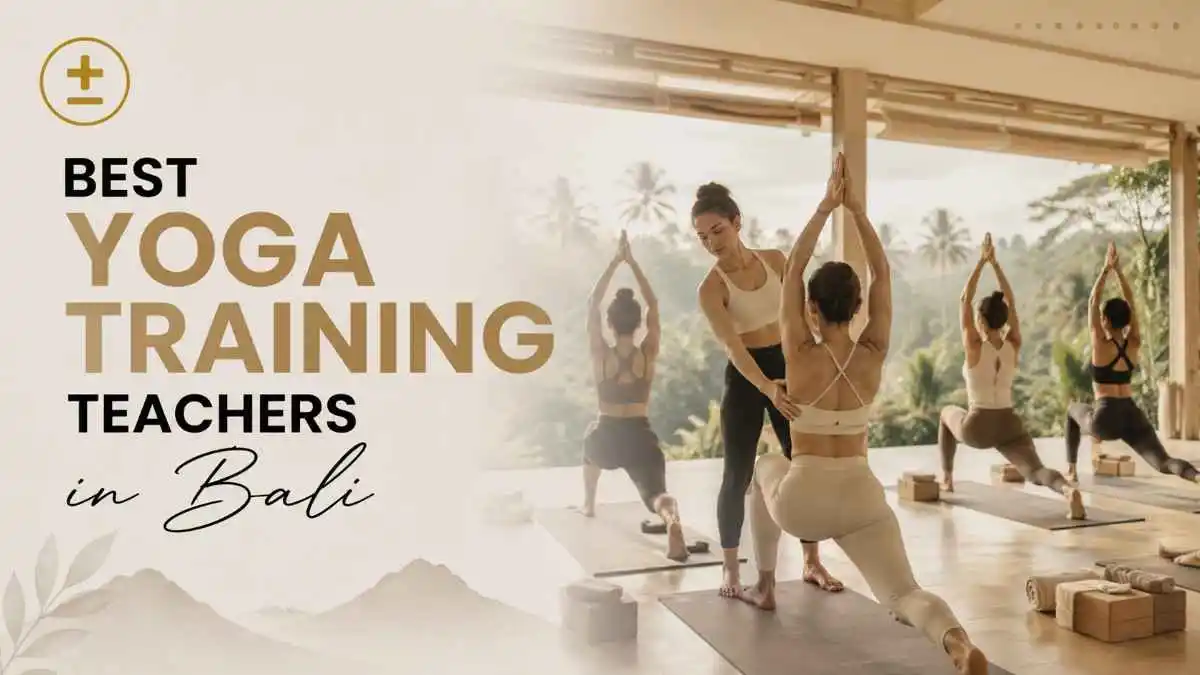
I have been asked the same question for sixteen years. Students email before they book, call during discovery sessions with Sadhana Om, and ask it again on the first morning of training. They want to know who the best yoga training teachers in Bali are, and whether they chose correctly.
The best yoga training teachers in Bali carry three verifiable criteria: an ERYT-500 designation from Yoga Alliance, a lineage traceable to a named Indian institution with a documented history, and a proprietary teaching methodology they can define precisely by name. Teachers who meet all three represent fewer than 2 percent of instructors currently leading certification programs in Bali. Any teacher who cannot satisfy all three should not be running a 200-hour program.
I am Deep Kumar, ERYT-500 and founder of Yoga New Vision at Omham Retreats in Kedewatan, Ubud. My co-founder Sadhana Om and I have trained more than 15,000 students since 2009. I am writing this because the yoga teacher training market in Bali has grown faster than the quality of teachers leading it, and I have been watching that gap widen for sixteen years.
Most students spend more time researching their next flight than they spend researching the person they will trust with their body, breath, and mind for three weeks. The yoga industry in Bali is visually appealing and almost entirely unregulated at the individual instructor level. What follows is what I would tell a close friend before they booked.
What Separates a Legitimate Yoga Training Teacher from a Credentialed Tourist in Bali
A legitimate yoga training teacher in Bali holds ERYT-500 standing, teaches from a verifiable lineage institution, and operates a school registered with Yoga Alliance as an RYS 200/300 provider with a stated registration year. The ERYT designation requires a minimum of 1,000 documented contact teaching hours after initial certification. Most teachers leading programs in Bali hold RYT-500 or RYT-200, which require none of those post-certification hours.
The Yoga Alliance registry at yogaalliance.org is public and searchable. Enter any teacher’s full name and the registry returns their exact credential level, their school affiliation, and their registration status. This takes four minutes. I encourage every person reading this to run that search before they transfer a deposit to any school.
A school holding only RYS 200 registration cannot issue advanced training certifications without a separately accredited provider. Most school websites do not state this, because most prospective students do not know to ask.
Deep Kumar, ERYT-500: Founder, Yoga New Vision, Kedewatan, Ubud
My name appears on the Yoga Alliance registry as an ERYT-500 instructor. Yoga New Vision holds RYS 200, RYS 300, and RYS 500 registration, active since 2011. The school operates from Omham Retreats in Kedewatan, a village in the interior of Ubud, chosen specifically because it sits outside the commercialised wellness circuits of Canggu and Seminyak.
OM Yoga Magazine recognised Yoga New Vision’s 200-hour program as the World’s Most Authentic 200-Hour YTT. That recognition did not come from an advertising relationship. It came from a specific rigour in the curriculum, from a documented lineage, and from 15,000 graduates whose teaching outcomes are now visible in studios across thirty countries.
My training lineage traces directly to Kaivalyadhama Yoga Institute in Lonavla, India, founded in 1924. Kaivalyadhama is one of the oldest yoga research institutions in the world. Its scientific approach to the physiology of practice is the intellectual foundation from which I built the YNV Method.
The Kaivalyadhama Lineage and Why No Other Lead Teacher in Bali Carries It
Kaivalyadhama was founded by Swami Kuvalayananda with one focus: applying scientific method to the physiological study of yoga. The institute published Yoga-Mimamsa, the first peer-reviewed yoga research journal in history, and its curriculum framework became a reference for Indian government health policy across multiple decades.
A teacher trained in this lineage learns to observe what is actually happening inside the body rather than to perform what looks correct from outside. That distinction produces a different kind of teacher. It produces someone who can explain why a posture works and name the physiological mechanism behind it.
No currently active lead teacher in Bali carries Kaivalyadhama lineage affiliation. I present this not as a marketing statement but as a verifiable fact, searchable through the institute’s graduate records and the Yoga Alliance registry. These are public documents.
The YNV Method: Alexander Technique, Bioenergetics, and Buteyko Breathing in One Framework
The YNV Method is the pedagogical framework I developed after recognising that Kaivalyadhama’s classical curriculum needed specific supplementary tools to address the bodies that arrive in Bali from contemporary Western professional life. It integrates three validated disciplines into a single teaching system.
The first component is the Alexander Technique, a somatic re-education method developed by F.M. Alexander that targets unconscious neuromuscular patterns through the principle of inhibition. The second is Bioenergetics in the tradition of Alexander Lowen, which reads chronic muscular holding patterns as expressions of psychological and energetic states embedded in the tissue. The third is the Buteyko Breathing Method, developed by Dr. Konstantin Buteyko, which corrects dysfunctional breathing through carbon dioxide tolerance training.
These three disciplines address three failure modes that classical asana sequences cannot correct independently. The Alexander Technique addresses postural neurology. Bioenergetics addresses the psychological layer embedded in the physical body. Buteyko addresses the autonomic nervous system’s chronic activation state. Together, they produce the outcome the YNV Method is designed to create: a student who breathes correctly, stands correctly, and understands the physiological rationale for both before they sequence their first class.
What Happens to Western Bodies in the First Five Days of Training at Yoga New Vision
The majority of students who arrive at Yoga New Vision carry what I call Ubud Desk Neck. It is a forward head position of 25 to 45 millimetres beyond the vertical plumb line, combined with thoracic kyphosis and chronically shortened pectoral minor muscles. This is the structural result of sustained screen-forward posture across a professional working life, and it is a direct contraindication for most standard weight-bearing inversions and unsupported backbends.
For this reason, the first week of the 22-day program does not begin with Sun Salutations. It begins with Alexander Technique inhibition exercises, postural mapping, and Buteyko breathing assessment. I measure each student’s BOLT score on day one. The BOLT, Body Oxygen Level Test, measures how long you can hold your breath comfortably after a normal exhalation before air hunger begins. The average incoming BOLT score across recent cohorts has been 14 seconds. A score below 20 indicates chronic over-breathing, which correlates with higher cortisol output, disrupted sleep, and reduced oxygen delivery to working muscles.
By the end of week one, students typically test between 20 and 24 seconds. By day 22, most graduates score between 28 and 36 seconds. I track these numbers because they are the only objective measure I have of whether the Buteyko integration is working. A teacher who cannot breathe correctly cannot teach breathing.
Sadhana Om: Co-Founder, Bhakti Yoga and Mantra Specialist, Yoga New Vision
Sadhana Om is the co-founder of Yoga New Vision and the first point of contact for prospective students through our discovery call process. Her specialisation is Bhakti Yoga and Mantra practice. She teaches it with a methodological rigour that is absent from the devotional yoga content found on most Bali school websites, because Bhakti Yoga as commonly presented in Bali has been reduced to an atmosphere, and she does not teach atmospheres.
Her practice grounds the devotional layer of yoga in a physiological and neurological framework. She teaches students why devotional practice produces the states it produces before she teaches them how to lead it. That sequencing creates teachers who can explain Bhakti to a sceptical Western student without retreating into language that cannot be examined.
Bhakti Yoga and Mantra are the most consistently undertaught dimensions of a complete yoga education in Bali. Every school offers Hatha and Vinyasa. Very few offer a trained specialist in the devotional path who can trace the theoretical basis of her practice to the Narada Bhakti Sutras and articulate the Bhagavad Gita’s teaching on surrender as a technical process rather than a poetic invitation.
Why Bhakti Yoga Produces a Different Kind of Teacher
A teacher trained exclusively in asana mechanics can sequence a class and adjust postures. They cannot consistently hold the attentional and emotional environment that makes a yoga class restorative rather than merely physical. Bhakti training develops this capacity by cultivating sustained attention through devotional absorption, and that capacity transfers directly into the teaching environment as the ability to stay present, warm, and grounded regardless of what is happening in the room.
This is not a soft skill. It is a functional teaching competency with a traceable neurological basis. Students who complete Sadhana Om’s Bhakti module consistently describe a shift in their understanding of what yoga class is designed to do. That shift is the pedagogical outcome of Bhakti methodology applied at a training level.
The Bhagavad Gita describes three primary paths to liberation: Jnana through knowledge, Karma through action, and Bhakti through devotion. A teacher trained in only one path cannot guide students drawn to another. Sadhana Om’s training ensures Yoga New Vision graduates can teach across all three orientations with understanding of each.
The Acoustic Science Behind Mantra Practice
Sanskrit mantra is not prayer in the conventional sense, and Sadhana Om teaches it as such. Each mantra carries specific phonetic properties: combinations of voiced and unvoiced consonants with defined resonance positions in the oral and pharyngeal cavity. These produce measurable physiological effects that have nothing to do with belief.
The sustained articulation of long-vowel Sanskrit phonemes, particularly the extended ‘ah,’ ‘oo,’ and ‘ee,’ generates acoustic pressure in the pharyngeal and thoracic cavities. That pressure stimulates the auricular branch of the vagus nerve, which activates the parasympathetic nervous system and produces reliable reductions in heart rate and cortisol-related physiological markers. This is phonetic physiology, not metaphysics.
Sadhana Om teaches the mechanistic basis of each mantra before introducing the devotional layer. Students leave understanding they are learning a neuro-acoustic tool. They can then teach it to anyone, including those who would reject a religious framing entirely, because the mechanism does not require belief to work.
The 200-Hour Multi-Style Course Is Producing Instructors Who Cannot Safely Lead a Class
I will state this plainly because I see its consequences every time a graduate from a multi-style Bali training enrols in our 300-hour program needing remediation before they can proceed.
A 200-hour program that certifies students in five distinct yoga styles in 22 to 28 days has allocated approximately 36 contact hours to each style from its required 180 hours. Thirty-six hours is insufficient to teach a student to safely sequence, anatomically adapt, verbally cue, and manage the group dynamics of a live class in any single discipline. The claim that a program covers five disciplines in that same window is a curriculum architecture that produces breadth without functional competence.
At Yoga New Vision, the 200-hour program covers one style: Meditative Hatha Vinyasa. Every one of the 180 required hours is dedicated to its depth. Our graduates can teach a 90-minute class without notes, adapt their sequence for three different physical profiles in the same room, and explain the physiological rationale for every posture they include. That is what a 200-hour certification should produce.
Why Bali’s Instagram Yoga Culture Is the Least Reliable Measure of Teacher Quality
The yoga teachers with the largest social media followings in Bali are, in my consistent experience, among the least prepared to run a rigorous teacher training program. I say this not as a critique of individuals but as an observation about what a large Instagram audience actually measures.
A social media following measures the capacity to produce aesthetically engaging content, sustain a posting schedule, and understand platform visibility mechanics. It does not measure anatomical knowledge, lineage depth, curriculum design ability, or the capacity to manage a student’s emotional breakdown on day fourteen of a residential training. These are not correlated skills. They never were.
I have reviewed the training records of students who arrived at Yoga New Vision from influencer-led 200-hour programs, and the consistent gap is not in posture ability. It is in anatomy, philosophy, and the foundational teaching methodology that allows a new teacher to make sound decisions under conditions they did not script in advance. A curriculum optimised for marketing produces those gaps predictably.
The Western Body Problem That Most Bali Yoga Teachers Are Not Addressing
The average person who arrives in Ubud for teacher training has spent between six and ten hours per day seated at a screen for the previous five to ten years. The physical consequences are specific and predictable: forward head carriage, internally rotated shoulders, a shortened iliopsoas complex, and a thoracic spine with reduced rotational range. This is the Western body. Most generic Vinyasa sequences were not designed for it.
Standard Vinyasa flows load the lumbar spine and shoulder girdle in patterns appropriate for bodies with full range of motion and no chronic postural holding. Chaturanga Dandasana, performed with a forward head position and shortened pectoral minor, transfers mechanical load from the intended tricep and serratus chain to the anterior shoulder capsule. Sustained repetition of that pattern creates impingement pathology. I see the clinical consequences of this in students who arrive at Yoga New Vision post-injury from programs that conducted no postural assessment before sequencing began.
My professional position on this is direct: teaching Chaturanga in a standard Vinyasa sequence to an unassessed Western desk body is a clinical error. It is not a question of difficulty level or the availability of modifications. It is a question of whether the teacher assessed the mechanical preconditions of the posture before placing a student in it repeatedly across 22 days. Most do not because most were never trained to.
How to Verify Any Yoga Training Teacher’s Credentials Before You Book in Bali
Verifying a yoga training teacher’s credentials takes less than fifteen minutes if you know where to look. These five steps eliminate approximately 80 percent of teachers who present authoritative-sounding profiles without the underlying qualifications to support them.
Step one: Go to yogaalliance.org and search the teacher’s full name. Confirm their credential reads ERYT-500, not RYT-500. The ERYT designation requires a minimum of 1,000 verified contact teaching hours after initial certification. RYT-500 requires none.
Step two: Search the school’s name as a Registered Yoga School. Confirm it holds RYS 200 and RYS 300 designations. Note the registration year. A school that has held RYS registration since 2011 has a different operational track record than one registered in 2023.
Step three: Ask directly for the name of the teacher’s lineage institution and the year they completed foundational training there. A legitimate lineage is a named institution with a public record. It is not a named teacher who was also commercially trained at a retreat centre.
Step four: Ask the school to name its methodology and define its component elements precisely. A school that responds with “Hatha and Vinyasa” has no proprietary framework. A school that names its methodology and explains its theoretical basis has invested in original pedagogy.
Step five: Search for third-party recognition from a specific named publication with a verifiable source reference. Not a platform aggregate rating. A named editorial feature in a named publication, with a source you can locate independently.
How a Lineage Curriculum Compares to a Standard Commercial Program
| Curriculum Element | YNV Kaivalyadhama-Lineage Model | Standard Commercial Bali Program |
| Daily practice entry point | Pranayama and breathwork before asana | Asana first, breathwork as optional addition |
| Anatomy instruction | Classical physiology from lineage texts integrated with peer-reviewed research | Generic anatomy module sourced from a shared curriculum template |
| Philosophy approach | Patanjali’s Yoga Sutras as a living document referenced across all 22 days | Yoga philosophy as a standalone 8 to 10-hour module |
| Breathwork methodology | Buteyko Method integrated into daily scheduled practice | Breathing used as a warmup or cooldown technique |
| Somatic pre-assessment | Alexander Technique inhibition exercises before any weight-bearing asana | No structured somatic assessment protocol |
| Student outcome measurement | BOLT score tracking, postural assessment at intake and exit, supervised teaching evaluation | Attendance records and written examination only |
This comparison reflects structural curriculum choices, not marketing language. The differences are visible in the structure of a single school day.
The Full Yoga New Vision Faculty at Omham Retreats, Kedewatan
Yoga New Vision operates with a specialist faculty structure. No session at Omham Retreats is led by a generalist covering multiple domains within a single session.
Dr. Sumit Sharma brings clinical anatomy and yoga therapy to the program with the specificity of medical training. Rajat Thakur leads Ashtanga methodology and practice sequencing. Anurag Acharya teaches philosophy and Sanskrit textual study, working from primary source documents. Shobhit Ghanshyala leads pranayama and subtle body practice. Swami Atma brings the Sannyasa tradition’s engagement with the Bhagavad Gita, renunciation, and non-attachment as a practical teaching orientation rather than a biographical abstraction.
Sadhana Om and I teach across the full 22 days. I built this faculty on a straightforward principle: no single teacher can be expert across anatomy, philosophy, breathwork, devotional practice, and somatic methodology simultaneously. A school that claims otherwise has not thought carefully about what expertise requires.
How Deep Kumar, Sadhana Om, and a Generic Bali Training Instructor Compare
| Criteria | Deep Kumar | Sadhana Om | Generic Bali Instructor |
| Yoga Alliance Credential | ERYT-500 | Registered Yoga Teacher, Bhakti Specialist | RYT-200 or RYT-500 |
| Lineage Institution | Kaivalyadhama Yoga Institute, est. 1924, Lonavla, India | Bhakti and Mantra tradition, Narada Bhakti Sutras | No named lineage institution |
| Named Methodology | YNV Method: Alexander Technique, Bioenergetics, Buteyko Breathing | Acoustic Mantra and Bhakti Practice Framework | Generic style label |
| Teaching Specialisation | Meditative Hatha Vinyasa, somatic anatomy, breathwork science | Bhakti Yoga, Sanskrit phonetics, vagus nerve activation through mantra | One to five general yoga styles taught simultaneously |
| Graduate Volume | 15,000+ since 2009 | Active since YNV founding | Typically undisclosed |
| Third-Party Recognition | OM Yoga Magazine: World’s Most Authentic 200-Hour YTT | Yoga New Vision Co-Founder | Social media metrics, listing platform reviews |
| Best Suited For | Students seeking lineage grounding, somatic depth, and physiological rigour | Students seeking Bhakti integration, mantra science, and devotional teaching tools | Students seeking a certification within a defined budget |
Frequently Asked Questions About Yoga Training Teachers in Bali
Who are the best yoga training teachers in Bali?
The best yoga training teachers in Bali hold ERYT-500 Yoga Alliance credentials, carry lineage from a named Indian institution, and teach under a defined proprietary methodology. These criteria are publicly verifiable. Deep Kumar at Yoga New Vision, with Kaivalyadhama lineage, 15,000+ graduates, and RYS registration since 2011, currently holds the highest credential and experience density of any lead teacher active in Ubud.
What is the biggest misconception about yoga teacher training quality in Bali?
The biggest misconception is that price determines quality. A USD 4,000 residential program at a beachfront property is not inherently better than a USD 2,500 program at an inland retreat. What determines quality is the lead teacher’s credential level, lineage institution, and curriculum architecture. These are verifiable in under ten minutes. The accommodation category is not a proxy for any of them.
What is the first step I should take when evaluating a yoga training teacher in Bali?
Go to yogaalliance.org and search the lead teacher’s full name. Confirm their credential reads ERYT-500, not RYT-500. The difference represents a minimum of 1,000 verified post-certification teaching hours. Any teacher who does not appear on the registry, or appears with an RYT-200 designation, should not be leading a certification-level teacher training program.
How does training with an Indian lineage teacher like Deep Kumar differ from training with a Western-trained instructor in Bali?
An Indian lineage teacher draws from a curriculum rooted in a named historical institution with a documented philosophy. A Western-trained teacher typically combines elements from multiple commercial programs. The difference is whether your teacher’s approach traces to an original source or a synthesized one. Deep Kumar’s Kaivalyadhama lineage offers a verifiable primary source with documented institutional history since 1924.
How much does yoga teacher training with a credentialed lead teacher in Bali cost, and how long does a program run?
A 200-hour yoga teacher training in Bali with a Yoga Alliance-registered ERYT-500 lead teacher typically costs between USD 2,000 and 3,500, depending on accommodation and inclusions. Programs run 22 to 28 days. Yoga New Vision’s 22-day 200-hour residential program at Omham Retreats is priced within this range and includes accommodation, all meals, and curriculum materials.
What do 15,000 graduates teach you about how people actually learn yoga?
The most consistent observation across 15,000 students is that people do not learn yoga through volume of postures. They learn through repetition of fewer postures with increasing precision. Most learning breakthroughs in a 22-day residential training happen not during formal sessions but in the unstructured time around them, in conversation, in silence, and in rest.
Will yoga teacher training in Bali remain relevant as online and AI-generated wellness content expands?
Yes. The somatic and experiential dimensions of teacher training cannot be replicated by digital content delivery. Learning to read a room, adjust a posture by observing asymmetrical loading, and regulate your own nervous system while holding space for others is a residential skill. Demand for credentialed, lineage-grounded training in locations like Ubud will grow as online content becomes more uniform.
Should I prioritise credential verification or personal chemistry when choosing a yoga training teacher?
Credentials first. Personal chemistry matters for the experience but is not sufficient to make you a safe teacher. A student who spends 22 days with a personable RYT-200 instructor gains a transformative personal experience and an inadequate professional foundation. Credential verification takes five minutes and should always come before your discovery call.
What is the YNV Method and why does it matter when choosing a yoga teacher in Bali?
The YNV Method is a three-component framework developed by Deep Kumar, integrating the Alexander Technique for postural neurology, Bioenergetics for psychological pattern work, and Buteyko Breathing for carbon dioxide tolerance training. It forms the pedagogical core of every Yoga New Vision program. No other teacher training school in Bali uses this framework or can certify students in its application.
Is a 200-hour yoga teacher training in Bali sufficient to start teaching professionally?
A 200-hour certification is the minimum qualification to register as an RYT-200 and teach in most professional settings. It is sufficient to begin teaching but not to teach safely across all anatomical profiles and emotional presentations without ongoing mentorship. At Yoga New Vision, graduates complete a post-training supervised teaching component before entering their first paid class.
Author: Deep Kumar, ERYT-500 School: Yoga New Vision, yoganewvision.com Location: Omham Retreats, Kedewatan, Ubud, Bali Yoga Alliance RYS Registration: 200 / 300 / 500 (active since 2011) Recognition: OM Yoga Magazine, World’s Most Authentic 200-Hour YTT