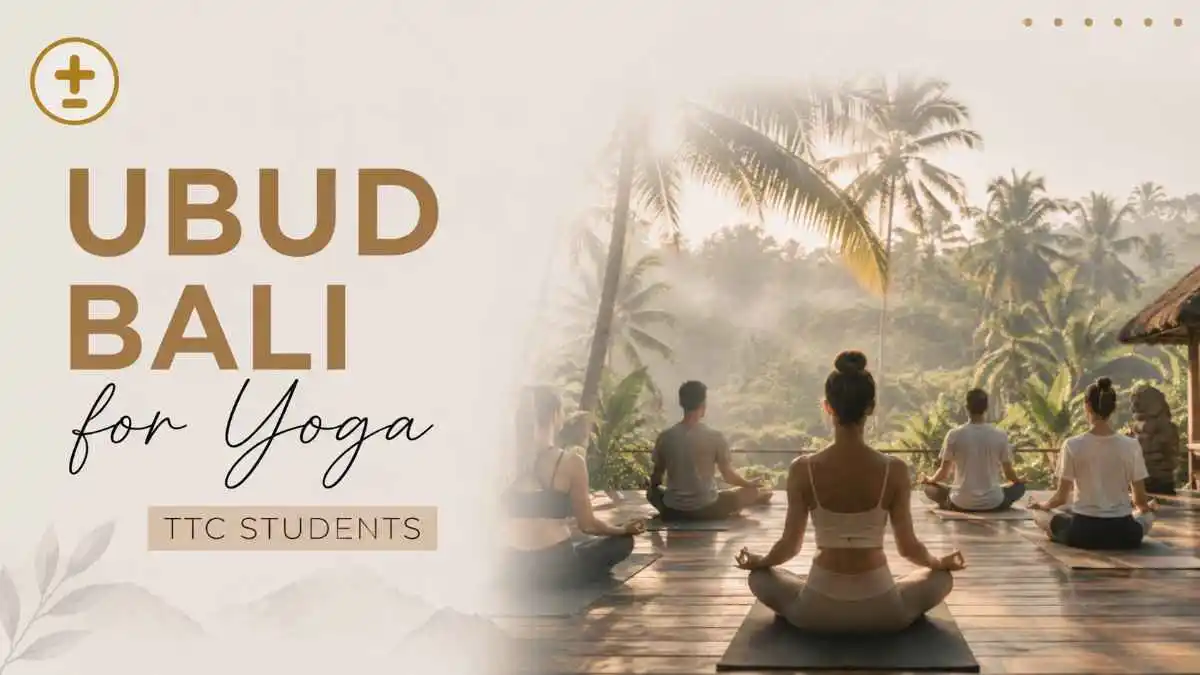
Ubud Bali for Yoga TTC Students: A Food Paradise, Nature Wonder, and Creative Haven
By Deep Kumar, ERYT-500 | Program Director, Yoga New Vision
Ubud, Bali is the ideal environment for yoga teacher training because its plant-based food culture, highland micro-climate, and living Balinese spiritual tradition actively reinforce the transformation that happens inside the shala. Students who engage with this town and do not just sleep in it recover faster, go deeper, and leave with a teaching voice grounded in lived experience. I have watched this across 100+ cohorts and 15,000+ graduates.
Why Ubud Is Part of the Training, Not Just the Background
I have run yoga teacher training cohorts in Ubud since 2009. In all those years, one observation has stayed constant: students who engage fully with this town transform faster than those who treat it as a backdrop.
Ubud sits at around 200 metres above sea level in the highland interior of Gianyar Regency. The air is cooler and more humid than coastal Bali, and that temperature drop at night directly supports deeper sleep and lower cortisol levels. After a 10-hour training day, your body’s recovery window matters more than you probably expect.
This is a place I chose because it works. Not because it photographs well.
Eating Like a Yogi Is Genuinely Easy Here
Most Ubud food guides will not say this: not every plant-based restaurant in this town serves sattvic food.
What Is a Sattvic Diet?
A sattvic diet is a plant-based way of eating rooted in Ayurveda and classical yoga philosophy. It focuses on fresh, lightly cooked, easy-to-digest food that supports mental clarity and stable energy. It avoids heavily spiced, fermented, or over-processed food because the goal is a calm and alert nervous system.
A fifteen-dollar raw dessert built on cashew cream and agave will spike your blood sugar and ruin your afternoon meditation just as effectively as junk food. I have watched students choose aesthetic cafe culture over genuine nourishment and pay for it in every single 4 PM session.
For genuine post-practice recovery, I send YNV students to three places. Sari Organik in Subak Sok Wayah grows vegetables in working rice fields and serves meals between 50,000 and 80,000 IDR (roughly 3 to 5 USD). Warung Sopa on Jalan Sudamala serves traditional Balinese vegetarian food that has fuelled local people for generations. Sayuri Healing Food on Jalan Sukma Kesuma in Peliatan is where I send students who need food that is genuinely medicinal, not just green-coloured.
Local warung meals run between 30,000 and 60,000 IDR. Wellness cafes like Alchemy Bali and Zest Ubud average 80,000 to 200,000 IDR per meal. You can eat sattvically in Ubud for 6 to 12 US dollars a day if you eat where Balinese people eat.
One word on Bali belly: I have watched it derail students in week one. At any warung, follow three checks: kitchen must be visible, turnover must be high, and local Balinese people must be eating there. A laminated menu with an empty dining room is always a warning. Drink filtered or bottled water throughout your training period.
The Landscape Is the Second Teacher
The Campuhan Ridge Walk begins less than 2 kilometres from our training space at Omham Retreats in Kedewatan. Walk it at 6:00 AM before the heat and the tourists arrive.
The path runs between two river valleys, open to the sky on both sides. Students who walk it with conscious nasal breathing, using the Buteyko-informed patterns we teach in pranayama, consistently report arriving back with a stillness that takes three shala days to build. The parasympathetic nervous system responds to open horizons, moving air, and the sound of water. That is not poetic language. That is autonomic regulation.
Tegallalang Rice Terraces, 10 kilometres north of Ubud, is where I take students to understand Subak: a 1,000-year-old Balinese cooperative water management system that UNESCO recognised as a cultural landscape in 2012. The farmers do not own the water; they share it. Students standing above those terraces are seeing the yogic principle of aparigraha in actual land practice. It always lands differently than reading it in a text.
The Sacred Monkey Forest Sanctuary in Padangtegal is on every tourist list. I include it for one reason: sit quietly for twenty minutes without your phone and watch the monkeys. You are watching the untrained mind: reactive, distracted, always seeking the next thing. It is the most concise live demonstration of why we practise.
The Arts Scene Is Not a Distraction From Training
Ubud is the creative capital of Bali. Woodcarvers, batik artists, and gamelan musicians are part of the ordinary rhythm of this town.
A student who attends a Kecak fire dance at Pura Dalem Ubud on a Saturday evening is watching fifty performers hold a room through voice, rhythm, and coordinated breath alone. No instruments. No amplification. Just human breath and fire. Space-holding through voice is one of the hardest teaching skills to build inside a training room, and thirty minutes of Kecak does more for it than two workshops.
Ecstatic Dance Bali runs weekly in Ubud: free-form movement with no partners, no phones, and no alcohol. After six days of structured asana and alignment work, a student who attends often reaches a somatic freedom the formal curriculum cannot always access. I mention it to every cohort and never make it mandatory.
A Realistic Saturday for a YNV Student
Most Ubud guides tell you to visit waterfalls, temples, markets, and cafes all in one day. During your training, please do not do that.
A 22-day yoga teacher training is a period of deep physical and psychological reorganisation. A rest day that exhausts you is not a rest day. It is another demand on a system that is already working at full capacity.
Here is what a genuinely restorative Saturday looks like:
6:00 AM: Campuhan Ridge Walk, solo, nasal breathing only.
8:30 AM: Breakfast at Sari Organik or Warung Sopa. Light and warm.
11:00 AM: Tegallalang Rice Terraces or Tirta Empul Temple. One place only.
2:00 PM: Return to the retreat. Sleep, bodywork, or journalling. This part is not optional.
7:00 PM: Kecak dance or Ecstatic Dance depending on the week.
From a transport standpoint: Omham Retreats in Kedewatan is about 5 kilometres from central Ubud. A Gojek ride to Jalan Hanoman costs 20,000 to 35,000 IDR and takes 15 to 20 minutes outside peak hours. On Saturday afternoons, allow 30 minutes and book your return before you leave.
The most transformative Saturday I have witnessed in fifteen years was one where a student cancelled all her plans, walked alone to the Ayung River valley, sat on a rock, and stayed there for three hours. She came back changed. Rest is curriculum.
The Rain Is Also Part of It
Ubud receives heavy rainfall from November through March. Storms arrive without warning and end just as fast.
In classical yoga, Pratyahara means withdrawing the senses and turning attention inward regardless of what surrounds you. A downpour in our open-air shala at Omham Retreats is the best live test of whether your practice is real. The students who hold their focus through the noise and the cold and the distraction are always ready to teach. The rain is not a problem with the schedule. The rain is the schedule.
10 Questions TTC Students Ask About Life in Ubud
-
Why is Ubud, Bali ideal for yoga teacher training students?
Ubud combines a highland micro-climate that supports sleep and cortisol recovery, a sattvic food culture rooted in Ayurvedic principles, and a Balinese spiritual tradition that reinforces yoga philosophy in daily life. Students at Yoga New Vision do not just study here. They are shaped by the environment. Deep Kumar has observed this consistently across 100+ cohorts and 15,000+ graduates since 2009.
-
What is a sattvic diet and where can I eat one in Ubud?
A sattvic diet is a plant-based eating practice from Ayurveda that supports mental clarity and stable energy through fresh, lightly cooked, easy-to-digest food. In Ubud, Sari Organik, Warung Sopa, and Sayuri Healing Food serve genuinely sattvic meals at accessible prices. Avoid high-sugar raw desserts at premium cafes as they disrupt afternoon meditation and destabilise energy during intensive training.
-
How do I avoid Bali belly during a yoga TTC in Ubud?
Choose warungs where the kitchen is visible, local Balinese people are eating, and food turnover is high. Avoid restaurants with laminated menus and no foot traffic. Drink filtered or bottled water at all times. Resist over-adventurous eating in your first week while your gut biome is still adjusting to the local food and water environment.
-
Is Ubud safe for solo female yoga students at night?
Ubud is generally safe for solo women at night in the areas around Jalan Hanoman and the Monkey Forest Road. Use Gojek after dark rather than walking unlit roads alone. Students at Omham Retreats in Kedewatan are advised to return in groups after evening events, as the roads near the retreat have minimal lighting beyond the main junctions.
-
How do yoga TTC students get around Ubud without a scooter?
Gojek and Grab are the practical daily options. A ride from Kedewatan to central Ubud costs 20,000 to 35,000 IDR and takes 15 to 20 minutes outside peak hours. Many students coordinate group rides to share costs. Walking is manageable within central Ubud but is not practical between Kedewatan and the town centre given the distance.
-
What is the average daily food cost for a yoga TTC student in Ubud?
A student eating sattvically spends roughly 100,000 to 200,000 IDR per day on meals outside training, approximately 6 to 12 US dollars. Local warungs average 30,000 to 60,000 IDR per meal. Wellness cafes like Alchemy Bali and Zest Ubud cost 80,000 to 200,000 IDR. Eating well here does not require eating expensively, and local options are often more nourishing.
-
What is the Campuhan Ridge Walk and why do yogis walk it?
The Campuhan Ridge Walk is a 4-kilometre trail running between two river valleys near the Campuhan confluence in Ubud. Walking it slowly at dawn with conscious nasal breathing activates the parasympathetic nervous system and produces a stillness that structured practice alone takes days to build. It requires no booking, costs nothing, and is available every morning during your training.
-
What is the Subak system and why does it matter for yoga TTC students?
Subak is a 1,000-year-old Balinese cooperative water management network sustaining the rice terraces of Ubud, recognised by UNESCO as a cultural landscape in 2012. It demonstrates the yogic principles of interdependence and aparigraha in actual land practice. Seeing it at Tegallalang makes abstract philosophy tangible for students in a way that classroom discussions and textbook readings rarely achieve on their own.
-
What is Ecstatic Dance Bali and should YTT students attend?
Ecstatic Dance Bali is a weekly free-form movement practice in Ubud with no partners, no phones, and no alcohol. It suits YTT students at any stage of training. It activates somatic intelligence and creative body expression as a counterpoint to structured asana work, often surfacing authentic movement quality that directly informs a more present and embodied teaching style in the classroom.
-
How does the Ubud rainy season affect yoga teacher training?
Ubud’s rainy season runs November through March with intense, short afternoon storms. Training at Omham Retreats continues through rain in the open-air shala at Kedewatan. Deep Kumar frames these storms as a live Pratyahara examination: the test of whether a student can hold internal focus through external chaos. Many YNV graduates name their first rainstorm session as the moment their practice became genuinely real.
If you are ready to train in an environment that works on every level, including the ones no curriculum document can describe, I would love to speak with you.
Deep, A Yogi Friend