Yoga Poses for Solar Plexus Chakra: 12 Asanas to Activate Manipura and Reclaim Your Personal Power
By Deep Kumar | Founder, Yoga New Vision | RYS-200 and RYS-300 Yoga Alliance Registered School | Recognized by Om Yoga Magazine, London
Let me be direct with you right from the start.
“Most articles about yoga poses for the solar plexus chakra give you a list of poses, slap on some yellow color imagery, and call it done. London’s Om Yoga Magazine called Yoga New Vision the world’s most authentic yoga teacher training, and that reputation was not built on that kind of content. We are going to do something different here.”
I have been teaching yoga for over 14 years, working with students from across the world at our training center in Ubud, Bali, from absolute beginners who cannot touch their knees without wincing, to seasoned practitioners who can hold Navasana (Boat Pose) for two minutes but still feel like they have zero personal power. Before founding Yoga New Vision, I built Siddhi Yoga in India, Deep Yoga Academy in Malaysia, and East+West Yoga in Bali. I started each one because the same problem kept appearing: people doing all the right poses and still walking out of class feeling small.
This guide exists to correct that.
We are going to go deep into the Manipura chakra not just which poses activate it, but why, when, and for some of you, whether you should be stoking that fire at all. You will get the anatomy, the philosophy, the contrarian truths, and a real 20-minute sequence built from actual studio experience.

What Is the Solar Plexus Chakra? (Manipura, Explained Simply)
The solar plexus chakra, known in Sanskrit as Manipura (meaning “city of jewels”), is the third of the seven primary chakras in the yogic energy system. It sits in the upper abdomen, roughly four finger-widths above the navel, between your belly button and the base of your sternum.
This is your energetic power center. Manipura governs willpower, self-esteem, decision-making, metabolic function, and your capacity to take intentional action in the world.
The associated element is Agni, or fire. The color is bright yellow, like morning sunlight. The bija (seed) mantra is RAM (pronounced “rahm”), and the organs connected to this energy center include the pancreas, stomach, gallbladder, liver, and spleen.
Where Exactly Is It?
Place one hand flat on your upper belly, about two inches above your navel. That area the region the ancient texts describe as the seat of samana vayu, the digestive life force is your Manipura. You may like to visualize it as the center of the body, not just the front surface.
The Psoas Connection Nobody Talks About
Here is something most yoga blogs skip completely: your psoas muscle meets your diaphragm directly at the solar plexus. This deep core muscle, which runs from your mid-back to your inner thigh, is a physiological neighbor of Manipura. When it is chronically tight which it is in most people who sit at desks, drive long distances, or carry unresolved stress it compresses your solar plexus region and restricts diaphragmatic breath. A tight psoas is often why people feel anxious, blocked, or physically nauseous during abdominal yoga poses.
We will come back to this when we reach the trauma-informed section.
Signs Your Manipura Chakra Needs Attention
Underactive Manipura
An underactive solar plexus chakra shows up in predictable ways. You second-guess your decisions constantly. You feel drained by situations that require you to assert yourself. Physically, you may experience sluggish digestion, constipation, or blood sugar instability.
In our training programs in Ubud, Bali, I have seen students who are wonderfully flexible, kind, and dedicated to their practice and yet they consistently shrink themselves. They apologize before asking questions. They abandon poses the moment things get uncomfortable. That pattern almost always corresponds to an underactive Manipura.
Overactive Manipura
An overactive solar plexus chakra is less commonly discussed, and this is a big gap in almost every competitor article I have read. Overactivity shows up as controlling behavior, perfectionism, chronic anger, acid reflux, and an inability to rest. People with overactive Manipura are often high achievers who burn out spectacularly.
Here is my honest professional opinion: if you feel constant anger, heartburn, or are the person who needs to be “right” in every conversation please do not book yourself into a hot yoga class and do 60 minutes of Kapalabhati. You will make it worse. We will cover the cooling practices you actually need.
Physical Symptoms of Third Chakra Imbalance
The organs governed by Manipura are remarkably specific. An imbalanced third chakra can correspond to issues with the gallbladder, liver, spleen, pancreas, and intestines. Yoga tradition connects Manipura imbalance to IBS, ulcers, diabetes, and eating disorders.
I want to be clear: yoga is a complementary practice, not a medical replacement. If you are experiencing serious digestive or metabolic conditions, please consult a qualified gastroenterologist alongside your yoga practice.
The Truth That Virtually No Yoga Blog Tells You
Truth 1: A Strong Core Can Actually Block Manipura
I will say this plainly because it contradicts most of what you read online. A rigid, constantly contracted core does not equal a healthy solar plexus chakra. It often means the opposite.
When your abdominal muscles are held in permanent tension think “sucking it in” all day, or doing hundreds of crunches your diaphragm cannot descend properly. The samana vayu (digestive life force) associated with Manipura gets trapped. You may look physically strong and still feel completely powerless inside.
At Yoga New Vision, this is a core teaching principle: the moment a student is cued to ‘pull the belly in,’ the stomach tightens, the breath becomes restricted, and the tension travels upward into the brain and even the temples. This is not a minor side effect. A tight belly directly interrupts the diaphragmatic breath that keeps the mind calm and the nervous system regulated. This is why we do not emphasize belly contraction in our teaching approach.
True Manipura health requires a core that is strong and supple one that can both contract and expand fully with each breath. A belly that can breathe is a belly that can heal.
Truth 2: “Stoking the Fire” Can Burn You
Almost every article on solar plexus yoga tells you to build more heat. Do more Breath of Fire. Do more Sun Salutations. Activate, activate, activate.
This advice is incomplete, and for some people, genuinely harmful. If your Manipura is overactive if you already run hot, get angry easily, or struggle with acid reflux adding fire to fire is a terrible idea. The Ayurvedic principle of sama (balance) applies here. Sometimes healing the solar plexus chakra means cooling it down, not heating it up.
For overactive Manipura, forward folds and Sheetali pranayama (cooling breath through a curled tongue) are the advanced, intelligent practice. Not more warriors and boat poses.
Truth 3: Your Belly Holds Memory
When you stretch the abdomen in poses like Dhanurasana (Bow Pose) or Bhujangasana (Cobra Pose), you expose one of the most protected areas of your body. This can produce unexpected emotional responses: anxiety, nausea, the urge to cry, or a sudden wave of unexplained dread.
This is not weakness. This is physiology.
The psoas your deepest core muscle, which connects directly to the solar plexus via fascial tissue is activated during the body’s fight-or-flight response. When stress or trauma is unresolved, the psoas remains chronically contracted, signaling to the brain that danger is still present. Yoga poses that stretch the abdomen can trigger this stored stress response.
If you feel suddenly overwhelmed during any of these poses, back off immediately. Child’s Pose (Balasana) is always your safe exit. This is not failure. This is your nervous system doing its job, and honoring that is real yoga.
12 Yoga Poses for Solar Plexus Chakra (Organized by Level and Purpose)
Before you begin: assess yourself honestly. Are you feeling low-energy, timid, and unmotivated? Your Manipura is likely underactive work through the activating poses. Are you feeling irritable, controlling, or burned out? Skip the fire-building poses and go straight to the cooling and restorative ones.
Beginner Poses: Awaken Manipura Gently
1. Navasana (Boat Pose) The Core Activator

Sit on your mat with knees bent and feet flat on the floor. Lean back slightly, lift your feet so your shins are parallel to the ground, and extend your arms forward at shoulder height. Hold for five breaths, rest, and repeat three times.
This is the beginner-friendly modification. In the full expression of Navasana, the legs straighten completely so the body forms a V shape, balanced entirely on the sitting bones.
What you should feel: A concentrated heat approximately two inches above your navel. If you feel the strain primarily in your lower back, your hip flexors are compensating bend your knees more and prioritize keeping the spine long over straightening the legs.
Contraindication: If you have diastasis recti (abdominal separation) or an abdominal hernia, skip this pose or practice with knees bent and hands supporting the back of your thighs. Always consult a physiotherapist before resuming core work post-pregnancy.
Manipura mechanics: Navasana directly engages the rectus abdominis and the deep transverse abdominis, the muscular home of your solar plexus region. The sustained hold builds both physical endurance and mental determination core qualities of a balanced third chakra.
2. Utkatasana (Chair Pose) The Standing Fire Builder
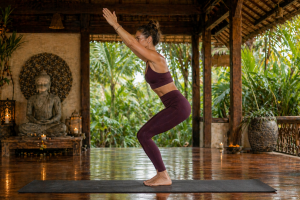
Stand tall with feet hip-width apart. Inhale, then bend your knees and lower your hips as if sitting back onto a chair. Raise your arms alongside your ears. Keep your core engaged and your chest lifted. Hold for eight breaths.
What you should feel: A full-body heat rising from the thighs into the abdomen. Your core should be active but your breath should remain steady. If the breath goes shallow, you have gone too deep in the squat.
Manipura mechanics: Utkatasana requires you to hold yourself upright against gravity while uncomfortable. That act of staying steady under pressure is, on an energetic level, exactly what a balanced Manipura is built on.
3. Bhujangasana (Cobra Pose) The Gentle Abdominal Opener
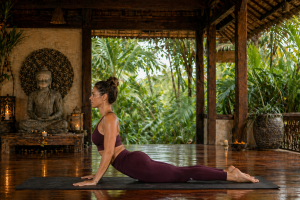
Lie face down on your mat. Place your hands under your shoulders. On an inhale, press through your palms and lift your chest off the mat, keeping your elbows slightly bent. Keep your pubic bone pressing gently into the mat. Hold for five breaths.
What you should feel: A gentle stretch across the entire front of the body, including the upper abdomen. If you feel compression in the lower back, lower your chest closer to the mat.
Trauma-informed note: This pose exposes the belly the most physically vulnerable area of the body. If you feel anxiety or the urge to collapse the chest, that is a valid nervous system response. Try placing your hands further forward to reduce the intensity. Breathe slowly. Stay within your comfort range.
Intermediate Poses: Strengthen and Transform Manipura
4. Virabhadrasana II (Warrior II) The Power Stance

From standing, step your left foot back about four feet. Turn your back foot out 90 degrees so it is parallel to the back of your mat. Bend your right knee to 90 degrees, keeping the knee over the ankle. Extend both arms to shoulder height, parallel to the ground. Gaze over your right fingertips.
What you should feel: Stability in your lower body and a sense of groundedness rising into the core. The arms extending in opposite directions create a line of energy that passes directly through the solar plexus.
“In our Bali training programs at Om Ham Resort, Ubud, I notice that students from across the world, regardless of their background, almost always let their core go slack in Warrior II. Rather than cueing ‘draw the navel to the spine’ which can trigger sucking, breath-holding, and outer muscle over-tightening we use a different cue: ‘Draw your hip bones toward each other.’ This gentle corset-like engagement of the transversus abdominis activates the deep core without disturbing the breath. Students report feeling immediately more present, grounded, and confident.”
5. Dhanurasana (Bow Pose) Full Abdominal Stretch and Stimulation
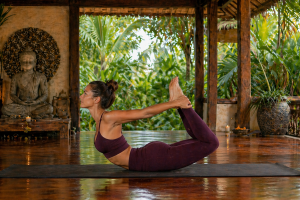
Lie on your stomach and bend both knees. Reach your arms back and hold the outside of each ankle. On an inhale, press your feet back into your hands as you lift your chest and thighs off the mat. Look forward and breathe steadily. Hold for five breaths.
What you should feel: A strong compression and then expansion of the entire abdominal region, directly stimulating the digestive organs associated with Manipura.
Contraindication: Avoid this pose if you have a recent back injury, are pregnant, or have high blood pressure. If holding both ankles is inaccessible, hold one side at a time. If you feel nausea or overwhelm, release immediately and rest in Child’s Pose.
6. Parivrtta Trikonasana (Revolved Triangle) Twist and Ignite
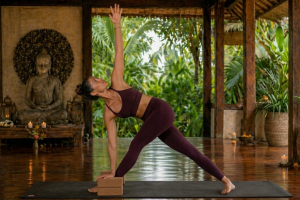
From a standing position, step your right foot forward three to four feet. Keep both legs straight. Reach your left hand down to your right shin or a block, and extend your right arm toward the ceiling. Hold for five breaths, then switch sides.
What you should feel: A strong rotational compression in the abdominal region as you twist. Twisting poses compress and then release the digestive organs, which in yogic anatomy is described as “wringing out” stagnant energy from the Manipura region.
7. Ardha Matsyendrasana (Seated Spinal Twist) Digestive Reset

Sit on your mat with legs extended. Bend your right knee and place the foot outside your left thigh. Press your right hand behind you for support. On an inhale, lengthen the spine. On an exhale, twist to the right, placing your left elbow outside your right knee. Hold for eight breaths per side.
What you should feel: Direct compression of the liver and spleen on one side, and a gentle release on the other. This alternating pressure supports the digestive function governed by Manipura.
Dynamic Flow Poses: Build Inner Fire
8. Surya Namaskar (Sun Salutation) The Complete Manipura Sequence
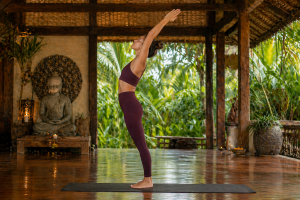
In my teaching experience, a full Sun Salutation sequence is the single most complete solar plexus chakra practice in yoga. Each of the 12 positions coordinates breath with movement, systematically building heat throughout the body and directly engaging the Agni (fire element) of Manipura.
Perform six rounds at a steady pace, breathing one full inhale or exhale per movement. Focus your attention on the upper abdomen throughout.
Note for overactive Manipura: If you are already running hot emotionally, practice two slow rounds rather than six fast ones. The benefit of Sun Salutations comes from rhythmic breath coordination, not from speed.
9. Anjaneyasana (High Lunge / Crescent Pose) Balance and Core Fire
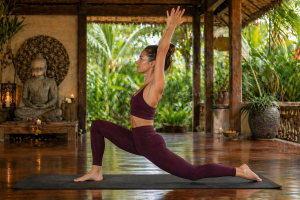
From Downward Dog, step your right foot forward between your hands. Lower your back knee if needed. Raise your arms overhead, pressing the palms together. Sink your hips low and lift your chest. Hold for eight breaths.
What you should feel: Your core working continuously to keep you upright. This sustained balancing effort, requiring focus under physical challenge, mirrors the psychological work of a balanced Manipura. Rather than drawing the navel to the spine, use the ‘Lightly Brace’ cue — imagine you are about to pull the stomach in, but stop at just 20% engagement. This subtle activation stabilizes the core without restricting the breath.
10. Shalabhasana (Locust Pose) Back Body Strengthener
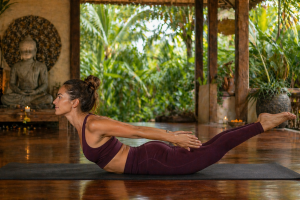
Lie on your stomach with arms alongside your body, palms facing down. On an inhale, lift your chest, arms, and legs simultaneously off the mat. Keep the gaze slightly forward and down. Hold for five breaths, then release.
Manipura mechanics: Shalabhasana strengthens the posterior chain while simultaneously stretching the front body. The engagement required to maintain the lift builds the kind of sustained effort that trains the willpower associated with Manipura.
Restorative and Cooling Poses: For Overactive Manipura
These poses are for practitioners dealing with anger, acid reflux, burnout, or over-stimulation. They cool the fire rather than add to it.
11. Paschimottanasana (Seated Forward Fold) Cooling and Calming
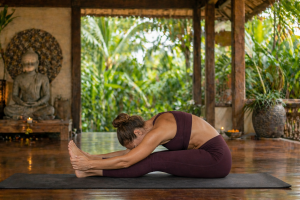
Sit with legs extended in front of you. On an exhale, fold forward from the hips, reaching toward your feet. Hold for 10 to 15 breaths, softening the belly with each exhale.
What you should feel: A gradual release of tension in the entire posterior body and a calming of the nervous system. This pose is the intelligent antidote to an overactive third chakra.
Scientific grounding: gentle compression of the abdominal region” from the sentence and keep only the diaphragmatic breathing claim which is what the study actually measured. Or add “this is believed to occur through” before the compression claim to make clear it is theoretical. Research published in Frontiers in Psychology confirms that diaphragmatic breathing significantly lowers salivary cortisol levels compared to control groups.
12. Supta Matsyendrasana (Supine Twist) Gentle Digestive Release
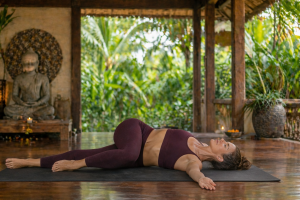
Lie on your back and draw your right knee to your chest. Let it fall across your body to the left, extending your right arm out to the side. Stay for 15 to 20 breaths, then switch sides.
What you should feel: A gentle compression of the abdomen on each side, followed by a sense of spaciousness as you switch. This pose is safe, accessible, and deeply effective for releasing tension around the digestive organs associated with Manipura.
Breathwork and Pranayama for Solar Plexus Activation
Kapalabhati (Skull-Shining Breath): For Underactive Manipura Only
Kapalabhati involves short, forceful exhales through the nose with passive inhales. Practice 30 to 50 pumps per round, rest for one minute, and repeat three times.
Who this is for: Underactive Manipura people who feel sluggish, low in confidence, or digestively stagnant. The rapid abdominal contractions directly stimulate the solar plexus nerve network and build digestive fire.
Who this is NOT for: Anyone with high blood pressure, acid reflux, anxiety, heart conditions, or who is pregnant or menstruating. Kapalabhati during menstruation is contraindicated in classical yoga texts and widely agreed upon by contemporary teachers. Do not skip this warning.
Sheetali Pranayama (Cooling Breath): For Overactive Manipura
Roll your tongue into a tube (or if that is not possible, press your tongue against the backs of your upper front teeth and inhale through the gap at the sides of your mouth. This variation is called Sitkari Pranayama and produces the same cooling effect.). Inhale slowly through the curled tongue, then close your mouth and exhale through the nose. Practice for three to five minutes.
This cooling breath is the intelligent practice for people whose solar plexus chakra is running too hot. It is rarely discussed in most blogs, and that omission is a disservice to anyone dealing with burnout or anger.
Ujjayi Breath: Your Anchor During Asana
During your solar plexus yoga practice, use Ujjayi breath a soft constriction at the back of the throat that creates a gentle ocean sound on both inhale and exhale. This slow, controlled breathing pattern directly stimulates the vagus nerve, shifting the nervous system toward its parasympathetic (“rest and digest”) state.
A 2023 meta-analysis published in Scientific Reports found that slow-paced breathwork significantly reduces self-reported stress compared to control conditions, with the strongest results from practices that include long exhalation patterns. Ujjayi breathing, with its naturally extended exhale, fits this profile precisely.
A Complete 20-Minute Solar Plexus Chakra Morning Sequence
Practice this before eating. Move through it at a steady pace, spending the suggested time at each stage.
Opening Intention (2 minutes) Come to a comfortable seated position. Place both hands on your upper abdomen, two inches above the navel. Take five slow diaphragmatic breaths, feeling the belly rise fully under your palms. Set one clear intention for your practice: not a wish, but a decision.
Warm Up (3 minutes) Three rounds of Surya Namaskar at a slow, deliberate pace. One full breath per movement.
Core Sequence (10 minutes) Perform each pose with the breath holds and repetitions described in the sections above: Navasana (Boat Pose) 3 sets of 5 breaths Utkatasana (Chair Pose) 8 breaths Virabhadrasana II (Warrior II) 8 breaths per side Anjaneyasana (High Lunge) 8 breaths per side Parivrtta Trikonasana (Revolved Triangle) 5 breaths per side Ardha Matsyendrasana (Seated Twist) 8 breaths per side
Cooldown (3 minutes) Paschimottanasana (Seated Forward Fold) 15 breaths Supta Matsyendrasana (Supine Twist) 15 breaths per side
Closing Practice (2 minutes) Come to a comfortable seat. Place the thumbs pointing toward your solar plexus and touch all fingertips together to form Hakini Mudra. Chant RAM aloud on each exhale for 10 rounds. Visualize a steady, warm yellow light at the center of your upper abdomen not a roaring flame, but a calm, constant flame like a candle in a still room.
Affirmations and Mudras to Deepen Your Practice
10 Solar Plexus Chakra Affirmations
Read these silently during Savasana or Seated Forward Fold. Notice which ones feel comfortable and which ones create resistance. The ones that make you uncomfortable are the ones you need most.
- I trust my own decisions.
- I act from a place of strength, not fear.
- My willpower is steady and consistent.
- I deserve to take up space in the world.
- I am confident without being aggressive.
- My digestion is healthy and efficient.
- I complete what I begin.
- I set boundaries from love, not anxiety.
- My personal power serves others as well as myself.
- I am enough, exactly as I am right now.
Rudra Mudra (For Personal Power)
Touch the tips of your thumb, index finger, and ring finger together on each hand. Extend your middle finger and little finger straight outward. Rest your hands on your knees, palms facing upward. Rest your hands on your knees with palms facing upward. This mudra is traditionally used to strengthen the fire element in the body and is associated with personal empowerment in Tantric yoga texts.
Hakini Mudra (For Mental Clarity)
Bring your hands to the height of your solar plexus. Touch all ten fingertips together, keeping space between your palms. The thumbs point toward your body. This mudra is described in classical texts as supporting integration between the right and left hemispheres of the brain, supporting the clear decision-making associated with a balanced Manipura.
Timeline: When Will You Actually Feel Results?
Based on what I have seen in years of teaching, here is an honest, realistic timeline. Every person is different, and these are general patterns, not medical guarantees.
Within 3 to 7 days: Improved digestion, less bloating, and a slight uptick in physical energy. These are the most immediate, tangible changes because you are physically stimulating the organs governed by Manipura.
Within 2 to 3 weeks: You may notice you are making decisions with slightly more ease. Small moments of assertiveness that previously cost you significant mental energy start to feel more natural.
Within 4 to 6 weeks of daily or near-daily practice: Emotional shifts around confidence and self-worth begin to consolidate. These changes take longer because they involve neurological rewiring, not just physical stimulation.
Be patient. This work is real, and it takes time.
Frequently Asked Questions About Yoga Poses for the Solar Plexus Chakra
-
What is the solar plexus chakra in simple terms?
The solar plexus chakra, called Manipura in Sanskrit, is the third energy center in the body.It sits in the upper abdomen, roughly four finger-widths above the navel, in the region of the solar plexus nerve network, just below where the rib cage meets. It governs personal power, self-esteem, willpower, and digestive function. The associated element is fire, the color is yellow, and the seed mantra is RAM.
-
Which yoga pose is best for the solar plexus chakra?
Navasana (Boat Pose) is the single most effective yoga pose for the solar plexus chakra because it directly engages the core, builds mental endurance, and creates localized heat in the upper abdomen. For overactive Manipura, Paschimottanasana (Seated Forward Fold) is a better choice as it cools and calms the fire element.
-
How do I know if my solar plexus chakra is blocked?
Signs of a blocked solar plexus chakra include low confidence, difficulty making decisions, digestive problems like constipation or IBS, chronic fatigue, and a persistent feeling of powerlessness. An overactive blockage shows up differently: as anger, acid reflux, controlling behavior, and burnout. Both states indicate Manipura is out of balance.
-
Can yoga for the solar plexus chakra help with digestion?
Yes, with an important caveat. Twisting poses like Ardha Matsyendrasana mechanically compress and release digestive organs. Diaphragmatic breathing stimulates the vagus nerve, which directly governs digestion. Research published in Scientific Reports confirms breathwork reduces cortisol, which when elevated, suppresses digestive function. Yoga supports digestion through both physical and neurological pathways.
-
Is Kapalabhati safe for everyone doing solar plexus chakra yoga?
No. Kapalabhati is contraindicated for people with high blood pressure, acid reflux, anxiety disorders, heart conditions, hernia, and abdominal injuries. It should not be practiced during menstruation or pregnancy. It is specifically suited for underactive Manipura states. If your solar plexus is overactive, Kapalabhati will aggravate rather than heal it.
-
How often should I practice solar plexus chakra yoga?
Daily practice of even 20 minutes produces the most measurable results. If daily practice is not realistic, three to four sessions per week is a strong minimum. Consistency matters far more than duration. A steady 20-minute daily practice outperforms an occasional 90-minute session every two weeks, both physically and energetically.
-
Can these poses help with anxiety and low self-esteem?
Yoga for the solar plexus chakra supports confidence and reduces anxiety through two mechanisms. First, sustained physical effort during poses like Warrior II builds a felt sense of resilience in the body. Second, diaphragmatic breathing stimulates the vagus nerve, lowering cortisol and activating the parasympathetic nervous system, which reduces the physiological experience of anxiety. Results compound over weeks of consistent practice.
-
What is the RAM mantra and how do I use it for Manipura?
RAM (pronounced “rahm”) is the bija, or seed mantra, of the Manipura chakra. Chanting it creates vibrations in the upper abdominal region that traditionally correspond to activating the third chakra. Sit comfortably, place one hand on your solar plexus, inhale through the nose, and chant RAM slowly on each exhale for five to ten minutes. Pair this with a visualization of warm yellow light.
-
Should I avoid solar plexus yoga if I have abdominal health issues?
People with diastasis recti, hernias, recent abdominal surgery, severe IBS, or active ulcers should consult a qualified healthcare provider before practicing core-intensive solar plexus poses. Gentle options like Supta Matsyendrasana and Paschimottanasana are generally safer starting points. Yoga is a complementary practice and should be integrated with, not substituted for, medical care.
-
What foods support solar plexus chakra healing alongside yoga?
Ayurvedic tradition associates Manipura with warm, easily digestible, yellow-toned foods. Ginger, turmeric, lentils, bananas, corn, and chamomile tea are traditionally recommended to support digestive fire without over-stimulating it. Avoiding excessive raw foods, cold drinks, and processed sugar supports samana vayu and the metabolic functions of the third chakra. Think warm, nourishing, and grounding.
A Final Word from Deep Kumar Yoga
I started Yoga New Vision because I believe yoga should be honest, not performative. The solar plexus chakra work I have described here is real, grounded in both classical yoga philosophy and modern anatomy, and it can genuinely change how you inhabit your own body and life.
But it requires you to be honest too. Honest about whether you need more fire or less. Honest about when a pose feels overwhelming and you need to back off. Honest about the difference between building strength and white-knuckling through discomfort.
Start with the 20-minute morning sequence. Practice it daily for two weeks. Pay attention to what shifts, not just physically, but in how you carry yourself through a day.
That is where Manipura actually wakes up.
Deep Kumar is the founder of Yoga New Vision (yoganewvision.com), a Yoga Alliance registered school based in Ubud, Bali. With over 14 years of teaching experience, Deep has previously founded Siddhi Yoga in India, Deep Yoga Academy in Malaysia, and East+West Yoga in Bali. Yoga New Vision has been recognized by London’s Om Yoga Magazine as the world’s most authentic 200-hour yoga teacher training, and holds a perfect 5.0 rating on Google from graduates across the world. Deep personally teaches every training cohort in 2026, specializing in Hatha, Vinyasa, Yin, Pranayama, and chakra-integrated practice rooted in classical Indian yogic texts.
Medical Disclaimer: The content in this article is for educational purposes only and does not constitute medical advice. Always consult a qualified healthcare professional before beginning any new physical practice, particularly if you have pre-existing health conditions.