By Deep Kumar | Program Director and Master Teacher, Yoga New Vision, Ubud Bali Reviewed by Sadhana Om | Creative Director and Bhakti Yoga Teacher, Yoga New Vision Last reviewed: May 2026
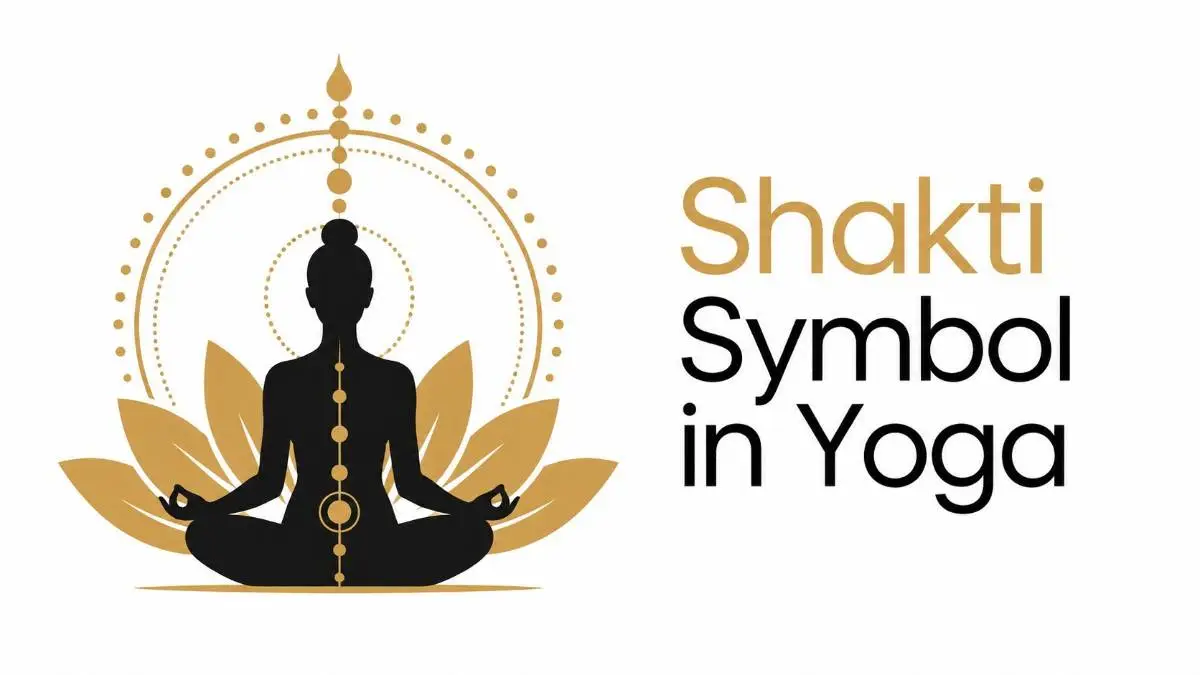
The Shakti symbol in yoga refers to the Adi Shakti yantra, a sacred symbol representing divine feminine energy. It has three components: the Khanda (central upright double-edged sword), the Chakkar (surrounding circle), and two Kirpans (curved outer swords). Rooted in Sikh and Kundalini yoga traditions, this symbol is used as a focal point for Shakti energy practices including mantra, mudra, meditation, and pranayama.
What the Shakti Symbol Actually Looks Like
The Adi Shakti symbol is not a vague spiritual doodle. It has precise geometry with precise meaning, and I want you to see it clearly before we go anywhere else.
At the center sits the Khanda, a double-edged upright sword. Around it is the Chakkar, a perfect circle with no beginning and no end. Flanking the circle on both sides are two Kirpans, curved swords that arch outward.
Most articles you will find online call the outer curves “crescents” and leave it at that. That is like calling the spine “a long bone.” Technically not wrong. Spiritually useless.
The Adi Shakti Symbol vs the Shakti Yantra: A Distinction That Matters
Here is something almost nobody explains correctly, and it has confused practitioners for decades.
The Adi Shakti symbol comes from Sikh tradition. Guru Gobind Singh, the tenth Sikh Guru, gave us this yantra. It entered modern yoga primarily through Yogi Bhajan and the Kundalini yoga lineage.
The Shakti Yantra is a completely different visual. It is a Hindu Tantric diagram built from interlocking triangles, used in Shakta and Tantric meditation traditions rooted in texts like the Shat-cakra-nirupana. Both appear on yoga studio walls. Both are legitimate. They are not the same thing.
If you are a yoga teacher and you have been using them interchangeably, this is a good moment to pause. Your students deserve the accuracy.
What the Three Components Are Actually Mapping
Most explanations treat the Adi Shakti symbol as mythology. I see it as anatomy.
The Khanda at the center represents the spine and the Sushumna nadi, the central energy channel running from Muladhara at the base to Sahasrara at the crown. It is the pathway through which Kundalini Shakti travels when she awakens.
The two Kirpans on either side represent the Ida and Pingala nadis, the left and right energy channels that spiral around the Sushumna. In Western anatomy, these map directly to the parasympathetic and sympathetic branches of the autonomic nervous system. Ida is cooling, receptive, and lunar. Pingala is heating, active, and solar.
The Chakkar that encircles everything? That is the truth that consciousness contains all of it. No polarity exists outside the whole.
When I teach this in our 200hr Yoga Teacher Training in Bali, the moment students see the symbol through this anatomical lens, something shifts. The symbol stops being decoration and starts being a diagram they already carry inside their own bodies.
Where Shakti Comes From: The Roots Are Older Than You Think
The Sanskrit root is shak, meaning “to be able.” Shakti is, at its simplest, the capacity to exist, to move, to create. She is the life force inside everything.
Archaeological findings from the Indus Valley civilisation, dated between 3300 and 1300 BCE, show early goddess worship through clay figurines at sites like Mohenjo-daro. Shakti as a concept predates organised religion. She is that old.
In yoga philosophy, Shakti is the active principle. Shiva is pure consciousness, still and witnessing. Without Shakti, Shiva does nothing. Without Shiva, Shakti has no direction. This is the Prakriti and Purusha relationship that Kashmir Shaivism philosophers like Abhinavagupta spent lifetimes exploring.
The goddess forms of Shakti each express a different quality of this energy. Durga is the fierce protector. Kali is the destroyer of what no longer serves. Parvati is devotion, love, and steadiness in partnership. All three live inside every practitioner, regardless of gender.
Kundalini Shakti: The Energy That Already Lives in You
In Kundalini yoga, Shakti takes a specific form. She is described as a coiled serpent resting dormant at the base of the spine, at Muladhara chakra.
The practices of Kundalini yoga, including kriyas, pranayama, mantra, and meditation, are designed to awaken this energy and guide her upward through all seven chakras. The goal is not some dramatic spiritual explosion. The goal is a clear, steady column of energy rising from root to crown, resulting in what most practitioners describe simply as feeling awake.
I say this because the internet has turned Kundalini awakening into something terrifying. In fifteen years of teaching, the students who experience the most profound awakenings are usually the ones who practiced the most consistently, not the ones who pushed the hardest.
How to Work with Shakti Energy in Practice
The Adi Shakti Mantra
The full mantra:
Adi Shakti, Adi Shakti, Adi Shakti, Namo Namo Sarab Shakti, Sarab Shakti, Sarab Shakti, Namo Namo Pritam Bhagwati, Pritam Bhagwati, Pritam Bhagwati, Namo Namo Kundalini Mata Shakti, Mata Shakti, Namo Namo
Translation: I bow to the primal power. I bow to the all-encompassing power. I bow to the beloved divine creative force. I bow to the mother Kundalini energy.
To practice: sit with the spine upright, hands on the knees in Gyan Mudra, eyes closed. Draw the attention to the base of the spine. Chant aloud or follow a recording for eleven minutes. Visualise golden light rising from Muladhara with each repetition. This is a morning sadhana practice, not a special occasion ritual.
Shakti Mudra
Curl the index finger, middle finger, and thumb toward the palm. Extend the ring finger and pinky finger outward and touch their tips together. Hold at the level of the lower abdomen. This gesture activates the sacral chakra (Svadhisthana), calms the nervous system, and is particularly effective for releasing tension held in the pelvic floor.
Yoni Mudra
Press the tips of both thumbs together. Bring the tips of both index fingers together and point them downward, forming a downward-pointing triangle. Interlace the remaining fingers. Hold at the level of the lower belly. The triangle represents feminine creative energy and connects directly to the Shakti Yantra geometry of the Hindu Tantric tradition.
Sadhana Om’s Perspective: The Feminine Lineage at YNV
My co-founder Sadhana Om spent six years in the corporate world before she left it. She does not talk about that period with regret. She talks about it as the education that made her teaching real.
She says this often in our training: “Shakti is not what you perform on the mat. Shakti is what you recover in your body after years of performing everywhere else.”
Her approach to Bhakti yoga and meditation at YNV holds the feminine wisdom that I, as a teacher rooted in anatomy and philosophy, cannot fully carry alone. In our 200hr Yoga Teacher Training, she leads practices that help students reconnect with intuition, creative flow, and the somatic experience of Shakti energy rather than just the intellectual framework.
The combination of her approach and mine is precisely what OM Yoga Magazine called the world’s most authentic yoga teacher training. I am not saying that to impress you. I am saying it because the methodology matters, and it took us years to build it.
Shakti Awakening and the Laughter Connection
Here is the honest truth about Shakti that most articles miss entirely.
When Shakti energy is genuinely balanced and moving freely through the body, the first sign is usually not tears or trembling. The first sign is often spontaneous laughter. Not performance. Not relief. The kind of laughter that has no cause and needs no explanation.
My classes end in dancing more often than not. Students who arrived at YNV serious and guarded, people who had not laughed freely in years, find something in the third week of the immersion that breaks open quietly. That is Shakti. That is what a nervous system regulated by genuine practice feels like.
The Kirpans in the Adi Shakti symbol represent the ability to cut through what no longer serves. For most of our students, that is not drama or darkness. It is the habit of holding joy at arm’s length.
Global Parallels: This Energy Has Many Names
Shakti is not exclusive to the Hindu tradition. Similar principles appear across cultures and traditions.
In Sikhism, the Khanda symbol shares visual and philosophical DNA with the Adi Shakti. In Vajrayana Buddhism, female deities embody wisdom and transformative power in comparable ways. The Taoist concept of chi or qi describes a universal life-force energy with a comparable relationship to stillness and movement.
These parallels exist because the experience of Shakti precedes every tradition that named her. She was there before the names.
The Shakti Symbol in Your Yoga Teacher Training
At Yoga New Vision, the Adi Shakti symbol is not wall art. It is a teaching tool.
In the first week of the 200hr programme, we introduce the symbol in the context of pranayama, specifically Nadi Shodhana (alternate nostril breathing), which directly works with the Ida and Pingala nadis that the Kirpans represent. By the second week, students are mapping those nadis onto their own anatomy, their own nervous system responses, and their own patterns of activation and rest.
By the third week, most students have stopped seeing the symbol and started feeling it. That is when the real learning begins.
If you want to understand Shakti at that level rather than just intellectually, that is what our 22-day immersive training in Ubud, Bali is designed for. Fifteen-thousand-plus graduates since 2009. Every cohort rated five stars. Come and find out why.
Book a free 15-minute call with our team
Frequently Asked Questions About the Shakti Symbol in Yoga
- What is the Shakti symbol in yoga?
The Shakti symbol in yoga refers to the Adi Shakti yantra, representing divine feminine energy. It consists of three parts: the Khanda (central sword), the Chakkar (surrounding circle), and two Kirpans (curved outer swords). Rooted in Sikh and Kundalini yoga traditions, it is used as a meditation and mantra focal point.
- What are the three parts of the Adi Shakti symbol?
The Adi Shakti symbol has three precise components. The Khanda is the central double-edged upright sword, representing the spine and Sushumna nadi. The Chakkar is the circular ring, representing infinite time and wholeness. The two Kirpans are the curved outer swords, representing the balance of Ida and Pingala nadis, or the parasympathetic and sympathetic nervous systems.
- Is the Adi Shakti symbol the same as the Shakti Yantra?
No, they are different. The Adi Shakti symbol comes from Sikh tradition via Guru Gobind Singh and entered yoga through Yogi Bhajan’s Kundalini lineage. The Shakti Yantra is a Hindu Tantric diagram of interlocking triangles from traditions like Kashmir Shaivism. Both appear in yoga spaces and both hold genuine significance, but they should not be used interchangeably.
- What chakra is Shakti associated with?
Shakti is primarily associated with Muladhara, the root chakra at the base of the spine, where Kundalini Shakti rests dormant. As she awakens through practice, she moves upward through all seven chakras toward Sahasrara at the crown. Every chakra is a stage in Shakti’s journey, not a separate energy system.
- How do you chant the Adi Shakti mantra?
Sit upright in a comfortable cross-legged position with hands in Gyan Mudra on the knees. Close the eyes and bring awareness to the base of the spine. Chant the four-line Adi Shakti mantra aloud or with a recording for eleven minutes daily. Visualise golden light rising from the root with each cycle. Morning practice is most effective.
- What is Shakti Mudra and how do you practice it?
Shakti Mudra is performed by curling the index finger, middle finger, and thumb toward the palm, then extending the ring and pinky fingers and touching their tips together. Hold at the level of the lower abdomen. It activates the sacral chakra, supports nervous system regulation, and is traditionally used in Ayurvedic and Kundalini yoga practices for grounding and calming.
- How is Shakti energy taught in a yoga teacher training?
At Yoga New Vision, Shakti philosophy is taught through a curriculum that integrates Sanskrit theory, pranayama, and somatic anatomy. Students map Ida and Pingala nadis onto their own nervous system and practice Nadi Shodhana as a direct Shakti balancing technique. By the third week of the 22-day immersion, most students move from intellectual understanding to embodied experience.
- What is the difference between Shakti and Kundalini?
Shakti is the universal feminine energy that permeates all of existence. Kundalini is a specific expression of Shakti that resides dormant at the base of the spine in Muladhara chakra. When Kundalini awakens and rises through the chakras via the Sushumna nadi, that process is called Kundalini awakening. Kundalini is Shakti in her most concentrated, personal, and evolutionary form.
- Does the Shakti symbol appear in traditions outside Hinduism?
Yes. The Adi Shakti symbol originates in Sikh tradition. Similar energy principles appear in Vajrayana Buddhism through female wisdom deities, and in Taoism through the concept of chi or qi as a universal creative force. The philosophical parallels across traditions suggest that the experience of Shakti predates every name any tradition has given her.
- Can men work with Shakti energy in yoga practice?
Completely. Shakti energy exists in every body regardless of gender. In yoga philosophy, Shakti represents the active, creative principle within all of existence, paired with Shiva as the witnessing consciousness. Working with Shakti through mantra, mudra, pranayama, and meditation is not gendered practice. It is the practice of becoming more fully alive, which applies to everyone.
Deep Kumar is the Program Director and Master Teacher at Yoga New Vision, Ubud Bali. Born and raised in India, he trained at India’s most prestigious yoga academies and has guided 15,000-plus students through teacher training since 2009. Yoga Alliance Profile
Sadhana Om is the Creative Director and Bhakti Yoga Teacher at Yoga New Vision. She holds the feminine lineage traditions within the YNV curriculum and leads meditation, devotional practice, and teacher formation sessions across all programmes.