Table of Contents
ToggleWant to Start a Career in Yoga? Here Is What Nobody Tells You Before You Begin
By Deep Kumar, Founder and Lead Teacher, Yoga New Vision Bali
Starting a career in yoga requires three things: a 200-hour Yoga Alliance accredited certification, a personal practice you take seriously, and a genuine willingness to teach human beings rather than just poses. Most people focus on the first. The teachers who actually build careers focus on all three.
I have been teaching yoga for over 16 years. I have trained more than 15,000 students across four schools, including Siddhi Yoga, Deep Yoga Academy, East+West Yoga, and now Yoga New Vision, which is the one I built when I finally had the clarity to offer this practice in its most honest form. I studied under, completed a postgraduate degree in Yogic Sciences from Mangalore University, and carry the lineage of the Dev Parampara tradition from Kullu-Manali. I also work as a consultant physiotherapist at Yuvaan Wellness Center.
I am telling you all of this not to impress you but to be clear about where this perspective comes from. This post is the advice I give every student who sits across from me and asks: is teaching yoga a real career?
The Market Is Not Saturated. Generic Instruction Is.
The number one reason people hesitate to start is this: “But isn’t the yoga world flooded with teachers already?”
It looks that way from the outside. On Instagram, everyone seems to be certified and posting about their practice. The actual reality in studios, corporate wellness programs, and clinical settings is completely different.
Employers in this industry are constantly looking for teachers who understand nervous system regulation, trauma-informed sequencing, injury prevention, and functional biomechanics. They are not finding enough of them. The world genuinely does not need more instructors who learned 50 postures and call it a class. It needs teachers with real clinical knowledge, real lineage, and the ability to hold space when a student breaks down in Savasana.
That space is wide open. The teachers filling it are the ones who trained properly.
What You Legally and Practically Need to Start
A yoga teaching career begins with a 200-hour yoga teacher training accredited by Yoga Alliance USA. This is the globally recognized minimum standard. The RYT-200 credential that follows is what most studios, gyms, and corporate wellness clients require before they will book you.
You do not need a prior background in fitness, education, or healthcare. The minimum age requirement is 18. You need a personal practice you take seriously and the readiness to learn how to lead people, not just perform in front of them.
Beyond the training itself, factor in the practical costs that most blogs skip: Yoga Alliance registration runs approximately $115 per year. Liability insurance costs $150 to $300 annually. Continuing education workshops, which are required to maintain your RYT credential, add another $200 to $500 per year depending on what you choose. Budget for these from the start so they do not catch you off guard in month three.
Choose Your Style Deliberately, Not Reactively
Before choosing a training program, you need to know which yoga style fits your body and the students you want to serve. Hatha yoga is the foundation of most modern practice and the safest starting point for a new teacher. Vinyasa yoga suits those drawn to dynamic, breath-linked movement. Yin yoga works deeply with connective tissue through long holds and stillness.
The niches with growing demand right now are corporate wellness yoga, prenatal yoga, therapeutic and rehab yoga, and trauma-informed practice. Teachers who specialize in any of these command higher rates and steadier client relationships than general-purpose studio instructors.
My honest advice: train broadly in your 200-hour program and specialize once you have real classroom time behind you. Choosing a niche before you have taught real students in a room is guesswork. After six months of teaching, your students will show you exactly where your gifts are.
Online Yoga Teacher Training Has a Real Limitation
I will say this plainly because I think people deserve an honest perspective on it.
Online YTT is convenient and accessible, and it has its place. A school with strong faculty and a rigorous curriculum can provide good theoretical foundations through a screen. But teaching yoga requires you to read a room, feel the energy shift when someone is struggling, provide safe hands-on adjustments, and hold silence without filling it out of nervous habit. None of those skills develop behind a laptop.
A 22-day full immersion program like our Yoga Teacher Training in Ubud, Bali puts you inside a daily practice from early morning until evening. You live alongside your cohort. You begin teaching your fellow students on day three. The transition from student to teacher happens through doing, in a real room, with real bodies, under real guidance.
I have watched students arrive who have never led a class in their lives and graduate three weeks later with the quiet confidence of someone who knows they can hold a room. That shift does not come from a module watched on a Tuesday evening.
What Yoga Teachers Actually Earn: The Honest Numbers
Teaching studio classes at $25 to $35 per class, with 20 classes per week, produces roughly $30,000 to $45,000 annually in the United States before taxes. That number does not account for unpaid preparation time, travel between studios, or cancellations. US Bureau of Labor Statistics places the median annual salary for fitness instructors, including yoga, at $46,180.
The teachers who build genuine financial stability treat yoga as a portfolio career. They combine studio classes with private sessions at $80 to $150 per hour, corporate wellness programs at $200 to $400 per session, online memberships or course offerings, and eventually retreat leading or teacher training facilitation. Those multiple income streams together push annual earnings well past $60,000 to $100,000 for established teachers.
The realistic timeline to sustainable full-time income is 12 to 18 months after certification. Anyone presenting a faster timeline to justify an enrollment decision is not giving you an honest picture.
Why Bali Changes What Is Possible in 22 Days
My own practice was shaped profoundly by where I trained and who I trained with. The location and the lineage were not separate things. They were the same thing.
Ubud, Bali is the spiritual center of an island built around daily devotional practice. It is not a resort town with a yoga add-on. The quality of stillness here, the cultural environment, and the community of serious practitioners who gather each season create a particular kind of learning pressure that I have not found replicated anywhere else.
At Yoga New Vision, our faculty includes physiotherapists, movement specialists, and teachers rooted in Bhakti yoga, Tantra, and Vedanta. Our curriculum integrates the Alexander Technique, Bioenergetics as developed by Alexander Lowen, and Buteyko Breathing principles. This is not standard textbook anatomy. It is clinical biomechanics applied directly to how the body moves in yoga.
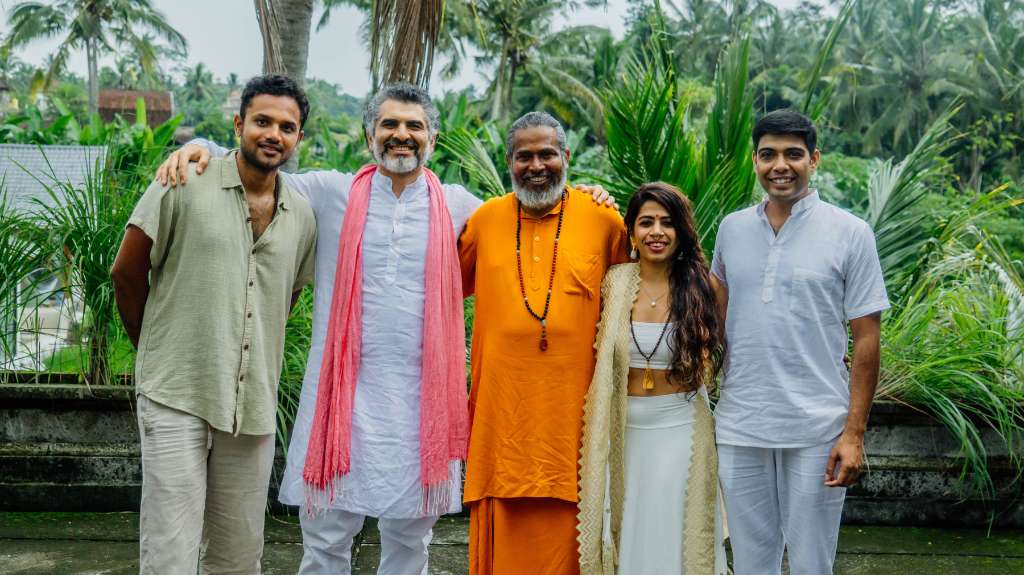
Our co-founder Sadhana Om studied with teachers across ashrams in India, including time with the Baul mystics in Rishikesh, before bringing her knowledge of Bhakti yoga, mantra practice, and feminine embodiment to this school. When she holds space in the training room, something changes. Students who arrive guarded leave open. She built that ability through decades of real practice, not through a framework.
OM Yoga Magazine named Yoga New Vision the World’s Most Authentic 200-Hour Yoga Teacher Training. Yoga Alliance has recognized our school since 2011. We have maintained five-star ratings across every cohort we have run since opening.
What Happens After You Leave Bali
Every graduate of our 200-hour program receives 12 months of free access to our full online course library. This means you can revisit every anatomy session, philosophy module, and asana lab from wherever you land next. The post-graduation community group keeps new teachers connected to each other and to our faculty during the first year, which is the period when most of the real questions arrive.
Your first 90 days after graduating should include securing two to three consistent teaching slots, beginning your RYT-200 Yoga Alliance registration, and identifying one continuing education workshop to complete within the year.
Sadhana personally holds every free discovery call for prospective students. She does this by choice. If you are weighing whether this program fits your specific life situation, that call is the right place to ask the real questions. She will not oversell you. Book a free 15-minute call with Sadhana.
The next cohort for our 200-hour yoga teacher training in Bali begins July 6 in Ubud. If you feel called to teach, the right time to begin is not when you feel ready. That feeling rarely arrives on schedule.
Frequently Asked Questions About Starting a Career in Yoga
1. Can a complete beginner with no prior yoga experience join a 200-hour YTT?
Yes. Many of our graduates at Yoga New Vision arrived with less than a year of personal practice. What matters far more than existing skill level is genuine curiosity and a willingness to do real inner work. The training builds your abilities from the ground up in a structured and supported way.
2. How long does it take to become a certified yoga teacher?
The certification itself takes 22 days in a full immersion format or six to eight weeks in a part-time weekend structure. Becoming a confident, consistently working teacher takes 12 to 18 months after graduation. The certificate opens the door. Experience builds what comes next.
3. Do I need to register with Yoga Alliance after completing a 200-hour training?
Registration with Yoga Alliance is not legally required, but most studios and corporate wellness clients in the US, UK, and Australia require an RYT-200 credential before hiring. The process involves submitting your training hours and paying a registration fee. Processing takes approximately four to six weeks.
4. How much does a 200-hour yoga teacher training cost?
Training costs range from $1,500 to $4,000 depending on the school and what is included. At Yoga New Vision, residential packages with accommodation and three daily meals range from $2,999 to $3,999. A course-only option starts at $1,999. All packages include Yoga Alliance certification and a free 50-hour Yin Yoga course valued at $599.
5. Is teaching yoga a viable full-time career?
Yes, with realistic planning. Studio teaching alone typically produces $30,000 to $45,000 annually in the US. Teachers who build multiple income streams combining private clients, corporate sessions, and online offerings reach $60,000 to $100,000. The median income across all formats sits at $46,180 according to the Bureau of Labor Statistics.
6. What is the difference between an RYT-200 and an E-RYT 200?
An RYT-200 is your initial credential after completing an accredited 200-hour training. An E-RYT 200 (Experienced Registered Yoga Teacher) requires accumulating 1,000 teaching hours and at least two years of post-certification experience. The E-RYT designation is required to lead Yoga Alliance accredited teacher training programs of your own.
7. What yoga style should a new teacher specialize in first?
Start with Hatha or Vinyasa yoga, as these form the foundation of most studio class programming worldwide. Specialize after your first 6 to 12 months of teaching real students. High-demand niches in 2026 include prenatal yoga, corporate wellness, therapeutic rehab yoga, and yin yoga. Choose based on genuine interest, not perceived marketability.
8. What are the hidden costs of becoming a yoga instructor?
Beyond training fees, budget for Yoga Alliance registration at approximately $115 annually, liability insurance at $150 to $300 per year, and continuing education workshops. Total first-year costs outside of training typically run $500 to $800. Knowing this upfront prevents financial pressure during the early months of building your teaching schedule.
9. Can I build a career with an online yoga certification?
An online 200-hour certification from an accredited school is technically valid. However, online training has real limitations in developing hands-on adjustment skills, spatial teaching awareness, and the confidence that comes from leading live students in a room. Many teachers who trained online later seek in-person immersion to fill those practical gaps.
10. Why train in Bali specifically rather than in my home country?
Bali’s cultural and devotional environment accelerates personal transformation in ways a generic studio setting cannot replicate. Ubud in particular has been a global center for serious yoga practice for decades. The combination of daily immersive training, Balinese ceremonial culture, and a cohort of international practitioners creates a depth of learning that travels home with you.
Deep Kumar is the founder and lead teacher of Yoga New Vision Bali. He holds a postgraduate degree in Yogic Sciences from Mangalore University, studied under BNS Iyengar in Mysore, and carries the lineage of the Dev Parampara tradition. He practices as a consultant physiotherapist at Yuvaan Wellness Center and personally teaches every cohort at Yoga New Vision.