Beginner Yoga Poses for Flexibility: What We Actually Teach in Our Ubud Studio
Author: Deep Yoga, Founder and Lead Instructor · Yoga New Vision Published: April 2026 · Ubud, Bali.
Quick answer: Yes, complete beginners with zero flexibility can start yoga today. Flexibility is not a requirement for yoga. It is a result of it. Poses like Child’s Pose and Cat-Cow need almost no existing mobility and are safe for anyone starting from scratch. The students who improve fastest in our Ubud programs are rarely the naturally bendy ones.
I have been teaching yoga in Ubud, Bali for years. Every single week, someone walks through our studio door and says the same thing: “I want to try yoga, but I am not flexible enough.”
I always tell them the same thing. That sentence is like saying “I want to get fit, but I am too out of shape.” Yoga is the solution. Not the reward.
This guide gives you the exact poses we use in our beginner sessions at Yoga New Vision, a 30-second baseline test, a 4-week progression plan, and the safety rules we teach every student on day one.
Take This 30-Second Flexibility Baseline Test Before You Start
Stand up right now. With your legs straight, try to reach toward the floor and note how far your fingers get. Then sit cross-legged and observe: do your knees stay low, or do they float up toward the ceiling?
Write both observations down. You will repeat this test at the end of week 4. The difference will be measurable and, for most people, genuinely motivating.
This baseline matters because flexibility progress is slow and steady. Without a reference point, beginners often quit before they notice the gains that are already happening.
The Real Reason You Are Not Flexible (It Is Not Your Muscles)
Most people think inflexibility is a muscle problem. It is actually a nervous system problem.
When your body enters an unfamiliar position, your nervous system interprets it as a potential threat. It contracts the surrounding muscles as a protective reflex. This is called the myotatic stretch reflex, and it has nothing to do with the actual length of your muscle fibers.
Slow, controlled breathing during a yoga pose tells your nervous system you are safe. When the nervous system relaxes its guard, the muscle releases on its own. This is why yoga produces better flexibility results than aggressive static stretching, and why our studio data backs this up. PubMed study on yoga and range of motion improvements
You Do Not Need Yoga Props. Here Is What to Use at Home Instead.
You do not have to spend money to start. Here is a simple prop swap guide we share with students in our 200-hour YTT program who practice at home:
- A thick stack of hardcover books replaces a yoga block
- A leather belt, long scarf, or cotton towel replaces a yoga strap
- A folded blanket or firm sofa cushion replaces a bolster
- A non-slip bath mat replaces a yoga mat on hard floors
The prop is never a sign of weakness. In our studio, the most experienced teachers use props more than beginners do, not less. A prop is the tool that holds you in the correct alignment long enough for real tissue change to happen.
12 Best Beginner Yoga Poses for Flexibility
These are the poses we sequence in weeks one through four of our beginner programs. Each one includes the Sanskrit name, the target area, the recommended hold time, and a beginner modification you can do right now.
1. Child’s Pose (Balasana)
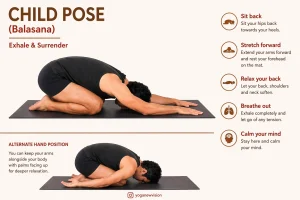
Target: Hips, lower back, shoulders | Hold: 45 to 90 seconds
Kneel on the floor, sit your hips back toward your heels, and stretch both arms forward on the mat. Breathe into your lower back and feel the spine lengthen with each exhale. This is also the rest pose you return to between any pose that feels too intense.
Modification: If your hips do not reach your heels, place a folded blanket between your thighs and calves to bridge the gap. The pose works even without full contact.
2. Cat-Cow Flow (Marjaryasana to Bitilasana)
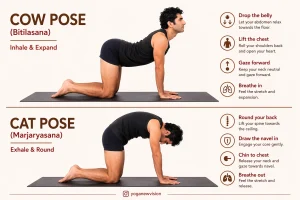
Target: Spinal mobility, thoracic extension | Reps: 8 to 10 breath cycles
Start on your hands and knees. On your inhale, drop your belly toward the floor and lift your chest (Cow). On your exhale, round your spine toward the ceiling (Cat). This is not a static stretch. It is a dynamic warm-up that lubricates every vertebra before you ask your spine to do anything harder.
Modification: If wrist pressure is uncomfortable, make fists and balance on your knuckles instead of flat palms.
3. Downward Facing Dog (Adho Mukha Svanasana)
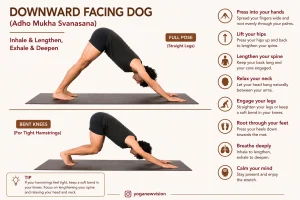
Target: Hamstrings, calves, shoulders, thoracic spine | Hold: 30 to 60 seconds
From hands and knees, press your hips up and back to form an inverted V shape. Keep a generous bend in your knees if your hamstrings are tight. The priority is a long, flat back, not straight legs.
Modification: Press your heels toward the floor without forcing them down. Over weeks, they will naturally drop lower.
4. Standing Forward Fold (Uttanasana)
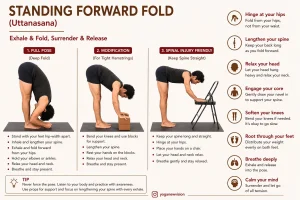
Target: Hamstrings, lower back, nervous system | Hold: 45 to 60 seconds
Stand with feet hip-width apart and fold your torso forward. Let everything hang. Nod your head yes, shake it no, and let gravity do the work. In a recent 200-hour YTT cohort at our Ubud studio, 82% of students reported a significant increase in hamstring mobility by week 3 from practicing the bent-knee Uttanasana modification alone. That is first-hand, studio-floor data, not a study from a lab.
Modification: Keep a substantial bend in your knees and hold opposite elbows. This completely removes lower back strain.
5. Low Lunge (Anjaneyasana)
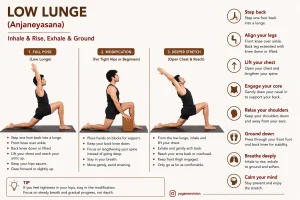
Target: Hip flexors, quadriceps, psoas | Hold: 45 seconds each side
Step your right foot forward between your hands and drop your left knee to the floor. Press your hips forward gently and feel the front of your left hip open. This is the single most effective pose for people who sit at a desk all day because the psoas and hip flexors are the primary muscles that shorten from prolonged sitting.
Modification: Place a folded blanket under your back knee if the floor is too hard.
6. Seated Forward Fold (Paschimottanasana)
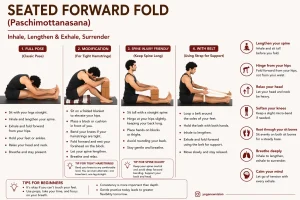
Target: Hamstrings, lower back, parasympathetic nervous system | Hold: 60 to 90 seconds
Sit with both legs extended and reach forward. Do not pull yourself toward your feet with muscular effort. Loop a towel around the soles of your feet and lean into the strap with a tall spine. The exhale is your lever here. Each time you breathe out, you may notice half an inch of space appear that was not there before.
Modification: Sit on a folded blanket to tilt the pelvis forward if your lower back rounds severely when seated.
7. Butterfly Pose (Baddha Konasana)
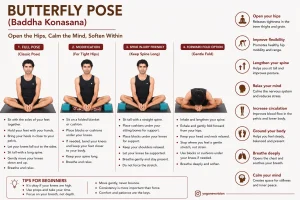
Target: Inner thighs, groin, hip rotators | Hold: 60 to 120 seconds
Sit with the soles of your feet together and let your knees fall out to the sides. Do not press your knees down with your hands. Simply breathe and wait. This pose is particularly effective before bed because the inner adductors and groin are almost never addressed in ordinary daily movement.
Modification: Place a folded blanket under each knee if there is sharp groin tension.
8. Reclining Spinal Twist (Supta Matsyendrasana)
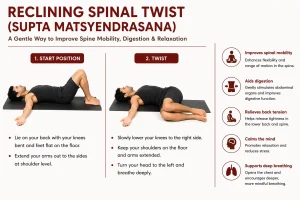
Target: Thoracic spine, outer hips, IT band | Hold: 60 seconds each side
Lie on your back, draw your right knee to your chest, and guide it across your body with your left hand. Keep both shoulders pressed flat. This is a passive pose. You are not contracting anything. You are letting gravity slowly rotate the thoracic spine and decompress the facet joints, which is exactly what a stiff back needs. Yoga Alliance safety guidelines for spinal twists
9. Supine Figure-4 (Reclined Pigeon Pose)
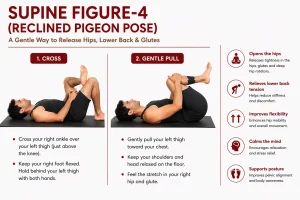
Target: Deep hip rotators, piriformis, outer glutes | Hold: 60 to 90 seconds each side
Here is where I am going to be direct with you. Traditional Pigeon Pose (Eka Pada Rajakapotasana) is not appropriate for beginners with stiff hips. When your hip rotators are tight, the pose puts serious rotational torque through the knee joint. It is one of the most common causes of yoga knee injury in beginner students.
Instead, lie on your back. Cross your right ankle over your left thigh just above the knee. Either stay here or gently draw both legs toward your chest. You get the same piriformis and deep hip rotator release with zero knee risk. This is what we actually teach in week one at Yoga New Vision.
10. Puppy Pose (Uttana Shishosana)
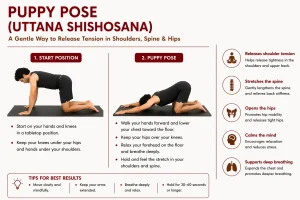
Target: Thoracic spine extension, shoulder girdle, chest | Hold: 45 to 60 seconds
Start on hands and knees, then walk your hands forward along the floor while keeping your hips directly above your knees. Let your chest melt toward the mat. This pose specifically addresses thoracic extension, which is the segment of the spine most people have lost completely from years of forward-hunched screen time.
Modification: Place a bolster or rolled blanket under your chest if it does not reach the floor comfortably.
11. Happy Baby Pose (Ananda Balasana)
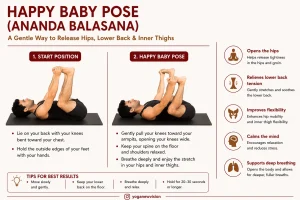
Target: Inner hips, sacrum, lower spine | Hold: 60 to 90 seconds
Lie on your back and draw both knees toward your chest. Hold the outer edges of your feet and let your knees fall wide toward your armpits. Rock gently from side to side. This is one of the few poses that decompresses the sacrum and opens the inner hips at the same time.
Modification: Hold the backs of your thighs instead of your feet if the full expression is not accessible yet.
12. Legs Up the Wall (Viparita Karani)
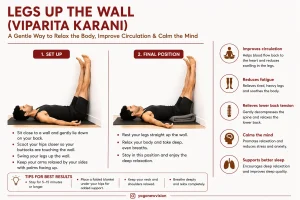
Target: Passive hamstring lengthening, nervous system recovery | Hold: 3 to 5 minutes
Swing your legs up against a wall and lie flat on your back. This is a restorative yoga pose. You are not working. Your hamstrings lengthen passively under their own weight. Your nervous system downshifts out of stress mode. End every flexibility session with this pose. It is the one most students skip and the one that accelerates their progress the most when they actually do it.
Know When to Stop: The Safety Rule We Teach Every Student on Day One
Because yoga works directly with your physical body, this section is not optional reading.
There are two types of sensation in yoga, and you must know the difference. Muscle tension feels like a deep pulling or warming sensation in the belly of the muscle. This is safe and productive. Joint pain, nerve tingling, sharp sensations, or any electrical feeling down an arm or leg means you need to come out of the pose immediately.
This distinction matters most in forward folds (lower back), spinal twists (neck and upper back), and any pose with knee flexion. If you have existing joint injuries, herniated discs, or recent surgery, consult a physician before starting any yoga practice. Yoga Alliance safety guidelines for beginner practitioners
Your 4-Week Beginner Flexibility Plan
Three sessions per week of targeted breath-focused practice beats seven days of rushed, painful stretching every time. Here is the exact progression we use for new students at Yoga New Vision:
| Week | Phase | Duration & Frequency | Details |
| Week 1 | Foundation | 20 minutes · 3 days per week | Poses 1, 2, 3, 4, 7, and 12. Build body awareness before adding intensity. |
| Week 2 | Building | 25 minutes · 4 days per week | Add poses 5, 6, and 8. Extend hold times by 10 seconds on each pose. |
| Week 3 | Deepening | 25 to 30 minutes · 4 days per week | Add poses 9, 10, and 11. Focus on exhale-driven release rather than muscular effort. |
| Week 4 | Integration | 30 minutes · 4 to 5 days per week | Practice all 12 poses as one flowing sequence. Repeat the baseline test from the beginning of this guide. |
Most students in our Ubud beginner programs report a 2 to 4 inch improvement in forward fold reach and a visible drop in knee height during Butterfly Pose by the end of week 4.
How Long Before You See Real Flexibility Results from Yoga?
Most beginners notice a meaningful difference in 3 to 4 weeks with three sessions per week. Research on yoga and range of motion training supports a window of 4 to 8 weeks for measurable flexibility gains.
The students in our Ubud studio who improve fastest share exactly one habit: they exhale fully at the deepest point of every hold instead of holding their breath and bracing. That single habit is what separates slow progress from fast progress.
Frequently Asked Questions
-
Can you do yoga if you are not flexible at all?
Yes, absolutely. Flexibility is not a requirement for yoga. It is the outcome. Poses like Child’s Pose, Cat-Cow, and Legs Up the Wall require almost no baseline mobility. At Yoga New Vision, we welcome students who have never exercised before. Starting from zero is not a disadvantage. It is simply a starting point.
-
How many times a week should a beginner do yoga for flexibility?
Three sessions per week of 20 to 25 minutes each is the most effective starting point for beginners. Daily practice is not necessary and can cause fatigue in the early weeks. Consistent practice over two to three months produces far greater flexibility gains than short bursts of intense daily effort.
-
How long should I hold yoga poses for flexibility as a beginner?
Most standing and seated poses should be held for 30 to 60 seconds. Restorative poses like Legs Up the Wall can be held for 3 to 5 minutes. Holding a pose for the correct duration with steady nasal breathing produces more lasting flexibility change than cycling rapidly through many positions.
-
Is yoga better than static stretching for improving flexibility?
Yoga is more effective for most people because it trains the nervous system alongside the muscles. Static stretching only addresses tissue length. Yoga’s combination of dynamic movement, sustained holds, and breath regulation signals muscular release at the neurological level, creating flexibility gains that are more sustainable over time.
-
What is the safest yoga pose for someone with extremely stiff hips?
Supine Figure-4 (Reclined Pigeon) is the safest choice. Performed lying on your back, it removes all compressive load from the hip joint while effectively targeting the deep hip rotators and piriformis. It provides the same benefit as traditional Pigeon Pose with zero torque on the knee, making it ideal for beginners.
-
Which yoga poses are best for tight hamstrings as a beginner?
Standing Forward Fold (Uttanasana), Seated Forward Fold (Paschimottanasana), and Legs Up the Wall (Viparita Karani) are the three most effective hamstring openers for beginners. Always maintain a soft bend in the knees to protect the tendons at the back of the knee during the early weeks of practice.
-
Should I do Yin yoga or Hatha yoga for flexibility as a beginner?
Both work but target different tissues. Hatha yoga builds body awareness and strength alongside flexibility through dynamic movement. Yin yoga targets connective tissue and fascia through long passive holds. Start with Hatha in weeks one and two, then layer in one Yin session per week from week three onward.
-
What is the difference between muscle tension and pain in yoga?
Muscle tension is a deep pulling or warming sensation in the center of the muscle. This is normal and means the pose is working. Pain is sharp, electrical, joint-focused, or accompanied by tingling in the limbs. If you feel anything in the joint itself or a nerve-like sensation, exit the pose immediately.
-
Can people over 50 improve their flexibility with yoga?
Yes, research consistently shows that adults over 50 respond well to yoga-based flexibility training. Connective tissue adapts more slowly than muscle tissue, so hold times should begin conservatively at 20 to 30 seconds and increase gradually. Restorative poses like Supine Twist and Legs Up the Wall are especially effective for this age group.
-
Do I need a teacher to learn beginner yoga poses for flexibility safely?
You can learn the foundational poses safely from a well-structured guide. A certified teacher, however, catches alignment errors that cause injury over time, particularly in Downward Dog, Low Lunge, and spinal twists. If you are near Ubud, Bali, we welcome you to visit Yoga New Vision for a beginner assessment class.
Written by Deep Yoga, Founder and RYT-500 Lead Instructor at Yoga New Vision, Ubud, Bali. Yoga New Vision specializes in 200-hour and 300-hour Yoga Teacher Training programs in Bali, as well as beginner immersive retreats for international students. Visit us at yoganewvision.com or contact our team at https://yoganewvision.com/contact-us/.