Table of Contents
ToggleYoga, “The Path to Samadhi: The Journey Through All Stages of Inner Stillness”
By Deep Kumar | Yoga Mitra, ERYT-500 | Founder, Yoga New Vision | Trained at Kaivalyadhama Yoga Institute | 16 Years Teaching in Bali, India, and Malaysia
Samadhi is the eighth and final limb of Patanjali’s Yoga Sutras. It is the state where the mind stops its constant movement, the individual self dissolves into pure awareness, and what remains is complete, undisturbed inner stillness. It is not a trance. It is not an escape from life. It is the most awake you will ever be.
I have been teaching yoga since 2009. Across 15,000 students at our shala in Ubud and in programs across India and Malaysia, I have watched people transform. I have also watched a large number of genuinely sincere practitioners meditate for years without ever touching the edge of Samadhi. That observation is what this post is really about.
What Samadhi Actually Means
The word Samadhi comes from two Sanskrit roots. “Sama” means equal or balanced. “Dhi” means to see or to hold. Samadhi is not becoming blissful. It is learning to see without distortion.
[External Link: Yoga Sutras of Patanjali, Swami Satchidananda commentary] In Sutra 1.2, Patanjali defines yoga as “Yogas citta vrtti nirodhah.” Yoga is the cessation of the fluctuations of the mind. That cessation is the doorway. Samadhi is what lives behind that door.
Most people think of Samadhi as something rare, mystical, and reserved for monks in Himalayan caves. That is not what Patanjali teaches and it is not what I have seen in practice. Samadhi is the natural state of consciousness when the noise of the mind finally gets quiet enough.
The Eight Limbs Are a Single Continuous Path
Many students treat yoga as a physical practice with an optional meditation add-on. That misunderstanding is the reason most people never move beyond Dhyana, no matter how many years they meditate.
Patanjali’s Ashtanga framework, the Eight Limbs, is not a menu of options. It is a sequential architecture. Yama and Niyama establish the ethical and personal ground. Asana steadies the body. Pranayama regulates the nervous system. Pratyahara withdraws the senses inward. Dharana focuses the mind. Dhyana sustains that focus into an unbroken flow. Samadhi is what that flow becomes when the observer and the observed stop being two separate things.
Skipping limbs is like trying to build a ceiling before you have walls. The body work is not separate from the spiritual work. It is the foundation for it.
Why Your Biomechanics Affect Your Inner Stillness
This is the part most yoga philosophy teachers will not tell you. You cannot meditate your way into Samadhi if your physical body is working against you.
When a student sits in a posture that collapses at the lumbar spine, the diaphragm compresses. Breathing becomes shallow and restricted. Shallow breathing directly stimulates the sympathetic nervous system, which is your body’s fight-or-flight state. You are asking the mind to become still while the body is running a low-grade emergency signal through the autonomic nervous system.
This is why at Yoga New Vision, we use the Alexander Technique alongside Asana practice. We use Buteyko Breathing to teach students how to shift respiration rate from 15 to 20 shallow breaths per minute down to 6 to 8 slow, diaphragmatic breaths. Research on heart rate variability shows that slow, nasal breathing significantly activates the parasympathetic nervous system. [External Link: Heart Rate Variability and Breath Research, PubMed] That activation is the physiological preparation that makes the inner stages of yoga possible. Citta Vritti Nirodha, the cessation of mental fluctuations, does not happen in a dysregulated nervous system. Vagal tone matters.
The Gateway: Dharana, Dhyana, and the Samyama Sequence
Dharana is concentration. You select a single point of focus. A flame. A mantra. The breath. You hold the mind there. Every time it wanders, you bring it back. This is not meditation yet. This is the training.
Dhyana is what happens when Dharana stops requiring effort. The mind no longer fights to stay with the object. It rests there naturally, like a river finding its own bed. This unbroken flow is what most Western practitioners call “deep meditation.”
The transition from Dhyana into Samadhi is the moment the distinction between the meditator, the act of meditating, and the object of meditation collapses into one. Patanjali calls the practice of these three together Samyama.
The Stages of Samadhi in Yoga
This is the section most blogs give you in a confusing pile of Sanskrit terms. I will walk through them the way I walk my students through them. One stage at a time.
Savitarka Samadhi
This is the first stage of Samprajnata Samadhi, which means cognitive absorption. The mind becomes fully absorbed in a gross object of meditation. A name, a shape, a concept. You know what the object is, you know its qualities, and yet you are no longer easily disturbed by outside stimuli. Most practitioners who have a strong Dharana practice have touched this state without knowing it had a name.
Nirvitarka Samadhi
The same object. But now the mind no longer engages its name or its conceptual qualities. The object is present, but the internal commentary about it has stopped. The Default Mode Network, the brain’s self-referential chatter system, begins to go quiet here. Neuroscientific research on advanced meditators shows measurable reductions in Default Mode Network activity in states corresponding to this stage. [External Link: Default Mode Network and Meditation Research, Nature Reviews Neuroscience]
Savichara Samadhi
The object of concentration shifts from gross to subtle. Instead of a physical form, the mind rests on the energy, the quality, the essence beneath the form. The mind is still engaged in a kind of refined analysis. But the quality of that engagement is much quieter than ordinary discursive thought.
Nirvichara Samadhi
The subtle analysis dissolves. What remains is pure awareness of the subtle object, without any reflection or discernment happening on top of it. Prajna, wisdom arising from direct perception rather than reasoning, begins to arise naturally in this state. This is the stage where I see experienced students at our 300-hour training begin to describe experiences they cannot fully articulate. That is a reliable sign of this state.
Sa-Asmita Samadhi
Only the “I am” remains. Not the ego with its stories and preferences. Just the pure sense of existence itself, without content. The Antahkarana, the inner instrument of mind, intellect, and ego, is still present in the subtlest form. But it is no longer directing the show.
Sabija Samadhi (Samadhi With Seed)
Everything above is Sabija Samadhi, which means Samadhi with a seed. A seed because the impressions of individuality, called Samskaras, are still present even if they are not active. The experience is real and profound. But it does not permanently alter consciousness. The practitioner returns to ordinary awareness when the meditation session ends.
Nirbija Samadhi (Samadhi Without Seed)
The seed is gone. The Samskaras are no longer capable of generating the experience of separation. The meditator and pure consciousness are not two things temporarily merged. They are recognized as having always been one. This is Asamprajnata Samadhi. It is not achievable by trying harder. It is what happens when the trying itself stops.
Dharma Megha Samadhi
Patanjali describes this as the cloud of virtue that descends just before Kaivalya, final liberation. The yogi has released even the desire for enlightenment. What remains is pure discriminative awareness, Viveka Khyati, knowing the real from the unreal without any personal agenda around that knowing.
Kaivalya
Absolute aloneness. Not loneliness. The original state of pure consciousness, unconditioned by matter, time, or experience. This is the culmination of the yogic path as Patanjali describes it.
Savikalpa, Nirvikalpa, and Sahaja: The Three Great Categories
The Patanjali taxonomy above is precise and technical. The broader tradition, particularly the teachings of Sri Ramana Maharshi and Sri Chinmoy, organizes Samadhi into three primary states.
Savikalpa Samadhi is the experience of unity with pure consciousness. The individual self merges temporarily with the infinite. But it cannot be maintained outside of formal meditation. It is like catching a glimpse of the ocean through a gap in the trees.
Nirvikalpa Samadhi is the complete dissolution of the individual self into pure awareness. There is no meditator. There is no object. There is no separation between the knower, the knowing, and the known. Nature itself becomes still.
Sahaja Samadhi is by far the most significant for everyday life. “Sahaja” means natural or effortless. In this state, the yogi moves through ordinary daily activity, speaking, eating, teaching, walking through a busy Ubud market, while remaining entirely rooted in pure inner stillness. The external world is fully engaged. The inner state never wavers.
The Mistake Most Sincere Practitioners Make
I want to say this plainly, because I have seen it derail too many good students.
Chasing Samadhi is the exact thing that prevents Samadhi. This is not a paradox for its own sake. It is a direct description of how the mechanism works. Treating Samadhi as a goal to achieve strengthens Asmita, the sense of a separate “I” that wants to accomplish something. That very sense of separateness is the obstacle Samadhi dissolves. You cannot achieve your way out of a state that is caused by believing you have something to achieve.
Vairagya, non-attachment, is not a nice-to-have alongside your meditation practice. It is the actual vehicle. The practitioner who has genuinely released the need to reach enlightenment is much closer to it than the one who sits for three hours every morning counting their meditation minutes.
In 16 years of teaching, the students who have most clearly touched the edges of deep meditative absorption were not the most effortful ones. They were the ones who became most comfortable with not knowing. That comfort is Vairagya in practice.
What Samadhi Actually Feels Like
I want to correct one more widespread misunderstanding. Samadhi is not a dreamy, floaty, dissociative state. Pop culture has given most people a picture of bliss as a kind of pleasant spacing out. That is almost the opposite of what practitioners report.
What students and masters across traditions describe is an acute, high-definition quality of awareness. A sharpening, not a softening. The sense of self drops away, but perception itself becomes cleaner and more present. B.K.S. Iyengar wrote in Light on Life that Samadhi is “a state of being intensely present without a point of view.” That description is precise.
Samadhi is not leaving the world. It is finally seeing the world without the filter of the thinking mind getting between you and it.
How We Teach This at Yoga New Vision
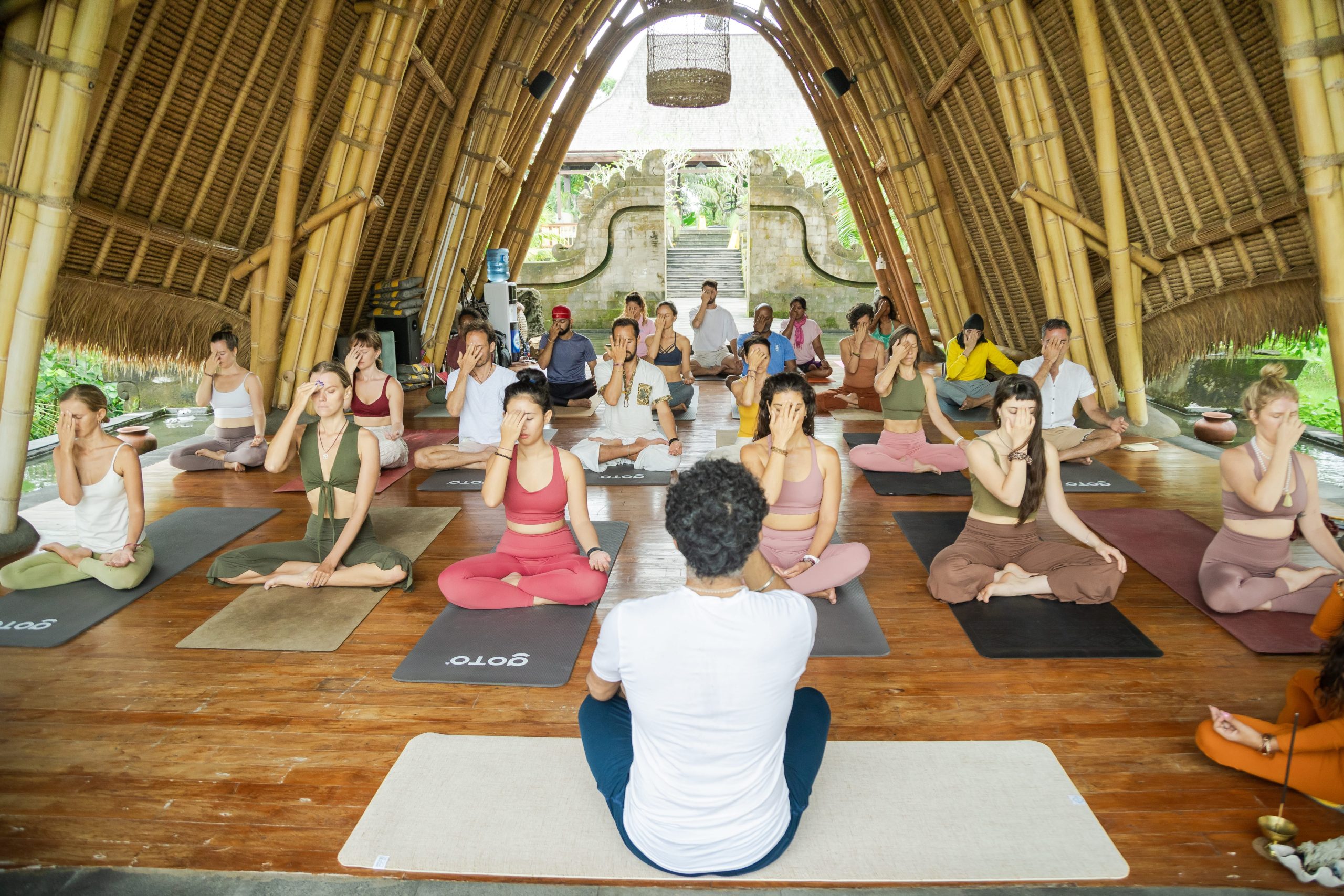
Our 200-hour and 300-hour programs in Ubud are built on exactly this bridge between ancient Indian Yogic wisdom and the evidence base of Western science. We do not treat philosophy as an intellectual exercise and Asana as a physical one. They are one practice.
The physiological preparation matters. Buteyko Breathing trains the respiratory system to shift into a state where deep meditation is actually accessible, not just theoretically possible. The Alexander Technique corrects the postural and biomechanical patterns that keep the nervous system in a low-grade alert state. Physio Yoga Therapy addresses the physical holding patterns that prevent the body from becoming a stable, quiet vessel. [Internal Link: 200-Hour Yoga Teacher Training in Bali]
If you want to understand the path to Samadhi not as a concept but as a lived experience, we would love to speak with you.
Book your free 15-minute call with our team at Yoga New Vision. We have trained 15,000 students since 2009. Voted the Most Authentic YTT in Bali by Global Gallivanting. We are not here to sell you a course. We are here to show you the path.
Frequently Asked Questions About Samadhi
1. What is the difference between Dhyana and Samadhi?
Dhyana is an unbroken flow of concentration toward a single object. Samadhi is what that flow becomes when the separation between the meditator, the meditation, and the object collapses completely. Dhyana requires effort. Samadhi is the dissolution of the one who was making the effort. One is the river. The other is the ocean the river empties into.
2. How many stages of Samadhi are there according to Patanjali?
Patanjali describes multiple stages within two primary categories. The first is Samprajnata (Sabija) Samadhi, which includes Savitarka, Nirvitarka, Savichara, Nirvichara, and Sa-Asmita stages. The second is Asamprajnata (Nirbija) Samadhi, leading through Dharma Megha Samadhi to Kaivalya. Most teachers summarize this as eight to ten distinct stages.
3. Is Samadhi the same as enlightenment?
Samadhi and enlightenment are related but not identical. Savikalpa and Nirvikalpa Samadhi are temporary states, however profound. Kaivalya, the permanent and irreversible stabilization of pure consciousness, is what most traditions mean by enlightenment. Sahaja Samadhi, where the state is effortlessly maintained during all daily activity, is the closest functional equivalent.
4. Can a beginner experience any state of Samadhi?
Yes. The earliest stages of Samprajnata Samadhi, particularly Savitarka, are accessible to anyone with a consistent Dharana practice. What is required is a stable, regulated nervous system and genuine one-pointed attention, not years of advanced study. Many practitioners touch these states without recognizing them because they lack a framework for what they just experienced.
5. What is the difference between Savikalpa and Nirvikalpa Samadhi?
In Savikalpa Samadhi, the meditator experiences unity with pure consciousness but retains a subtle seed of individuality. The experience cannot be sustained outside formal meditation. In Nirvikalpa Samadhi, that seed dissolves. There is no observer and no observed. The state is total absorption into pure awareness with no trace of the separate self remaining.
6. What is Sahaja Samadhi and why does it matter?
Sahaja means natural or effortless. Sahaja Samadhi is the state where pure inner stillness is maintained naturally during all ordinary daily activities, without requiring a formal meditation session to access it. It is considered the highest form of Samadhi because it requires no withdrawal from the world. A master in Sahaja Samadhi is fully present in activity, not despite the state but within it.
7. What is Kaivalya in yoga?
Kaivalya is the final destination of Patanjali’s path. The word means aloneness or absolute independence. It is pure consciousness resting in itself, no longer conditioned by matter, memory, or experience. Kaivalya is not emptiness. It is the recognition that consciousness was always free, and the work of yoga was simply removing what obscured that recognition.
8. How long does it take to reach Samadhi?
There is no single answer. In 16 years of teaching 15,000 students, I have seen practitioners touch the early stages of meditative absorption within weeks of consistent practice. Nirvikalpa Samadhi is rare and typically requires years of dedicated practice in a supportive environment. Chasing a timeline actively delays the result. Consistency and non-attachment to outcome are the actual accelerants.
9. What role does breath play in reaching Samadhi?
Breath is the direct bridge between the voluntary and involuntary nervous systems. Slow, nasal, diaphragmatic breathing activates the parasympathetic nervous system, lowers sympathetic arousal, and increases vagal tone. This physiological shift is what makes the mind genuinely available for Dharana and Dhyana. Without regulation of the breath, Citta Vritti Nirodha remains a beautiful concept and not an experience.
10. Does studying yoga philosophy help you reach Samadhi faster?
Understanding the map matters, but only to a point. Knowing the Sanskrit terms for every stage of Samadhi does not move you toward Samadhi. Consistent practice, a regulated nervous system, Vairagya, and sustained Dharana do. Philosophy gives you a framework to recognize what you are experiencing when it occurs. The practice itself is what creates the conditions for experience.
By Deep Kumar | Yoga Mitra, ERYT-500 | Founder, Yoga New Vision, Ubud Bali Training Since 2009 | 15,000+ Graduates | Yoga Alliance RYS 200 and RYS 300 Voted Most Authentic YTT in Bali by Global Gallivanting