Table of Contents
ToggleWhen’s the Best Time to Do Your YTT in Bali?
By Deep Kumar | Founder, Yoga New Vision | Updated June 2026
Reading Time: Approximately 12 minutes
I have been running yoga teacher trainings in Ubud since 2009. In that time, I have welcomed students who arrived in January with soaking wet luggage and students who arrived in July with perfect Instagram tans. Both batches produced brilliant teachers. But here is what I have also seen: students who chose the wrong month for their personality, their budget, or their practice goals. And it made a hard journey significantly harder.
So let me give you the honest answer that most websites won’t. The best time to do your YTT in Bali is not simply about avoiding rain. It is about matching the island’s energy to your own.
The Short Answer (For the Ones Who Scrolled Straight Here)
The best time to do a Yoga Teacher Training in Bali is during the dry season, from May to September, when temperatures stay between 25 and 30 degrees Celsius and outdoor practice conditions are genuinely comfortable. If you want the ideal balance of great weather, smaller class sizes, and lower costs, May, June, and September are the three months I recommend above all others.
If budget is your priority, January and February are your best friends. If a profound spiritual experience matters most to you, plan around Bali’s sacred calendar. I will explain all of this below.
Why Timing Your YTT in Bali Is About More Than Weather
Most articles on this topic treat Bali like a beach destination. Check the rainfall chart, pick a sunny month, book your flight. That is fine for a holiday. A yoga teacher training is something else.
Bali is not just a location. It is a living spiritual ecosystem. The Balinese philosophy of Tri Hita Karana, which describes harmony between people, nature, and the divine, is not a concept locals talk about at dinner. It is woven into the streets, the offerings left on doorsteps every morning, the sound of gamelan drifting from temple courtyards at dusk.
When you train here at Yoga New Vision Ubud, you are not studying yoga in a nice setting. You are studying it inside a culture that has been practicing its own version of yoga for centuries. That matters when you pick your month.
Bali Has Two Seasons and One Personality
The island runs on two climatic rhythms: the dry season (May to September) and the wet season (October to April). Unlike four-season countries, Bali does not swing between extremes. The temperature stays warm year-round. What changes is humidity, rainfall, crowd density, and the island’s spiritual calendar.
Understanding those four variables together is how you pick the right month.
How the Island’s Energy Shifts Between Seasons
I have practiced in every month Bali offers. The dry season has a social, outward-facing energy. The town is fuller, the cafes are louder, and the yoga community is visibly buzzing. For some students, that community fuel is exactly what gets them through the hard weeks.
The wet season is quieter, more inward. Ubud shrinks back into itself. Rice paddies deepen to an almost absurd shade of green. There is something about practicing pranayama in a tropical downpour that strips away every distraction you brought with you from home.
Neither is better. They are genuinely different experiences.
The Dry Season (May to September): Prime Conditions, Real Decisions
The dry season is when most students want to come. And honestly, for physical practice, it earns its reputation.
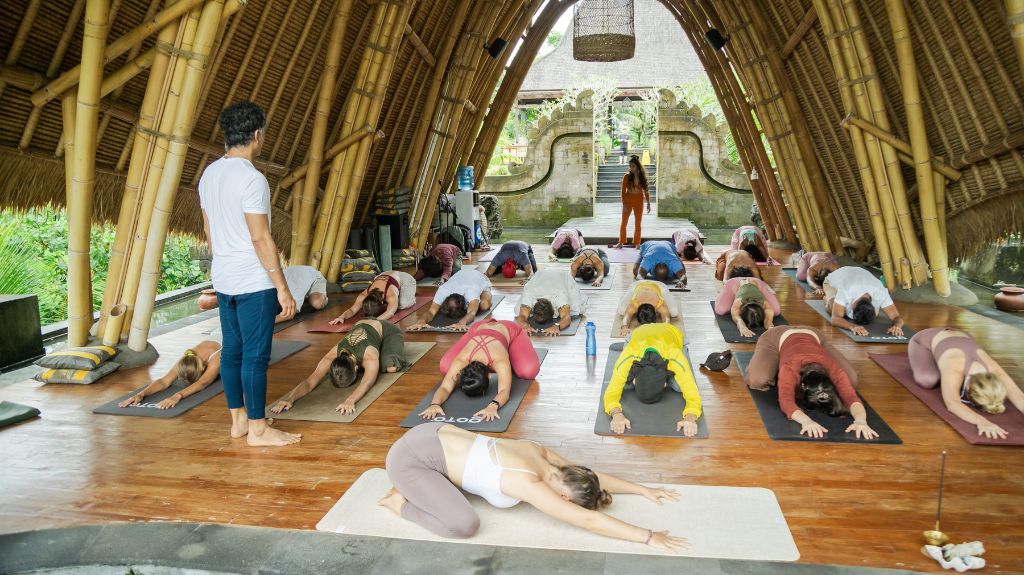
Temperatures sit around 25 to 30 degrees Celsius. Humidity drops noticeably. Our outdoor shala at The Mansion Resort Ubud is at its best in these months, catching the morning light across the rice fields before practice even begins. If you love outdoor yoga and you want conditions that support long, intense practice days, May through September delivers.
What the Bali Dry Season Actually Feels Like on the Mat
The air is lighter. Breath work is easier. Your body moves without the sticky resistance that humid air creates. Students who arrive during the dry season often tell me their asana practice accelerates faster in the first week than it has in months at home.
That is not magic. It is simply the physical reality of practicing in cool, dry air with a consistent daily schedule, good food, and no work emails.
The Sweet Spot: May, June, and September
July and August are the absolute peak of tourist season in Bali. The roads in Ubud slow to a crawl. Accommodation prices at every level jump noticeably. Our 200 Hour YTT Bali batches fill earliest in those two months, consistently.
May, June, and September give you the dry season conditions without the full peak-season chaos. The weather is essentially the same. The island is calmer. You can actually walk to a warung for dinner without navigating around three tour groups.
I personally find September to be one of the most beautiful months in Ubud. The dry season is wrapping up, the energy is mellowing, and there is a golden quality to the late afternoons that I have never quite seen in any other month.
If You Must Train in July or August
Book early. Seriously. Our July and August batches are typically the first to reach capacity each year. Yoga Alliance School Profile for Yoga New Vision shows our registration history and you will see the pattern clearly. If those are the only months you can travel, commit four to six months ahead.
The Wet Season (October to April): The Hidden Advantage
Here is what the generic travel content does not tell you: the wet season in Bali is one of the best times to go deep in your practice. Not despite the rain. Sometimes because of it.
The rain rarely falls all day. More typically, the sky opens for an hour or two in the afternoon and then clears. Morning practices are usually untouched. By the time you finish your anatomy lecture and your teaching methodology session, the downpour has passed and the garden is dripping and silent.
What Rainy Season Practice Actually Does to Your Yoga
High humidity does something real to the body in yoga. Joints warm up faster. Fascia softens more readily. Students often report that their flexibility progresses faster in wet season months than in dry months, and there is physiological backing for this Research on heat and connective tissue flexibility.
It is also worth noting: if you are planning to teach yoga in Southeast Asia, South Asia, or any tropical climate after your training, learning to practice in humidity is a genuine professional skill. You will understand your future students’ bodies in a way that someone trained in an air-conditioned studio in London simply does not.
January and February: The Most Affordable, Most Introspective Months
These are the two quietest months in Bali’s tourism calendar. They are also two of the rainiest. And they are my personal recommendation for students who are coming to do serious inner work, not just to collect a certification.
200 Hour YTT Program Dates shows our January and February batches typically have the smallest class sizes of the year. That means more direct time with teachers, more personalized feedback, and a slower, more careful pace through the curriculum.
Tuition and accommodation rates run 15 to 25 percent lower in these months compared to peak. If you are budget-conscious and practice-focused, this is your window.
How to Handle the Wet Season Without Losing Your Mind
Train at a school with covered indoor practice spaces. This is non-negotiable. At Yoga New Vision, our indoor shala means that a rainstorm does not rearrange your day. Check this before you book anywhere.
Stay hydrated constantly. The humidity pulls sweat out of you faster than you realize. Keep a 1.5 liter bottle beside your mat from day one.
And let the rain be part of the experience. Some of the most powerful savasanas I have ever guided happened during heavy tropical rain on a tin-roofed shala. That sound does something to people.
Bali’s Spiritual Calendar: The Factor Nobody Talks About
This section will not appear on most YTT comparison sites because most of those sites are written by people who visited Bali once, found it beautiful, and then wrote about it from a laptop in Europe. I have been here for over fifteen years. So let me tell you what actually matters on Bali’s spiritual calendar and how it affects your training.
Nyepi: The Day of Silence
Nyepi is the Balinese New Year. It falls in March, with the exact date shifting each year according to the Saka calendar. For 24 hours, the entire island stops. No vehicles on the road. No flights in or out of Ngurah Rai International Airport. No lights visible from outside. No noise.
If your training overlaps with Nyepi, you do not leave your accommodation. That is the rule. But here is what I want you to understand: for a yoga student, this is one of the most extraordinary experiences available on earth. A full day of enforced silence, no technology, no movement outside, nothing but your own breath and your practice. We incorporate Nyepi into our March curriculum as a full meditation immersion day.
Students who have trained through Nyepi consistently describe it as the single most transformative 24 hours of their teacher training. Plan around it deliberately, not accidentally.
Galungan and Kuningan
Galungan is the Balinese festival celebrating the victory of dharma over adharma, repeating every 210 days on the Balinese Pawukon calendar. The island transforms. Tall bamboo poles called penjor line every road, decorated with offerings. Temples fill with ceremony. The air itself feels different.
If your training falls during a Galungan fortnight, you will witness daily cultural immersion that no excursion or workshop could manufacture. Check the Galungan dates for the year you are planning to travel. Training through it is a gift, not a complication.
Month-by-Month: The Yoga New Vision Breakdown
This is the section I wish someone had handed me when I was planning my own first extended time in Ubud.
January and February
Lush, green, and quiet. These are introspective months. The island is emptier than you have ever seen it in any Instagram photo. Prices are lower. Classes are smaller. If you are going through a major life transition and you chose YTT as part of that, January and February hold a particular kind of space for that work.
March
The transition month. Rain is still frequent in early March. Nyepi falls here, which makes it one of the most spiritually charged months on the calendar. If you can time your training to include Nyepi, do it.
April
The shoulder season is beginning. Weather is improving. Prices have not yet jumped to peak rates. April is a genuinely underrated month that experienced students often discover on their second or third trip.
May and June
My top recommendation for most students. The dry season has established itself. The island is not yet flooded with peak-season visitors. Energy is fresh and focused. Our May and June YTT Bali Batch Dates typically have a strong international mix and excellent learning conditions.
July and August
Peak season, full stop. The weather is excellent. The energy is high and social. You will meet a lot of people. Classes fill to capacity. Book early or you will miss the dates you want. Not a bad time to train, just a busier one.
September
Possibly my favorite month in Ubud. The light changes in September. The dry season is reaching its end. The tourist numbers are starting to ease. There is a golden, contemplative quality to September that supports practice beautifully.
October and November
The rains return in October. November can be quite wet. These months suit students who do not mind some disruption to outdoor plans and who prioritize the quieter, more inward experience of wet season training.
December
December is interesting. It has a festive atmosphere driven by Western travelers, but it is also genuinely beautiful in Bali. Christmas and New Year bring a spike in tourists and prices. If you train in early December rather than the last two weeks, you get a pleasant, moderately quiet experience with good weather still present in the early part of the month.
Choosing Your Timing Based on Your Actual Goals
If You Want Optimal Weather for Physical Practice
Train in May, June, or September. These are the months where intensive asana practice is physically easiest and outdoor sessions are most reliable.
If You Are on a Tight Budget
January or February at Yoga New Vision YTT Pricing will give you the best combination of affordable tuition, lower accommodation costs, and smaller class sizes.
If Spiritual and Cultural Immersion Matters Most
Time your arrival to include Nyepi in March or train during a Galungan fortnight. These are experiences that reshape how you understand Balinese yoga culture at a foundational level.
If You Are a Complete Beginner to Yoga
Avoid July and August for your first YTT. The peer pressure of being surrounded by more experienced students in large peak-season batches can be discouraging. A quieter month lets you build confidence without comparison.
Practical Planning: What You Need to Know Before You Book
How Far in Advance Should You Book at Yoga New Vision
For May, June, July, August, and September batches: four to six months minimum. For October through April batches: two to three months is generally sufficient, though earlier is always better for accommodation selection.
Visa Requirements for Bali (2026)
Most nationalities can enter Indonesia on a Visa on Arrival (VoA) at Ngurah Rai International Airport. This allows a 30-day stay and can be extended once for another 30 days, giving you 60 days total. For our standard 200 Hour YTT Program at 23 days, a single VoA is sufficient. Check current requirements at Indonesian Immigration Official Site as visa policies can shift.
What Is Included in YNV Training Fees
Our fees cover tuition, course materials, daily meals, accommodation at The Mansion Resort, and your Yoga Alliance certification fees. Airport pickup and one massage session are also included. What is not included: flights, personal expenses, and Sunday meals when we give you a genuine rest day.
A Final Note from Me
I started Yoga New Vision because I genuinely believe yoga changes lives. Not as a slogan. As something I have watched happen a few thousand times in person.
The right time to do your YTT is the time you actually commit to showing up. I have seen students turn down their ideal month because of work schedules and then train in the “wrong” season and have the most powerful experience of their lives. The island will meet you wherever you arrive.
That said, give yourself the best possible conditions. Use this guide to pick a month that aligns with your body, your budget, and the kind of transformation you are actually ready for.
If you have questions about which batch is right for you, Schedule a Free 15-Minute Call with the YNV Team. That conversation is free and genuinely useful.
See you on the mat in Ubud.
Deep Kumar Founder, Yoga New Vision | E-RYT | Training since 2009 | About Deep Kumar
Frequently Asked Questions
1.What is the single best month to do a YTT in Bali?
May, June, and September consistently stand out as the strongest months at Yoga New Vision. You get dry season weather conditions without the full intensity of peak-season crowds in July and August. Class sizes are balanced, the Ubud atmosphere is focused, and accommodation pricing stays reasonable. Most experienced students land on one of these three months.
2.Is it worth doing a YTT in Bali during the wet season?
Yes, for the right student. The wet season runs roughly October through April and brings lower costs, smaller class sizes, and a quieter atmosphere for deep inner work. High humidity can actually improve flexibility during asana practice. If budget is a priority or you prefer introspective training over social energy, the wet season delivers real value.
3.How does Bali’s humidity affect yoga practice during a YTT?
Humidity accelerates the warming of joints and softens connective tissue, which supports deeper flexibility work. The challenge is stamina: practicing in high humidity raises your heart rate faster and increases fluid loss. Staying well hydrated and scheduling early morning sessions when humidity is lower makes a meaningful difference in how your body adapts.
4.What is Nyepi and should I time my YTT around it?
Nyepi is the Balinese Day of Silence: a 24-hour island shutdown in March with no travel, no noise, no lights. For yoga students, this enforced silence becomes a full-day meditation immersion unlike anything else. At Yoga New Vision, we build it into our March curriculum deliberately. Students consistently describe it as the most transformative single day of their training.
5.Are YTT programs in Bali available all year round at Yoga New Vision?
Yes. Yoga New Vision runs monthly batches of the 200 Hour YTT program throughout the year. Availability varies by month, with July and August batches filling earliest. January and February typically have the most open spots. Checking current available dates on the YNV booking page and enrolling with a deposit secures your place for any season.
6.How much cheaper is a YTT in Bali during the off-peak season?
YTT tuition at most schools in Bali, including Yoga New Vision, can run 15 to 25 percent lower during off-peak months like January, February, and November compared to July and August rates. Accommodation and local costs also drop in these periods. For budget-focused students, the savings across tuition and living expenses can be quite significant over a 23-day training.
7.What visa do I need for a yoga teacher training in Bali?
Most nationalities enter Indonesia on a Visa on Arrival (VoA), valid for 30 days and extendable once for an additional 30 days. This covers the duration of our 23-day YTT programs with time to spare. Check current visa regulations at the official Indonesian immigration website before travel, as policies can change. Some nationalities may require advance visa applications.
8.How does Bali’s spiritual calendar affect the YTT experience at Yoga New Vision?
Bali’s Hindu calendar includes major festivals like Galungan, Kuningan, and Nyepi that shift the island’s energy and daily rhythms. Training during these periods adds cultural immersion that cannot be manufactured through workshops or excursions. At Yoga New Vision, we integrate relevant festival context into the curriculum whenever our batches coincide with significant dates on the Balinese calendar.
9.Is July or August a bad time to do a YTT in Bali?
Not a bad time, but a demanding one logistically. Peak tourist season means higher costs, busier roads, and fuller programs across all schools. The weather is excellent. If July or August are your only realistic travel windows, book four to six months ahead to secure your preferred program and accommodation. The training itself is equally strong in these months.
10.What should a beginner yogi consider when choosing their YTT month in Bali?
Beginners benefit most from months with smaller class sizes, which allows more personal teacher attention and a less pressured learning environment. January, February, April, and September tend to offer this. Avoid July and August as a first-time student if possible. The social intensity of peak-season batches, while energizing for some, can amplify self-comparison anxiety for those new to the practice.
Yoga New Vision | 200 Hour and 300 Hour YTT Bali | Yoga Alliance Registered | Training Since 2009 | Ubud, Bali, Indonesia
Featured in Om Yoga Magazine (London) as the Most Authentic 200 Hour YTT | Voted Most Authentic YTT in Bali by Global Gallivanting