“From Asana to Shavasana” maps the complete arc of a yoga practice. Asana (aas + na) means “stable seat,” the point where conscious effort begins. Shavasana (shava + asana) means the practice of conscious surrender, the point where effort dissolves completely. Every Sanskrit term between these two is a doorway pointing in one direction: inward.
I am Deep Kumar, founder of Yoga New Vision in Ubud, Bali. I have been teaching yoga for sixteen years, across four schools, on three continents.
And in every training, without exception, the conversation that changes most for students is this one: what do these words actually mean?
Sanskrit Is Not Just an Old Language. It Is a Precise One.
Sanskrit is approximately 3,500 years old. It is also the most structurally exact language ever developed for describing human inner experience. When Patanjali composed the Yoga Sutras, he chose Sanskrit because no other language had the vocabulary to separate “concentrating” from “meditating.” Dharana and Dhyana are not synonyms. In Sanskrit, they cannot be confused.
That precision is what gets lost when yoga becomes purely English. “Pose” is a shape. “Asana” is a relationship.
How Sanskrit Yoga Terms Are Built: The Root System
Here is what most yoga glossaries skip entirely: Sanskrit works by combining roots. Once you know the roots, you can read nearly any pose name without memorizing each one by itself.
Adho means downward. Mukha means face. Svana means dog. String them together and Adho Mukha Svanasana tells you exactly what the pose looks like before it is demonstrated. This is not a quirk of the language. It is the design.
Seven roots that decode roughly forty pose names:
Asana: seat, to be seated Adho: downward Urdhva: upward Uttana: intense stretch Kona: angle Vrksa: tree Pada: foot
The Core Sanskrit Terms, Explained Without Fluff
Terms for Your Practice Space
Asana does not mean “pose.” Translating it that way is, in my opinion, a quiet mistranslation that costs practitioners a great deal. A pose is a shape you hold. A seat is a relationship you cultivate between your body, your breath, and the ground.
In my shala in Ubud, the moment a student truly hears this, their entire posture shifts without me touching them. Sixteen years of teaching and that moment still does not get old.
Vinyasa (vi = in a special way + nyasa = to place) is the intentional sequencing of movement through breath. In those same sixteen years, roughly 80% of students arrive thinking Vinyasa is a style of yoga. It is a principle: nothing on your mat should be accidental.
Drishti is a focused gazing point. It is not staring blankly at a wall. It is the practice of giving your eyes one object so your attention stops distributing itself across twenty different things at once.
Bandha (lock or bind) refers to the three primary muscular engagements: Mula, Uddiyana, and Jalandhara. They direct the flow of Prana through the body and change every pose you have ever practiced.
Mudra (seal or gesture) refers to hand and body positions that redirect internal energy. Anjali Mudra, pressing your palms together at your heart, is not just a greeting. It is a seal that draws your awareness inward the moment you use it.
Terms for Your Breath and Energy Body
Pranayama (prana = life force + ayama = extension) is the practice of breath as energy management. In our 200-Hour YTT in Bali, we teach Pranayama through traditional techniques (Kapalabhati, Nadi Shodhana, Bhramari) alongside Buteyko Breathing principles, which map how the nervous system responds to CO2 tolerance. The combination is unusual. It is also precise.
Prana is not oxygen. Prana is the life force that moves through you when you breathe, when you move, and when you are completely still. Every ancient yoga text draws this distinction with deliberate care.
Nadi means channel or river. The yogic anatomy describes 72,000 Nadis running through the subtle body, with three primary ones: Ida (lunar, left), Pingala (solar, right), and Sushumna (the central channel).
Chakra (cakra = wheel or circle) refers to the seven primary energy centers aligned along the spine. Each one governs a specific cluster of physical organs, emotional patterns, and spiritual qualities.
Terms for the Inner Journey
Dhyana (root: dhyai, to contemplate) is sustained, single-pointed meditation. In Patanjali’s eight-limb system, Dhyana is the seventh limb, reached only after Dharana (concentration). These two are not interchangeable: concentration is effort, meditation is what emerges when effort softens.
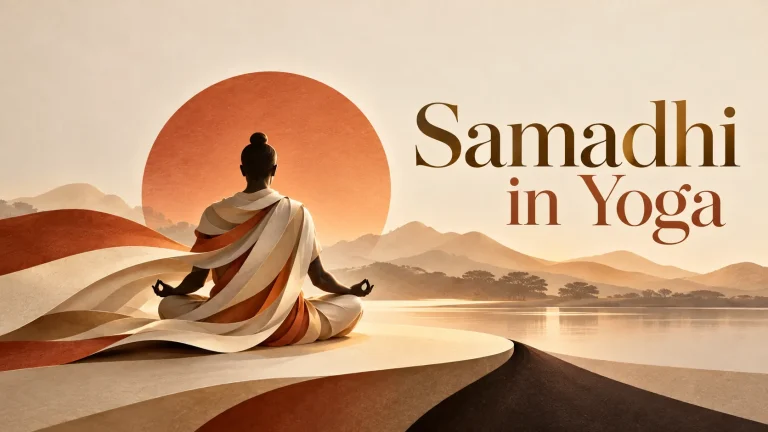
Samadhi is the eighth and final limb: complete absorption into the object of meditation. The root means “to place together.” It is the state in which subject and object stop feeling separate.
Sankalpa (sam = whole + kalpa = vow) is the heartfelt intention set at the start of practice. My co-founder Sadhana Om begins every training session with a Sankalpa practice. She calls it “deciding the direction of your inner weather before you step onto the mat.”
Ahimsa (non-violence) is the first of the Yamas, the ethical foundations of the Yoga Sutras. It applies to thought, speech, and action equally. Learning this term changed the way I teach physical adjustments.
Svadhyaya means self-study and personal inquiry. It is listed among the Niyamas, the personal observances. In practice, it means reading sacred texts and reading your own experience with the same quality of attention.
Sanskrit Pose Names: What the Words Actually Tell You
| English Name | Sanskrit Name | Root Meaning | What It Reveals |
| Mountain Pose | Tadasana | Tada = mountain | Stillness that is also strength |
| Downward Dog | Adho Mukha Svanasana | Downward facing dog | Full spinal decompression, not a rest |
| Warrior I | Virabhadrasana I | Virabhadra = fierce deity born from Shiva’s grief | A mythological origin, not a fitness cue |
| Warrior II | Virabhadrasana II | Same deity, expanded stance | Courage expressed outward toward the world |
| Tree Pose | Vrksasana | Vrksa = tree | Rootedness expressed vertically |
| Child’s Pose | Balasana | Bala = child | Inner retreat, not defeat |
| Cobra Pose | Bhujangasana | Bhujanga = serpent | Kundalini symbolism, the heart beginning to rise |
| Bridge Pose | Setu Bandhasana | Setu = bridge, Bandha = lock | The spine connecting earth and sky |
| Seated Forward Bend | Paschimottanasana | Paschima = west (the back body) | The entire back line stretches toward light |
| Corpse Pose | Shavasana | Shava = corpse, Asana = seat | Conscious surrender, actively practiced |
Virabhadra deserves a moment here. In the Linga Purana, he was not a generic warrior. He was a being created by Shiva from a lock of his own hair, born from raw grief after the death of Sati. When you stand in Virabhadrasana, you are embodying that mythology. Knowing the story does not make the pose easier. It makes it more honest.
The Arc: What Actually Happens Between Asana and Shavasana
Every yoga class moves along the same map. You arrive, settle into your seat (Asana), regulate your breath (Pranayama), begin withdrawing your senses inward (Pratyahara), focus your attention (Dharana), and if conditions align, something softens into stillness (Dhyana). Then comes Shavasana.
The Hatha Yoga Pradipika, Verse 1.32, written in the fifteenth century, describes Shavasana plainly: “Lying down on the ground supine, like a corpse, eliminates tiredness and promotes calmness of the mind.” That observation is 600 years old and still accurate.
What Western fitness culture keeps misreading is calling Shavasana a rest. It is the opposite of passive. Shavasana asks you to release every layer of control maintained through the entire session while remaining consciously awake.
In my experience, the students who struggle most in Shavasana are the most controlled people in the room. Not the least fit. The most controlled.
Sadhana Om said something in a training session that I still use: “Shavasana is the pose that asks whether you trust yourself enough to let go.” That sentence is the full philosophy of yoga in eleven words.
Pronunciation: Good Enough Is Actually Fine
People get anxious about pronouncing Sanskrit correctly. The fear is real, and I understand it: what if you offend someone, or sound like an imposter in class?
Here is what sixteen years of teaching students from 40 countries has taught me: Bhavana (intention) carries more weight than phonetic perfection. That said, three corrections matter enough to mention.
Shavasana: say “sha-VAH-sana,” not “sah-vuh-SAH-nah.” Pranayama places stress on the third syllable: “prahn-ah-YAH-mah.” Namaste closes with a slightly voiced final e: “nah-mah-STAY.” Start with these and the rest follows naturally.
How to Start Learning Sanskrit Without Feeling Buried
Pick three terms per week. Write the root breakdown for each one. Use it in at least one journal entry during that week.
By the end of a month, twelve terms are part of how you think about your practice, not just something you memorized for a quiz. That is the method that actually sticks.
In our 200-Hour Yoga Teacher Training in Bali, Sanskrit is taught as a living language across twenty-two immersive days. Students who arrive unable to pronounce Pranayama leave able to construct and explain terms they have never seen. The method is the root system, not rote memorization.
If you want to experience Sanskrit the way it was meant to be transmitted, inside a shala, from teachers who carry the lineage, we would love to talk. Book a free 15-minute call and we will tell you whether the training is the right fit for where you are right now.
Frequently Asked Questions
1. What does “From Asana to Shavasana” mean in yoga?
“From Asana to Shavasana” describes the full arc of a yoga practice: from the stable, conscious effort at the beginning to complete surrender at the end. Asana means “stable seat” in Sanskrit. Shavasana means “corpse pose,” the practice of releasing all physical and mental control while remaining consciously aware throughout.
2. What does Asana mean in Sanskrit?
Asana (aas + na) means “stable seat” or “to sit.” In yoga, it refers to a posture that holds both physical steadiness and mental calm simultaneously. Reducing it to “pose” loses the relational quality embedded in the original meaning. Understanding the root shifts the entire experience of being in any posture.
3. What does Shavasana literally mean in Sanskrit?
Shavasana combines shava (corpse) and asana (posture or seat). The earliest written mention appears in the Hatha Yoga Pradipika, Verse 1.32, from the fifteenth century, describing it as a practice that eliminates fatigue and promotes mental stillness. It is active and conscious, not passive sleep.
4. Is it Savasana or Shavasana, and which spelling is correct?
Both spellings are accepted in modern yoga. “Shavasana” reflects IAST transliteration, closer to original Sanskrit phonetics. “Savasana” is the simplified Western spelling used by most studios. The pronunciation is identical: sha-VAH-sana. Most Yoga Alliance registered schools use both spellings interchangeably.
5. What are the 8 limbs of yoga in Sanskrit?
The eight limbs from Patanjali’s Yoga Sutras, Book II Sutra 29 are: Yama (ethical disciplines), Niyama (personal observances), Asana (posture), Pranayama (breath extension), Pratyahara (sense withdrawal), Dharana (concentration), Dhyana (meditation), and Samadhi (complete absorption). Together they map the full journey from outer behavior to inner union.
6. What does Om mean in yoga Sanskrit?
Om (also written Aum) is the primordial sound of Sanskrit and Vedic tradition. Its three syllables represent three states: A for waking, U for dreaming, M for deep sleep. When chanted with focused attention, it produces a vibratory resonance believed to align the nervous system, which is why it traditionally opens and closes yoga sessions worldwide.
7. How does knowing Sanskrit improve your yoga practice?
Sanskrit shifts practice from shape-matching to meaning-understanding. Knowing that Paschimottanasana means “intense stretch of the west body” (the entire back line) adjusts your alignment before a teacher corrects you. Language carries instruction. The more precise the language, the more precise and intentional your physical and energetic practice becomes.
8. Do I need Sanskrit knowledge before joining a 200-hour yoga teacher training?
No prior Sanskrit knowledge is needed before joining a 200-hour YTT. A strong training teaches it as a living part of the curriculum. At Yoga New Vision’s 200-Hour YTT in Bali, Sanskrit is woven into philosophy, asana, and meditation sessions across twenty-two days of full immersion.
9. Which Sanskrit yoga terms should a beginner learn first?
Start with the terms heard most in class: Asana (posture), Pranayama (breathwork), Om (primordial sound), Namaste (recognition of the divine in another), Vinyasa (intentional breath-led movement), and Shavasana (final surrender pose). Once these feel natural in practice, move to philosophical terms: Dhyana, Samadhi, Ahimsa, and Sankalpa.
10. Why is Shavasana considered the hardest yoga pose?
Shavasana requires releasing all physical, mental, and emotional control simultaneously while staying consciously awake. Every other pose gives the mind something to anchor effort to. Shavasana removes that anchor. The Hatha Yoga Pradipika describes it as eliminating tiredness and cultivating mental calm, which demands genuinely practiced inner stillness.