This piece is published by Yoga New Vision, whose Bali program appears first on this list. That relationship is disclosed here rather than left for the fine print, and Yoga New Vision was evaluated against the same facts as the nine California programs below it: current 2026 dates, published tuition, location, and who actually teaches the training. Every entry states what’s verified and what to confirm directly with the school before you enroll.
How We Chose These Programs
We looked for programs with a public 2026 schedule, pricing and curriculum details published on the school’s own site, and named faculty rather than an anonymous “our expert team.” Yoga Alliance registration mattered where a school claimed it, but it wasn’t the only filter, since who actually leads the training matters as much as the badge on the page. Where a detail wasn’t published at the time of writing, we say so instead of guessing.
Yoga House is a useful example of why detail matters. Its 2026 page lists six three-day weekends totaling 108 hours of scheduled instruction, with the remaining hours completed through a supervised apprenticeship at the studio. The same “200-hour” label can be delivered through very different schedules and learning structures, so check exactly what’s included before comparing tuition side by side.
The 10 Options at a Glance
Dates and tuition below come from each school’s own site as of this writing. Several California schools hadn’t yet published their exact next 2026 cohort at the time of research, and those are marked “verify current” rather than guessed at. Confirm details directly before paying a deposit anywhere on this list.
| Program | Location | Format | 2026 Schedule | Tuition | Best For |
| Yoga New Vision | Ubud, Bali | 22-day residential | Nov 9–30 | From $1,999 | California students wanting a full reset |
| Yoga House | Pasadena | 6 weekends | Apr 10–Nov 8 | $2,995 | Working professionals near LA |
| Indie Yoga | San Diego | Weekend series | Sep 19–Dec 13 | $2,595–$2,695 | Community-focused beginners |
| UCSB Recreation | Santa Barbara | Academic-year | Verify current | ~$3,400 (last cycle) | University-style structure |
| Haum | San Francisco | Hybrid online/studio | Verify current | ~$3,300 (last cycle) | Staying employed while training |
| Mount Madonna | Watsonville | 30-day residential | Jun 13–Jul 12 | $2,000 (excl. lodging) | Philosophy and lineage |
| The Green Yogi | Berkeley | Studio-based | Verify current | Verify current | First-time beginners |
| Niroga Institute | Bay Area | Therapeutic-focus | Verify current | Verify current | Trauma-informed teaching |
| One Down Dog | Los Angeles | Studio-based | Verify current | Verify current | LA studio community |
| Sivananda | Grass Valley | Ashram intensive | Verify current | Verify current | Traditional lineage training |
The 10 Programs
Below are all ten, starting with our featured pick and followed by nine California programs listed for their own strengths, not ranked against each other on one scale.
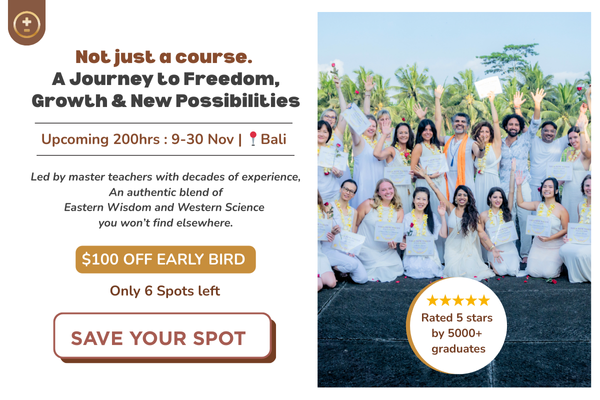
The next 200-hour training runs November 9 through 30, 2026, at Omham Retreat in Ubud, with lead teacher Deep Kumar guiding the cohort from day one through graduation. Batches run small by design, around 25 students with four teachers and one or two assistants. Tuition starts at $1,999 for shared accommodation and meals, rising to $4,599 for a private room, and the school has held RYS 200 and RYS 300 status with Yoga Alliance since 2011. This is the pick for a California student who has decided that stepping fully away from work and home, not staying near them, is what will actually get the certification finished.
Located in Pasadena, the program runs six three-day weekends from April through November, with the final weekend landing November 6, 2026. Farzaneh Noori, ERYT 500 and studio co-founder, leads the training alongside a small named faculty. Tuition is $2,995, and the format suits someone who needs to keep a full-time job running through the months of training.
Based in Ocean Beach, San Diego, this cohort runs September 19 through December 13, 2026, meeting Saturdays and Sundays. It includes a three-month studio membership alongside the training itself. Tuition sits between $2,595 and $2,695 depending on membership tier, making it one of the more accessible weekend-format options on this list.
Run through the university’s recreation department in Santa Barbara, this program follows an academic-year calendar, most recently fall through spring. Its 2026–27 cohort dates weren’t yet published at the time of writing, so confirm directly with the department before planning around it. The most recent published community tuition was around $3,400.
Split between weekday online sessions and weekend in-studio modules at their Mission and Haight-Ashbury locations, this San Francisco studio built its format specifically for people who can’t take extended leave from work. Exact 2026 cohort dates weren’t confirmed at the time of writing. A recent cycle was priced around $3,300, structured across four progressive modules from foundation through integration.
This is a 30-day residential program on a mountaintop campus near Watsonville, running June 13 through July 12, 2026, guided by a faculty of about 20 teachers. Tuition alone is $2,000, with lodging and meals priced separately by room type. The curriculum centers on classical Ashtanga philosophy, making this the most philosophy-dense California option here, alongside a hybrid five-month version for students who can’t take a full month away.
A Yoga Alliance registered studio in Berkeley offering both 200 and 300-hour tracks. Its approach leans community-first over competitive, and current 2026 cohort dates should be confirmed directly with the studio. Worth a look if you’re nervous about being the least experienced person in the room on day one.
Based in the Bay Area, this school is built specifically around trauma-informed and therapeutic yoga, with subsidized fellowships available to some students. It’s a different kind of “best for” than most of this list: relevant if you want to teach survivors, seniors, or clinical populations, not just run studio classes.
A Los Angeles studio offering a 200-hour program in Hatha and Vinyasa styles. Location does real work here, since LA’s studio density and job market are part of what this program offers beyond the certificate itself.
Located in Grass Valley, this is an ashram-style intensive inside a specific traditional lineage, with a set daily structure rather than a flexible schedule. It suits students who want the decisions about their day made for them so they can focus entirely on practice and philosophy.
Once you’ve narrowed this list to two or three programs, the next real question is usually format, not which school sounds most impressive.
Weekend, Intensive, or Residential: Which Format Fits You
For many students, the practical difference between these formats comes down to time. Weekend and hybrid formats let you keep working while training over several months. Intensive and residential formats compress the same total hours into a few uninterrupted weeks, which changes your daily life during training without necessarily changing what you learn.
Ask yourself three questions before comparing schools further:
- Can you take three to four consecutive weeks away from work and home?
- Do you want to stay close to your local studio network, or step outside your routine completely for a set period?
- Is time or money the scarcer resource for you right now?
Choose weekend or hybrid if: you have a job you can’t pause, family responsibilities that need you nearby, or you’d rather test the waters before a bigger commitment.
Choose intensive or residential if: you can take real time away, weekly life keeps interrupting your home practice, or you specifically want distance from your normal routine to focus.
Format also changes the economics of training, so it’s worth looking at cost next.
California or Bali: The Honest Trade-Offs
Staying local and training abroad solve different problems, not one better version of the same problem. Local training keeps you close to your job, your family, and the studio community you already know. Training abroad removes you from that routine for a fixed period, which some students genuinely need in order to finish a training without daily interruptions pulling them away from it.
Staying local, California advantages:
- No international travel or visa planning required
- Easier to keep working through a hybrid or weekend format
- Local studio relationships and post-training networking happen naturally
- Easier to visit a school in person before committing
- Simpler for anyone with caregiving responsibilities at home
Training abroad advantages:
- A fully immersive, uninterrupted period with no daily work distractions
- A residential international student community you live alongside, not just study with
- Real physical distance from your normal routine, which some students need to actually focus
- Meals and accommodation often bundled directly into the program
| Local (California) | Abroad (Residential) |
| Local studio connections | International student network |
| Easier post-training networking nearby | Immersive shared living and training |
| Familiar environment throughout | A real break from your normal routine |
| No international travel required | All-inclusive residential structure |
If your local network and job matter more right now, the local option is the more practical fit. If you genuinely need to step away to finish the training at all, the residential path earns its place instead.
What a 200-Hour Certification Actually Costs
There isn’t one number that works for every student comparing these programs. Three separate costs matter, and blending them into one figure hides real differences between a local weekend program and a residential one abroad. Compare all three separately for any program you’re seriously considering.
Program cost is tuition plus any required materials, and bundled accommodation or meals where they’re included. This is the number every school advertises. Attendance cost covers travel, local transport, and travel insurance for anything international, and it’s close to zero for a local weekend program. Opportunity cost is the income you give up if you take unpaid leave; a remote worker on flexible hours and someone on unpaid leave will land on very different totals for the exact same program.
Understanding RYS, RYT, and E-RYT
RYS stands for Registered Yoga School, Yoga Alliance’s designation for a training provider, not a personal credential. Current RYS 200 standards require 200 hours of qualifying instruction, delivered fully in person, fully online, or as a mix, with online-delivery programs required to hold a set share of that time as live, synchronous class time. Completing an RYS 200 program makes you eligible to apply for RYT-200 registration, but the credential itself still requires submitting that application and proof of completion, not just finishing the hours.
E-RYT-200, the experienced tier, isn’t automatic either. It requires at least two years of teaching and 1,000 logged teaching hours after your RYT-200 is issued, so plan on real time in the classroom before you can claim it. It’s worth asking any school directly whether its named lead trainer is the person who will actually teach most of your program, since lead trainers, trainers, and other faculty can carry different qualifications under Yoga Alliance’s standards.
Before You Enroll: A Verification Checklist
Before paying a deposit anywhere on this list, verify a handful of details directly rather than trusting marketing copy. Most of these take one email or a quick look at Yoga Alliance’s public school directory. A few extra minutes here can save you from a program that doesn’t match what it advertised.
- Confirm RYS status directly on Yoga Alliance’s own directory, not just the school’s claim
- Ask exactly how many hours are classroom-based versus apprenticeship or self-study
- Confirm whether the named lead trainer is who will actually teach most of the program
- Get the refund and cancellation policy in writing before paying a deposit
- Ask the teacher-student ratio and how practice-teaching feedback is structured
- Ask what happens if the lead teacher becomes unavailable before your cohort starts
- Ask what percentage of past graduates went on to teach, if the school tracks it
Learn More
A few related resources go deeper on specific parts of this decision. For a numbers-first comparison, see our companion piece, California vs. Bali Yoga Teacher Training. If you’re specifically weighing the Bali path, read Yoga Teacher Training in Bali for California Students. Before paying a deposit anywhere, our Yoga Teacher Training Red Flags guide covers the warning signs worth checking first. For accreditation verification on any school on this list, use Yoga Alliance’s official school directory rather than a school’s self-reported badge.
FAQs
-
Is 200 hours enough to start teaching in California?
A 200-hour Yoga Alliance training provides the standard foundation, but there is no California state license requiring it. Studios, gyms, and other employers set their own hiring requirements, and some prefer additional experience or a specialization on top of the base certificate.
-
Is a weekend-format certificate weaker than an intensive one?
Not automatically. What matters most is total instructional hours, curriculum depth, and the quality of feedback during practice-teaching, not whether the hours are spread across months or compressed into a few weeks.
-
Can I do a California YTT without quitting my job?
Yes. Yoga House runs six separate weekends instead of one continuous block, and Haum splits its schedule between weekday online classes and weekend in-studio sessions. Both were built around people who need to keep working through training.
-
Is training abroad actually cheaper once travel is included?
It depends entirely on the specific programs and your travel cost from home. Add attendance cost and opportunity cost to published tuition for both options before deciding, since comparing sticker prices alone can mislead in either direction.
-
Do I need E-RYT status to get hired?
No. Most entry-level teaching roles only require RYT-200. E-RYT-200 becomes relevant later, once you’ve logged two years and 1,000 teaching hours, and some studios look for it specifically when hiring for senior or studio-lead positions.
-
How do I verify a school’s Yoga Alliance status is real?
Search the school’s name directly in Yoga Alliance’s public directory rather than trusting a badge displayed on the school’s own website. The directory also shows which credential level, such as RYS 200 or RYS 300, the school actually holds.
-
Is a residential program abroad right for a first-time international traveler?
Yes, if you confirm specifics in advance: airport arrival support, on-site accommodation, an emergency contact, local transport, and what happens if you get sick during training. Ask these questions directly with the school rather than assuming they’re already covered.