The Ancient Science of Stillness for the Modern Yogi
By Deep Kumar, Founder and Teacher, Yoga New Vision
We live in an age of extraordinary information.
We can speak to someone on the other side of the world in seconds. We can learn almost anything online. We can move between thousands of ideas in a single day.
And yet, many people find it increasingly difficult to sit quietly with themselves.
The body is tired.
The mind is busy.
Attention is fragmented.
The nervous system is constantly receiving information.
Even when nothing is happening outside, something is usually happening inside.
A thought.
A memory.
A plan.
A worry.
A desire.
Another thought about the previous thought.
This is where the ancient science of yoga becomes remarkably relevant.
Thousands of years ago, Patanjali was not asking how to make people more productive or digitally focused. He was asking something much deeper:
What happens when the fluctuations of the mind become quiet?
And beyond that:
What is consciousness when it is no longer constantly occupied by thought?
In Patanjali’s Yoga Sutras, the deeper territory of this inquiry is called Samadhi. Samadhi in yoga is the state of deep absorption in which the mind has become quiet and consciousness is no longer scattered by thought.
Samadhi is not simply a state of relaxation.
It is not sleep.
It is not escaping from life.
It is not having a strange mystical experience.
It is a progressive refinement of consciousness: from scattered attention toward deep absorption, from absorption toward stillness, and ultimately toward awareness that is no longer dependent upon an object.
For the modern yogi, Samadhi can be understood as a map of what becomes possible when attention, body, breath and mind are gradually brought into harmony.
THE FIRST STEP: LEARNING TO STAY (DHARANA)
Before we can understand Samadhi, we need to understand attention.
Most of us believe we control our attention.
But watch the mind for five minutes.
Choose the breath.
Stay with it.
Very soon, a thought appears.
Then another.
A sound.
A memory.
A sensation.
A plan for tomorrow.
We suddenly realize that attention has left the breath.
Then we return.
This simple movement is the beginning of dharana, concentration.
Dharana is the practice of holding attention on a single object. It is not about fighting the mind.
It is about learning to notice where attention has gone and gently bringing it back.
Again.
And again.
This is important because attention is the doorway through which the entire yogic journey unfolds.
Modern psychology and contemplative science also investigate this capacity: sustained attention, mind-wandering, awareness of distraction and the ability to regulate attention. Research does not prove Patanjali’s Samadhi, but it does support the idea that attention and our relationship with mental activity can be trained.
The ancient yogi and the modern researcher may use different language.
But both are looking at something remarkably human:
Where is your attention right now?
WHEN CONCENTRATION BECOMES MEDITATION (DHYANA)
With practice, something changes.
At first, concentration feels like effort.
Eventually, it becomes more natural.
The mind wanders less.
Attention remains longer.
There is less struggle between the meditator and the object.
This is the movement toward dhyana, meditation, in which attention flows continuously toward its object.
Dharana gathers attention.
Dhyana allows attention to become continuous.
Imagine watching a flame.
At first:
“I am watching the flame.”
Then the commentary becomes quieter.
There is simply watching.
The relationship between the observer and the object becomes increasingly subtle.
This is where meditation begins to become more than a relaxation technique.
We are not merely trying to feel better.
We are investigating the nature of experience itself.
WHAT IS SAMADHI? WHEN THE MIND BECOMES TRANSPARENT
Samadhi follows dharana and dhyana. Where meditation is attention flowing continuously toward an object, Samadhi is absorption so deep that the mind becomes transparent.
Patanjali describes Samadhi through increasingly refined forms of absorption.
A useful image is a clear crystal.
When a crystal is surrounded by different colours, it appears to take on those colours.
In the same way, consciousness is constantly influenced by what passes through it.
A thought appears.
We become the thought.
An emotion appears.
We become the emotion.
A memory appears.
We enter the memory.
A desire appears.
We begin moving toward the desire.
The mind is rarely simply observing.
It is participating.
As the mind becomes quieter and more stable, consciousness can become more transparent.
There is less distortion.
Less interpretation.
Less personal projection.
This is the beginning of a very different way of experiencing reality.
SAVITARKA: WHEN EXPERIENCE IS MIXED WITH THOUGHT
Patanjali first describes savitarka samapatti, a form of absorption in which the object is still mixed with thought, language and conceptual knowledge.
Take a simple example.
You look at a tree.
You don’t simply see the tree.
You think:
“Tree.”
“Beautiful.”
“Old.”
“That reminds me of my childhood.”
“What kind of tree is it?”
“What would it look like in winter?”
The actual object and your mental interpretation are mixed together.
This happens constantly.
We rarely see something without immediately adding a story.
Meditation begins to reveal the difference between:
what is happening
and
what we think about what is happening.
That distinction is psychologically powerful.
NIRVITARKA: SEEING WITH LESS INTERFERENCE
As conceptual activity becomes quieter, Patanjali describes nirvitarka samapatti, absorption in which the object is seen with less interference from thought and naming.
The object remains.
But the commentary becomes less dominant.
There is less naming.
Less comparing.
Less remembering.
Less judging.
The experience becomes more direct.
This does not mean becoming unconscious.
It means becoming more present.
Imagine listening to someone you love.
Usually, while they are speaking, the mind is preparing a response.
Comparing their words with something from the past.
Judging.
Planning what to say next.
But sometimes we listen completely.
There is no internal commentary.
There is simply listening.
That small experience gives us a glimpse of what happens when awareness becomes less crowded.
FROM THE GROSS TO THE SUBTLE: SAVICARA AND NIRVICARA
Patanjali then moves toward increasingly subtle objects of meditation.
This is the territory of savicara and nirvicara.
The practitioner is no longer concerned only with obvious physical objects.
Attention becomes subtler.
The question gradually changes from:
“What am I experiencing?”
to:
“What is happening in the very process of experiencing?”
The mind becomes quieter.
The object becomes subtler.
The distinction between observer and observed becomes increasingly delicate.
And eventually we approach nirvicara, a state in which discursive thought has become profoundly quiet.
This sounds like the end.
But it is not.
There is one more subtle discovery.
THE MOST SUBTLE THOUGHT: “I HAVE NO THOUGHTS”
Imagine sitting in meditation.
The mind becomes very quiet.
There are no obvious thoughts.
There is spaciousness.
There is silence.
Then something very subtle appears:
“There are no thoughts.”
Look closely.
There is still an “I.”
And there is still something called “no-thought.”
The mind has made silence into an object.
This is one of the most profound points in the traditional exploration of Samadhi.
The mind can become attached to almost anything, even emptiness.
A person can become proud of being peaceful.
Proud of being detached.
Proud of being spiritual.
Proud of having transcended the ego.
The ordinary ego says:
“I have achieved.”
The spiritual ego can say:
“I have transcended achievement.”
The structure is still there.
This is why Samadhi is not simply the absence of thoughts.
It is a gradual freedom from identification with what appears in consciousness.
SABĪJA SAMADHI: THE SEED REMAINS
Patanjali uses the beautiful word sabīja, meaning “with seed.” Sabīja Samadhi is absorption in which, even in very refined states of meditation, something still remains as a support.
An object.
An impression.
A subtle identification.
A seed is tiny.
But inside the seed is the potential for an entire tree.
Likewise, a subtle identification can contain an entire psychological structure.
“I am the witness.”
“I am peaceful.”
“I am awakened.”
“I have attained.”
The experience may be genuine.
The identification with the experience is the subtle problem.
This is why the deeper yogic path is not about collecting extraordinary experiences.
It is about becoming free even from the need to possess them.
NIRBĪJA SAMADHI: WHEN THERE IS NOTHING LEFT TO HOLD
Patanjali then describes nirbīja Samadhi, Samadhi without seed.
There is no longer an object providing the foundation for the state.
Nothing needs to be held.
Nothing needs to be achieved.
Nothing needs to be claimed.
This is where language begins to become inadequate.
Because if we say:
“I have achieved nirbīja Samadhi,”
the sentence itself has already created an experiencer and an experience.
The mind has returned.
This is the paradox.
The deepest state cannot become another possession of the mind.
It cannot be manufactured by ambition.
It cannot be collected as a spiritual achievement.
Practice prepares the ground.
Understanding clears the ground.
Awareness reveals what remains.
WHEN THE MIRROR BECOMES CLEAR
Patanjali’s teaching also points toward adhyatma prasada, an inner clarity or grace that arises as consciousness becomes purified.
Think of a window.
The sunlight does not need to be created.
It is already there.
But if the window is covered with dust, the room appears dark.
Cleaning the window does not create the sun.
It simply allows the light to enter.
In a similar way, yoga does not necessarily create awareness.
It gradually removes what obscures it.
The body becomes more sensitive.
The breath becomes more refined.
Attention becomes steadier.
Mental patterns become visible.
Identification becomes weaker.
And clarity begins to emerge.
RITAMBHARA PRAJNA: A DIFFERENT KIND OF KNOWING
Patanjali then introduces ritambhara prajna, often translated as truth-bearing or truth-filled wisdom.
This is not simply intellectual knowledge.
There is a difference between knowing about something and knowing through direct experience.
You can read one hundred books about the ocean.
Study its chemistry.
Understand its tides.
Memorize its geography.
But you still have not entered the ocean.
Yoga values direct experience.
The student first hears the teaching.
Then studies it.
Then practices.
Then observes.
Then experiences.
Knowledge begins to move from the head into the whole being.
This is why the deepest education in yoga cannot remain intellectual.
THE BODY, THE MIND AND THE MODERN HUMAN
This is also where yoga can enter into meaningful dialogue with modern psychology.
Freud explored unconscious processes and the hidden forces influencing conscious behaviour.
Wilhelm Reich explored relationships between psychological patterns and bodily expression.
Alexander Lowen developed Bioenergetic approaches emphasizing grounding, breathing, movement and bodily awareness.
Gestalt psychology and therapy placed strong emphasis on direct awareness of present experience.
These approaches are not the same as Patanjali’s yoga.
They should not be artificially made identical.
But they offer different windows into the same complex human being.
The body can hold patterns.
The mind can create patterns.
Breathing can influence experience.
Attention can change our relationship with thought.
And awareness can reveal what previously operated automatically.
This is where ancient wisdom and modern scientific understanding can sit together without either one needing to disappear.
CAN MODERN SCIENCE EXPLAIN SAMADHI?
Modern science can study meditation and attention. It has not explained Samadhi.
Contemporary neuroscience is increasingly interested in meditation, attention, mind-wandering, self-related processing and the brain networks involved in these processes.
Researchers study systems including the default mode network, salience network and executive-control networks in relation to meditation and attentional regulation.
Some studies suggest that meditation practice can influence patterns of brain activity and connectivity.
But an important distinction must remain.
We cannot honestly say:
“This brain pattern is Samadhi.”
Science has not established such a conclusion.
Nor should an ancient spiritual experience be reduced to a single brain mechanism.
Science can investigate measurable correlates.
Yoga investigates lived experience and consciousness.
One gives us instruments.
The other gives us a phenomenological map.
When they meet carefully, they can create a richer understanding of the human being.
FROM EAST TO WEST, FROM KNOWLEDGE TO EXPERIENCE
Yoga has travelled far beyond the place of its origin.
Its teachings now live in homes, studios, universities and retreat centres across the world.
From East to West, people are returning to ancient practices because modern life has created an old human problem:
we have forgotten how to be still.
The answer is not to reject modern life.
It is to develop a deeper capacity to meet it.
The body becomes a house of awareness.
The breath becomes a bridge.
Meditation becomes a way home.
And the ancient sound Om, used traditionally as a support for contemplation, can become a simple reminder to pause, listen and turn attention inward.
The goal is not to escape the world.
It is to become present enough to actually live in it.
WHY THIS MATTERS IN YOGA TEACHER TRAINING
This is why the study of Samadhi belongs in serious yoga education.
A teacher may learn hundreds of postures.
But can they explain meditation?
Can they distinguish concentration from contemplation?
Can they explain what Patanjali means by Samadhi?
Can they help a student understand the difference between having a thought and identifying with it?
Can they understand how body, breath and attention influence one another?
Can they bring ancient philosophy into the language of a modern human being?
These questions change the meaning of teacher training.
At Yoga New Vision, the intention is to move progressively from intellectual understanding toward experience.
Students study the traditional teachings.
They explore asana, anatomy and biomechanics.
They work with breath and pranayama.
They study meditation and the psychology of awareness.
They explore how ancient teachings can be understood alongside modern physiology, psychology and scientific research.
And then comes the most important part:
practice.
Because yoga cannot be fully understood only by reading about yoga.
STUDY. PRACTICE. EXPERIENCE. EMBODY.
A deeper yoga education can be understood as a movement:
Study: understand the map.
Practice: walk the path.
Observe: become aware of your patterns.
Experience: allow knowledge to become personal.
Embody: bring understanding into everyday life.
Express: share what has genuinely been understood.
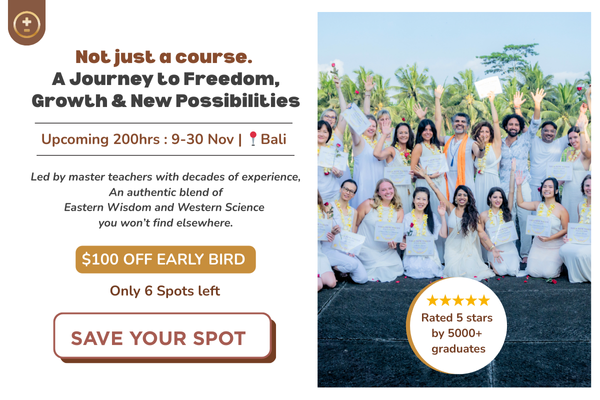
This is why a yoga teacher training in Bali can become much more than learning how to teach physical postures.
It can become an opportunity to step away from habitual noise.
To live more consciously.
To explore the body.
To refine the breath.
To understand the mind.
To discover meditation.
And gradually, to experience yoga not as information, but as something alive.
THE JOURNEY HOME
Samadhi may sound like a distant spiritual destination.
But the journey begins with very ordinary moments.
One conscious breath.
One moment of listening.
One thought observed without following it.
One emotion felt without immediately reacting.
One moment of sitting quietly.
One moment in which nothing needs to be achieved.
These moments matter.
Because the journey toward stillness is not about becoming somebody extraordinary.
It is about becoming intimate with what is already here.
The body becomes a house.
The breath becomes a doorway.
The mind becomes quieter.
Awareness becomes clearer.
And slowly, what once seemed distant begins to feel like home.
Perhaps this is the deeper promise of yoga:
not to give us another identity, but to free us from the need to constantly create one.
The journey begins with attention.
It deepens through meditation.
And somewhere beyond the thought of no-thought, the seeker discovers something that cannot be collected, explained or possessed.
It can only be experienced.
Experience • Evolve • Embody • Express
Yoga New Vision | Bali
A NOTE OF GRATITUDE
This exploration has been deeply inspired by Osho’s interpretation of Patanjali, particularly his discourse on the subtle movement from nirvicara toward the “thought of no-thought,” and his reflections on seeded and seedless Samadhi, inner clarity and truth-bearing wisdom.
For readers who would like to explore this subject more deeply, we recommend Osho’s Yoga: The Alpha and the Omega, Volume 3, especially the chapter “The Thought of No-Thought.”
The inspiration belongs to the master.
The inquiry belongs to every sincere seeker.
And the experience can only belong to the one who sits, becomes still, and looks within.