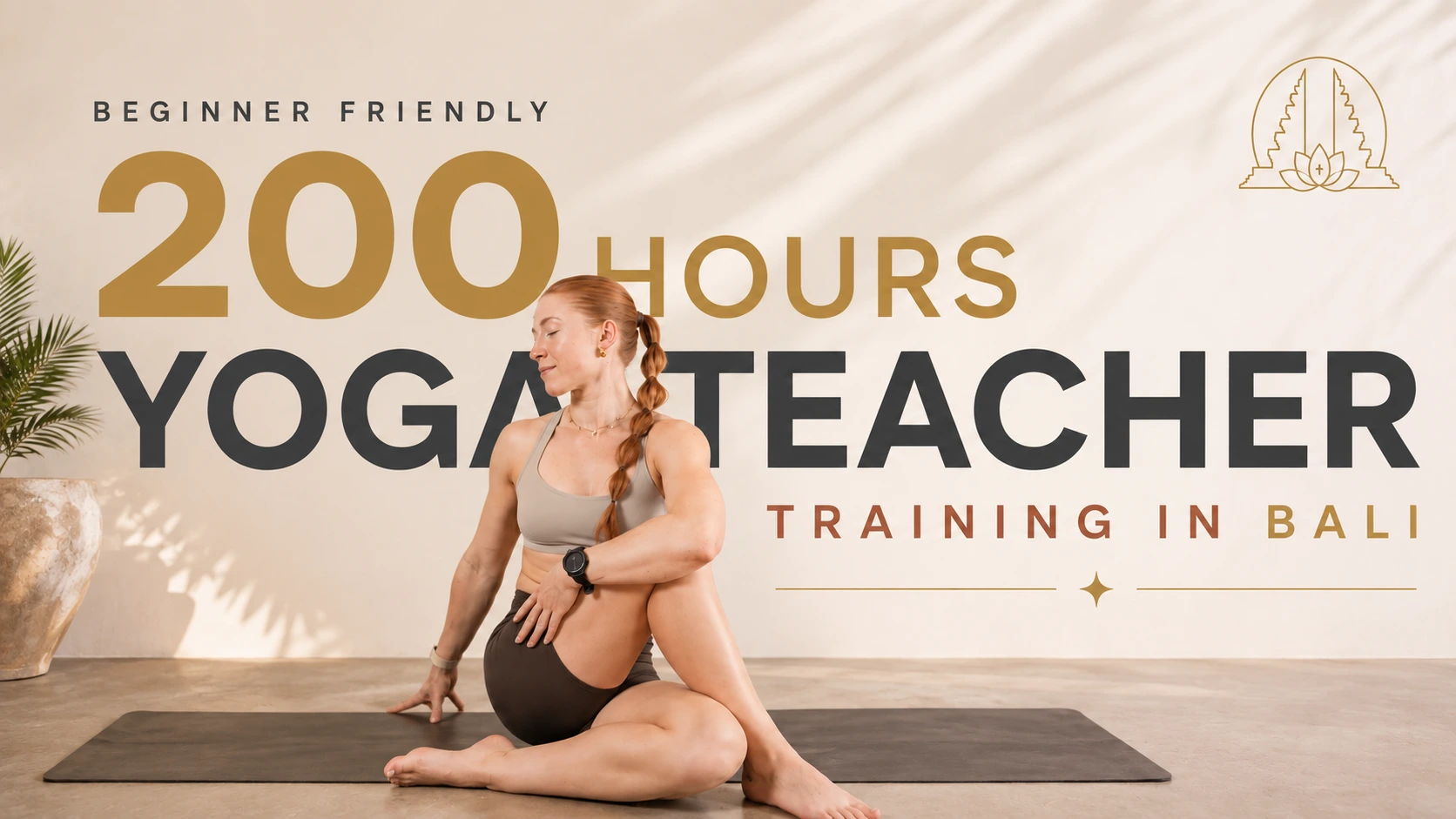
Yes, a 200 hour yoga teacher training in Bali works for complete beginners. I have watched people walk into our shala who have never done a single sun salutation before. By week three, they are teaching a full class.
That is not luck. It is how the course is built.
Is This Training Really Beginner Friendly
Most schools use the words beginner friendly on their website. Then you read the fine print and it says prior practice recommended. At Yoga New Vision we do not do that.
Our 200 hour program follows Yoga Alliance RYS 200 standards. That means the curriculum is designed to take you from zero to teaching ready. Nobody expects you to already know what Ashtanga or Yin yoga even mean.
The biggest myth I hear on discovery calls is that you need to be flexible. You do not. Flexibility is something your body builds during the month, not something you bring with you.
How to Know If You Are Actually Ready
Ask yourself these three questions before you apply. Have you practiced yoga at all, even a few YouTube classes at home? Can you commit to five to six hours of practice and study each day for three weeks straight?
Are you doing this to teach, or mainly for your own growth? Both reasons are fine. I just want you to know which one you are, because it changes how you experience the month.
Who This Training Is Not For
I would rather tell you this now than have you find out on day four. If you are recovering from a serious injury and have not cleared it with a doctor, wait. If you are looking for a spa holiday with some stretching, book a retreat instead.
If you cannot go five days without checking work email, this month will frustrate you. A 200 hour training asks for your full attention. Being honest about this upfront saves people a lot of money and disappointment.
What You Actually Learn
The curriculum covers five areas set by Yoga Alliance. Asana and alignment come first, because you need to feel a pose in your own body before you can correct it in someone else’s.
Pranayama and meditation come next, along with basic mantra chanting. Anatomy and physiology follow, then yoga philosophy and ethics. Teaching methodology and supervised practicum close out the month, which is where most beginners have their actual breakthrough.
We teach Hatha before Vinyasa on purpose. Hatha slows you down enough to actually learn alignment. Vinyasa without that foundation just becomes memorizing a sequence.
Choosing Where to Base Yourself
Bali is not one place. Ubud, Canggu, Uluwatu, and Nusa Lembongan each feel completely different, and picking the wrong one can make your month harder than it needs to be.
| Location | Vibe | Good Fit For |
| Ubud | Quiet, jungle, few distractions | First timers who want to focus without temptation nearby |
| Canggu | Beach town, cafes, social scene | Beginners who still want some nightlife after class |
| Uluwatu | Cliffside, surf culture | Ocean lovers who want quiet mornings and open evenings |
| Nusa Lembongan | Small island, slow pace | Anyone who wants to fully disconnect from city noise |
We are based in Ubud for exactly this reason. Fewer distractions means more focus in your first month of practice.
Your First Week, Honestly
Day one, almost everyone thinks they are the least flexible person in the room. Day three, the soreness hits and people start asking if this was a mistake. By day seven, most students are teaching their first five minute sequence to a partner.
A few mistakes show up every single round. Students try to nail every pose perfectly instead of just learning it. Students compare themselves to whoever looks most flexible in the shala.
Students skip proper meals because they are nervous, then wonder why they feel exhausted. Skipping rest days because they feel guilty is another one. None of these mistakes are fatal, but knowing about them in advance helps.
Cost, Duration, and What Is Included
Our 200 hour program runs for 21 days. Course fees typically cover tuition, shared accommodation, and daily vegetarian meals, though this varies by school so always ask for the exact breakdown in writing.
Budget for extras too. Flights, visa fees, laundry, weekend outings, and travel insurance all add up beyond the course price.
What Yoga Alliance Certification Actually Means
Completing an RYS 200 program lets you register with Yoga Alliance as an RYT 200. This is the entry level credential most studios worldwide recognize when hiring new teachers.
It does not mean you know everything. It means you have met a baseline standard for safe, ethical teaching. Many of our graduates go on to complete a 300 hour training later for the ERYT 500 pathway.
Life After You Graduate
Nobody becomes a confident teacher the day they get their certificate. In the first week, most graduates teach a free class to family or friends just to practice out loud.
By month one, they are usually leading small community classes or covering for other teachers. By month six, many are applying to studios or building an online following. This slow build is normal, and rushing it usually backfires.
My Honest Take
Everyone in this industry talks about flexibility like it decides your future as a teacher. I do not think that is true, and I have trained enough beginners to say it with confidence.
Consistency matters more. Showing up every single day, even when your body is sore, beats any single perfect pose. Patience with yourself gets you further than any handstand.
Sadhana and I built this program around that belief. A smaller cohort with real feedback beats a huge glossy campus every time.
Frequently Asked Questions
Do I need any yoga experience before joining a 200 hour YTT in Bali?
No prior experience is required for most Yoga Alliance RYS 200 programs. Many students arrive having only practiced yoga a handful of times at home or in a gym class. The training is built to teach you from the ground up. In my experience, attitude matters far more than how many poses you already know.
Am I too old to join a yoga teacher training?
There is no upper age limit for a 200 hour YTT. We have trained students in their twenties and their sixties in the same cohort. Age brings different strengths, like patience and life experience, that younger students often still develop. What matters is your willingness to show up and practice daily.
Can I join if I am not flexible?
Yes, flexibility is not a requirement and it is not the point of the training. Your body opens up naturally over three weeks of daily practice. What actually predicts success is consistency, not how deep your forward fold is. Most instructors, including me, would rather train a stiff student who shows up than a flexible one who does not.
How long should I practice yoga before signing up?
There is no minimum amount of practice needed before applying. Some students sign up after a single introductory class. Others have practiced for years. What we ask for is honesty about your fitness level so we can support you properly from day one.
Can I start teaching immediately after certification?
Technically yes, an RYT 200 certificate qualifies you to teach. Realistically, most new teachers spend their first few weeks practicing on friends and family before taking on paid classes. Confidence builds through repetition, not through the certificate alone. Give yourself permission to start small.
What is the difference between a 200 hour and 300 hour YTT?
A 200 hour training is the foundational certification required to register as an RYT 200 with Yoga Alliance. A 300 hour training is an advanced program usually taken after the 200 hour, deepening anatomy, philosophy, and teaching skill. Together they lead toward the ERYT 500 credential. Most beginners should start with the 200 hour first.
Is Yoga Alliance certification necessary to teach yoga?
Legally, no license is required to teach yoga in most countries. Practically, most studios and gyms only hire teachers registered with Yoga Alliance or an equivalent body. Certification signals that you met a recognized safety and ethics standard. It also makes international hiring far simpler.
Can I do the training if English is not my first language?
Yes, many of our students train in English as a second or third language. Classes involve some technical vocabulary, but instructors slow down and repeat key terms often. Bringing a small notebook to jot down new words helps a lot. Most students say the language gap closes faster than expected.
What should I pack for a 200 hour YTT in Bali?
Bring comfortable yoga clothes, a personal mat if you have a favorite, and a notebook for lectures. Pack mosquito repellent, electrolyte tablets, and a universal power adapter, since these get used daily. A light rain jacket is useful since Bali weather changes fast. Prescription medicine should always travel in carry on luggage.
Is Ubud or Canggu better for a beginner?
Ubud tends to suit beginners who want fewer distractions and a quieter focus on practice. Canggu offers more nightlife and social energy but can pull attention away from training. Neither choice is wrong, it depends on what helps you focus. We chose Ubud for our own school for exactly this reason.