By Deep Kumar | Founder, Yoga New Vision | ERYT-500 | Ubud, Bali
Living in the present moment means resting your full awareness on the experience happening right now, without pulling it backward into memory or forward into anticipation. In yoga philosophy, this is not a destination you arrive at. It is the natural state that surfaces when you stop generating the conditions that pull you away from it.
The First Word of the Yoga Sutras Settles the Argument
When Patanjali wrote the Yoga Sutras roughly 2,000 years ago, he did not open with a definition of yoga, a list of postures, or a map of the chakra system. He opened with one Sanskrit word: atha.
Atha (Sanskrit: अथ) translates as “now.” More precisely, it signals the auspiciousness of this moment as the only valid starting point for any genuine practice. The very first word of the foundational text of yoga is a direct instruction to the present tense.
This is not a small detail. Patanjali was telling you, before anything else, that yoga only exists here. Not in the memory of yesterday’s session on the mat. Not in the goal you have set for your next retreat. The practice begins now, or it does not begin at all.
Most Western mindfulness content skips this entirely and starts with breathing exercises. I understand why. Breathing exercises are accessible. But they are most effective when practiced in the context of why they work, and that context is classical yoga philosophy, specifically Patanjali’s architecture for the mind.
Chitta Vritti: The Real Reason You Cannot Stay Present
Here is what I watch happen in almost every student who arrives at our 200-hour YTT in Ubud for the first time. They are physically present in Bali. They have flown thousands of kilometers to be here. And their minds are simultaneously reviewing their last work email and rehearsing a conversation they have not had yet.
This is not weakness. This is not a personal failing. Patanjali named this pattern directly in Yoga Sutra 1.2: Yogas chitta vritti nirodha. Yoga is the stilling of the mind’s fluctuations. These fluctuations, the vrittis, are not random distractions. He classified five specific types: correct perception, misconception, imagination, deep sleep, and memory.
The two vrittis that pull most people out of the present are smriti (memory) and vikalpa (imagination). You are either replaying something that happened or rehearsing something that has not. Your nervous system cannot biologically distinguish a remembered threat from a current one. This is why an argument that ended six months ago can spike your cortisol while you are sitting in a quiet room trying to meditate.
The conventional response to this is to try harder to focus. Patanjali’s response is different. He does not tell you to fight the vrittis. He tells you to recognize them, name the type of wave your mind is making, and return to the present without judgment. That distinction changes everything about how you practice.
The Two Forces Patanjali Prescribes
Patanjali gives you the solution in Sutra 1.12. The mind is steadied through abhyasa (sustained practice) and vairagya (non-attachment). Both terms get consistently misread.
Abhyasa is not just “doing yoga regularly.” In Sutra 1.13, Patanjali clarifies: abhyasa is the sustained effort to remain steadily established in one focus. It is the conscious act of returning. Not returning once, dramatically, in a breakthrough moment. Returning repeatedly, quietly, without fanfare, the way water returns to flow downhill after every obstacle in its path.
Vairagya tends to make people nervous. They read it as detachment and picture someone who has stopped caring about the people and things they love. That is not it. Vairagya is the loosening of the ego’s grip on outcomes. You can care deeply about something and still release your demand that it arrive on your exact schedule in exactly the form you imagined. That release is precisely what allows you to stop living three steps ahead of yourself.
A student in our last 200-hour cohort, a corporate lawyer from Singapore, told me on day four that she had never once in her adult life finished a meal without already planning the next task on her list. That is vikalpa, imagination, masquerading as efficiency. By day twelve, something had genuinely shifted. She described it like this: “I stopped negotiating with the present moment.” That is vairagya beginning to take root.
Your Posture Is Living in Your Past (And This Is a Clinical Reality)
This is the section that most mindfulness articles skip, and I think it is the most important one for people who have genuinely tried to “be present” and found that mental effort alone does not move the needle.
When a person carries sustained stress, whether from a demanding career, a difficult relationship, or a period of trauma, the body stores that stress somatically. The psoas muscle tightens. The thoracic spine rounds forward into a protective curl. The jaw holds. The breath becomes shallow and high in the chest. The shoulders elevate toward the ears.
This is not a metaphor. It is anatomy. When a student walks into the shala in Ubud carrying that forward-head, elevated-shoulder posture, their autonomic nervous system is still operating from a threat signal that the present moment has already resolved. Their biology is running a program written by the past. Their mind follows their body, not the other way around.
In Physio Yoga Therapy, the therapeutic methodology I developed over years of working with students coming off high-stress careers, one of the first things we address is not the mind. It is the physical architecture. We work with psoas release, thoracic extension, and precise scapular placement. Without fail, the moment the physical alignment corrects, the mental chatter reduces. Not because we instructed them to think less. Because we changed the signal their nervous system was sending.
I see this in Warrior II regularly. A student enters the posture with a collapsed front hip, a jutting chin, and tense hands. Their internal narrative is loud. We correct the hip stack, draw the chin level, soften the fingers. The mental noise drops immediately. The body now has real-time somatic feedback occupying its processing bandwidth, and the vrittis go quiet because the nervous system is fully engaged with what is actually happening right now.
You cannot think your way into the present if your spine is living in a past stress event. The body has to be addressed directly.
The Samskara Running Underneath the Vritti
There is a layer of yoga psychology that goes deeper than vritti, and modern wellness content almost never reaches it: samskara.
A samskara (Sanskrit: संस्कार) is a deep psychological and somatic imprint formed by repeated experience. These are the grooves worn into the mind and body by habitual patterns of response. A person who grew up in an unpredictable environment develops a samskara of vigilance. The mind is always scanning, always anticipating, always positioned one step ahead of the present moment because that is what kept them safe once.
Samskaras do not live only in the mind. This is critical to understand. They live in the fascia, in the breath pattern, in the reflexive tightening of the chest when a deadline appears. Working with them requires both the philosophical tools of Patanjali’s eight-limbed path, specifically pratyahara (the withdrawal of the senses from external stimulation) and dharana (single-pointed concentration), and the somatic tools of aligned, breath-integrated movement.
This is where Deep Conscious Vinyasa functions as more than a physical practice. The practice is a moving investigation into what the body is holding, using breath as the constant guide back to the present tense. Each transition between postures surfaces a habitual pattern. The practice is to notice it, breathe through it, and choose not to follow it. That choice, repeated consistently, is how samskaras are gradually released rather than perpetually reinforced.
The Breath Is Not a Technique. It Is a Location.
Every yoga teacher tells students to focus on the breath. Very few explain the actual mechanism behind why this works, and without that understanding, breath awareness stays a surface-level exercise.
The breath is the only autonomic function that exists exclusively in the present tense. Your heartbeat is regulated without your conscious participation. Digestion happens below your awareness. But breath, the moment you direct attention to it, becomes a real-time sensory event. You cannot breathe yesterday’s breath. You cannot breathe a future breath. The moment your attention lands on the breath, you are by definition already in the present.
In my teaching, I integrate elements of Buteyko Breathing alongside traditional pranayama techniques. The Buteyko approach emphasizes nasal breathing, reduced-volume breathing, and short breath retention as tools for recalibrating the nervous system’s CO2 tolerance. This has a direct, measurable physiological effect on anxiety: it slows the respiratory rate, activates the parasympathetic branch of the autonomic nervous system, and shifts the body out of the sympathetic fight-or-flight state where rumination feels inescapable.
Research now confirms what classical yoga described intuitively: regular pranayama practice can reduce anxiety symptoms significantly and lower cortisol levels. The mechanism is not mysterious. It is the vagus nerve, the parasympathetic signal, the straightforward physiological reality of what nasal, slow breathing does to the stress-response system.
But the deeper teaching is this: the breath is not a vehicle you board to travel toward the present moment. It is already there. You are simply catching up to it.
The Mindfulness App Problem Nobody Wants to Say Out Loud
I want to be direct about something, at the risk of sounding contrarian.
The current generation of meditation apps has introduced a specific vritti of its own: the future-orientation of the streak. When you meditate to protect a daily streak counter, you are not resting in atha, in now. You are managing a metric. The app has gamified presence, which is precisely what presence is not. Presence has no leaderboard position. It cannot be earned by completing a session.
Patanjali’s language in Sutra 1.14 is unambiguous: practice becomes firmly rooted when it is cultivated for a long time, without interruption, and with satkara, honor and respect. Satkara is the quality that distinguishes genuine abhyasa from behavioral compliance. A meditation session completed primarily to protect a streak is not satkara. It is anxiety wearing a wellness costume.
The apps are not the enemy. But the framing matters enormously. If the app is a doorbell that reminds you to sit, that is one thing. If the badge is the reason you sit, the vritti is already running before you close your eyes.
True practice strips the metrics away. It asks you to show up with no audience. Including yourself.
Stop Trying to Be Present
I say this in the shala regularly and it lands with some initial resistance.
“Trying” to be present is a future-oriented act. You are trying because you expect a result. You want to arrive somewhere. That intention itself is a departure from atha, from the now that is already here.
Presence is not achieved. It is revealed. You create the physiological and philosophical conditions for it to appear, and then you stop interfering. The correct practice is not intensified attention. It is disciplined surrender to what is already happening.
Lao Tzu, writing from outside the yoga tradition entirely, described the same understanding: “If you are depressed you are living in the past. If you are anxious you are living in the future. If you are at peace you are living in the present.” The peace he describes is not earned through effort. It is what remains when the efforting stops.
This principle mirrors what I teach in the context of Ahimsa. You cannot force a nervous system into peace. You remove the obstacles and provide the conditions. Then you get out of the way.
What Ubud Actually Teaches (That Cannot Be Replicated Digitally)
I have been teaching in Ubud for over fifteen years. And one of the most consistent observations I have is that students in our YTT often experience their first genuine present-moment awareness not on the mat, but during the walk to the shala in the early morning.
The rice paddies have a particular quality of stillness. The air carries something that is difficult to name precisely. There is a philosophical concept in Balinese culture called Tri Hita Karana, the three causes of wellbeing: harmony with Divinity, harmony with other humans, and harmony with nature. The built environment of Ubud, from its temple compounds to its terraced agricultural land, is physically organized around the understanding that presence is the baseline state of healthy human life, not an exceptional achievement.
I am not suggesting you need to come to Bali to be present. I am saying the environment you place yourself in is not irrelevant to the practice. Abhyasa requires conditions. Creating those conditions in your daily life, even modest ones, a corner of your home without a screen, a ten-minute morning walk without headphones, a meal eaten without your phone on the table, is part of the work.
The environment is not the practice. But it can make the practice possible when the internal conditions are still being built.
Clinical Perspective from Deep Kumar (ERYT-500, Founder of Physio Yoga Therapy)
I trained at Tapovan Dhyan Dham Vidhyapeeth in the Himalayas before establishing Yoga New Vision in Ubud. What struck me most in those early years of training was that the ancient teachers were not primarily concerned with what happened on the mat. They were concerned with what happened in the mind during every ordinary moment of the day.
Present-moment awareness was never an add-on to their practice. It was the practice. The postures, the breath, the philosophical study were all in service of one goal: reducing the conditions that drag the mind away from atha.
Fifteen years of teaching has only confirmed this. The students who make the most significant and lasting changes in their relationship to their own minds are the ones who stop treating presence as a session they complete and start treating it as the underlying quality of everything they do.
The body and the mind are not two separate instruments you tune separately. They are one system. When you work them together, with the precision of classical philosophy and the specificity of modern biomechanics, something shifts that no app can replicate.
Frequently Asked Questions
1. What does “living in the present moment” mean in yoga?
Living in the present moment means resting full awareness on current experience without memory or anticipation pulling it away. In yoga philosophy, this corresponds to Yoga Sutra 1.1, where Patanjali opens with “atha,” meaning “now.” It is not a mental state you achieve through effort. It is the natural state that surfaces when vrittis quiet.
2. What is chitta vritti nirodha and how does it connect to present-moment awareness?
Chitta vritti nirodha (Yoga Sutra 1.2) means the stilling of the mind’s fluctuations. The five vrittis, including memory and imagination, are what pull the mind out of the present. When these fluctuations settle through abhyasa and vairagya, present-moment awareness is what naturally remains. It was always underneath; the practice simply removes the noise.
3. Why is it so hard to stay present even when I genuinely want to?
The difficulty is largely physiological, not just psychological. Smriti (memory) and vikalpa (imagination) are hardwired vrittis. When the body also holds somatic stress from past experience, the nervous system sends backward-facing signals. Both the mental and physical architecture must be addressed together. Mental effort alone is rarely enough to override a body holding old stress.
4. Can yoga and pranayama actually reduce anxiety caused by overthinking?
Yes, and the mechanism is measurable, not merely philosophical. Pranayama activates the parasympathetic nervous system and lowers cortisol. Research confirms regular yoga practice reduces anxiety symptoms significantly. The deeper work is releasing the samskara, the body-stored habitual pattern, behind the overthinking. This requires consistent somatic practice alongside the breathing work.
5. What does “atha” mean in the Yoga Sutras and why does it matter?
Atha (Sanskrit: अथ) is the first word Patanjali uses in the Yoga Sutras, translating as “now” or “in this auspicious moment.” It establishes that the entire system of yoga begins in the present tense, not in a future goal or past achievement. Understanding this single word reframes the entire practice from aspiration to direct present-moment engagement.
6. What is the difference between mindfulness and present-moment awareness in classical yoga?
Mindfulness, in its common Western form, is a psychological technique for observing thoughts without judgment. Present-moment awareness in the classical yoga tradition is the state that arises naturally when chitta vrittis are stilled through abhyasa and vairagya. Mindfulness is a useful tool. Present-moment awareness as Patanjali describes it is the destination that tool is pointing toward.
7. How does breath awareness help with staying present in practical terms?
The breath exists exclusively in the present tense. You cannot breathe yesterday’s or tomorrow’s breath. Directing conscious attention to breath anchors you to now by definition. Pranayama, particularly nasal and slow breathing approaches, also activates the parasympathetic nervous system, directly reducing the physiological conditions that produce anxiety-driven rumination and future-focused mental chatter.
8. What are samskaras and how do they affect present-moment living?
Samskaras are deep psychological and somatic imprints formed by repeated experience. They create habitual, automatic patterns of response that pull a person into past-based reactions even in neutral present circumstances. Addressing samskaras requires pratyahara and dharana from Patanjali’s eight-limbed path, combined with somatic movement practices that surface the patterns without reinforcing them.
9. How can I practice present-moment awareness in daily life outside of a yoga class?
Start with breath as the anchor: three slow nasal breaths before any reactive decision. Create one screen-free space in your home. Take a ten-minute morning walk without headphones. These are not tips or hacks. They are the beginning of abhyasa: the sustained, respectful practice of returning attention to where your body actually is right now.
10. What is vairagya and why is non-attachment important for being present?
Vairagya means non-attachment, specifically the loosening of the ego’s grip on outcomes. Without it, the present moment feels inadequate because you are constantly measuring it against what you wanted. With vairagya, the present stops needing to be different from what it is. This is the doorway Patanjali prescribes in Sutra 1.12, alongside sustained practice, as the twin foundation of a quieted mind.
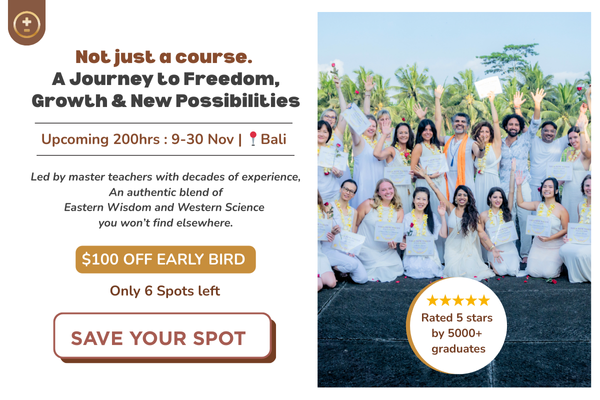
If what you read here landed somewhere real for you, come practice it in person. Yoga New Vision runs 200-hour and 300-hour Yoga Teacher Training programs in Ubud, Bali. The environment is not incidental. Ubud is built around the philosophy of presence. The training is built around you.
Schedule a free 15-minute call with our team
Deep Kumar is the founder of Yoga New Vision, a Yoga Alliance-accredited school in Ubud, Bali, recognized as the Most Authentic YTT in Bali by Global Gallivanting. He is an ERYT-500 certified teacher trained in the Kaivalyadhama lineage, with foundational study at Tapovan Dhyan Dham Vidhyapeeth in the Himalayas. He developed Physio Yoga Therapy and Deep Conscious Vinyasa as integrative approaches combining classical yoga philosophy with modern biomechanics. He has trained over 15,000 students across more than fifteen years of teaching in Bali.