By Deep Kumar, Founder, Yoga New Vision | Yoga Alliance Certified School, Ubud, Bali
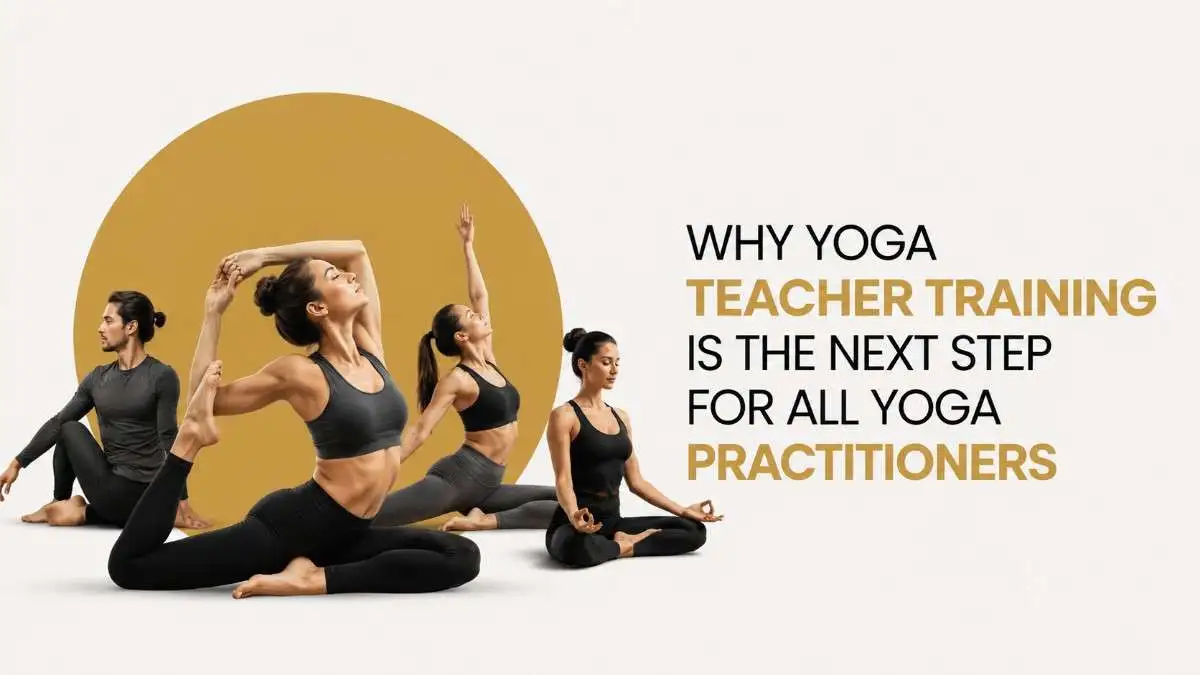
Yoga teacher training is the next step for every practitioner because it transforms your relationship with yoga from something you do into something you actually understand. Whether you plan to teach or not, a 200-hour immersion takes you inside the philosophy, the anatomy, the breath, and the mind in ways that years of drop-in studio classes simply cannot reach. Most of our 15,000 graduates at Yoga New Vision enrolled with no intention of standing at the front of a class.
You Do Not Have to Want to Teach to Do This Training
I want to say this clearly because I hear the same hesitation every week.
People write to us and say: “I love yoga, but I don’t want to become a teacher. Is this still for me?” The answer is yes, and actually that version of you tends to get the most out of this experience.
Selene, who joined our training in Bali, had never taken a yoga class before she arrived. She came to improve her physical and mental health. By the end, she told us she had learned yoga philosophy, anatomy, breathing, and meditation, and that sharing the journey with people from different parts of the world made the experience irreplaceable. Rissa, who came from a professional background expecting a physical practice, said what happened was a complete transformation of self-awareness, guided by Deep, Sadhana, Anurag, and Vijeth.
That pattern is not a coincidence. It is what this training is designed to do.
The 60-Minute Plateau: Why Studio Classes Stop Working
Here is something most yoga schools will not say out loud.
After one or two years of regular practice, most practitioners hit a ceiling. The classes feel familiar. The poses feel repetitive. Something that used to feel alive starts to feel like going through the motions. This is not a failure of willpower.
It is a structural limitation of the 60-minute drop-in format. You are getting physical instruction but no philosophical framework to place it inside, no breath education rooted in nervous system science, and no understanding of why your body holds tension in the exact places it does.
A 200-hour immersion breaks through that ceiling because it gives you the context behind every single thing you have been doing on the mat.
What You Actually Learn That Nobody Tells You About
The curriculum at a serious yoga teacher training program covers far more than how to sequence a class.
At Yoga New Vision, we teach the Yoga Sutras of Patanjali, the 8 Limbs of Yoga, and the Pancha Koshas (the five bodies) as living frameworks for understanding yourself, not as historical texts to memorize. Anatomy is led by expert physiotherapists, and we teach it in the context of the poses you already know, so it lands in your body instead of staying on a whiteboard.
Pranayama goes beyond counting breaths. We draw on the Buteyko Breathing Technique, developed by Konstantin Buteyko, which is evidence-based breathwork focused on nervous system regulation and oxygen efficiency. When you understand how your breathing pattern affects your anxiety, your sleep, and your emotional reactivity, your practice changes permanently.
Meditation at this level includes Chakra meditation for energetic awareness, Kundalini practice for activating the subtle body, Yoga Nidra for deep physiological rest, and Mantra Yoga for cultivating stillness through sound. These are not extras. They are the core.
The Science Behind Why Transformation Happens in the Body
Stretching without somatic awareness does not heal tension. It moves it around.
This is the insight behind what we call the YNV Method, our integration of Eastern yogic wisdom with three specific Western frameworks. The Alexander Technique, founded by Frederick Matthias Alexander, addresses the habitual postural and movement patterns that sit underneath all physical discomfort. Most people are not aware these patterns exist until someone trained in somatic work points to them directly.
Alexander Lowen’s Bioenergetics explains something that every practitioner intuitively senses but rarely hears named: emotions are stored in the body as muscular tension. The deep emotional releases that students experience in hip-opening sequences or spinal work are not random. They are the body completing what the mind left unfinished.
When both of these frameworks are paired with the Buteyko breathing method, you get a training that regulates the nervous system from three angles simultaneously. That is why students describe the change not as learning something new but as becoming someone different.
The “Advanced Practitioner” Myth
I have seen this for over two decades, and I still find it worth saying directly.
Advanced yoga has nothing to do with your asana. A practitioner who has been doing yoga for ten years but still holds their breath during a difficult conversation is, by yogic definition, a beginner. A practitioner who cannot touch their toes but has a working understanding of Nadi Shodhan, the Pancha Koshas, and how their nervous system responds to stress is genuinely advanced.
The question “Am I ready for teacher training?” is most often asked by the people who are most ready. The hesitation itself is a signal.
We Do Not Want You to Quit Your Job
Let me address the cliche directly.
Most yoga teacher training marketing shows someone quitting their corporate career, moving to Bali, and becoming a wellness influencer. That is a legitimate path, and we support it. But it is not the only one, and it is not the default we assume.
Sadhana Om, our co-founder, spent six years in a corporate career before she turned toward yoga completely. She did not leave because she hated her job. She left because she had developed enough inner stability to trust that there was something more aligned waiting for her. That took years of practice and a serious period of immersive training.
For the practitioner who wants to stay in their career and show up to it with a clearer mind, a regulated nervous system, and a genuine understanding of how to manage stress through breathwork and philosophy, this training is the most practical investment you can make.
When Are You Ready
There is no minimum requirement for joining a yoga teacher training.
At Yoga New Vision, we welcome practitioners at every level. Some arrive with a decade of practice. Some, like Selene, arrive for their first real immersion. What we look for is sincerity, not flexibility.
My own philosophy on this has not changed: understand your body, understand your mind, and in that understanding, you are already transformed. Readiness is not a threshold you cross. It is a direction you choose.
Who You Learn With in Bali
Yoga New Vision, named the World’s Most Authentic Yoga Teacher Training by OM Yoga Magazine, London, was established by Sadhana and myself after years spent founding and running Siddhi Yoga, Deep Yoga Academy, and East+West Yoga.
This school is our most personal creation. I teach in every single cohort, from the first morning to the last day. Sadhana holds the emotional architecture of the training, the conversations after class, the students who need a different kind of presence, and the quiet moments where the real work happens. Our faculty also includes Rajat Thakur in Yoga Anatomy, Anurag Acharya in Therapeutic Yoga, Swami Atma in Philosophy and Mantra, and Dr. Sumit Sharma in Holistic Yoga Therapy.
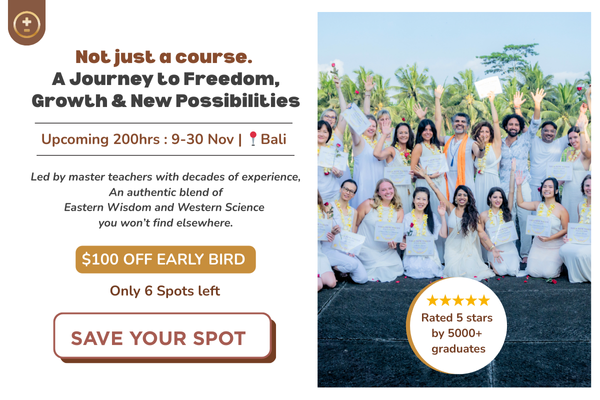
We cap each cohort at 25 students, and we run them at Omham Retreats and Resort in Ubud, the spiritual heart of Bali. Both January and February 2026 cohorts are fully sold out.
Frequently Asked Questions
1. Is yoga teacher training only for people who want to become yoga teachers?
No. The majority of practitioners who enroll at Yoga New Vision do not intend to teach professionally. A 200-hour training provides deep study in yoga philosophy, anatomy, pranayama, and meditation that any practitioner benefits from. Personal transformation, improved self-awareness, and a healthier nervous system are outcomes completely independent of a teaching career.
2. How long should I practice yoga before joining a teacher training?
There is no minimum practice requirement. Students at Yoga New Vision range from complete beginners to experienced practitioners. Readiness is determined by sincere intention, not years on the mat. What matters is your willingness to engage fully with philosophy, breathwork, anatomy, and meditation over the course of a 22-day immersion.
3. Is a 200-hour yoga teacher training physically demanding?
It is not a boot camp. Students of all ages, including those in their 50s and 60s, participate in every cohort. The physical practice is progressive and designed for safety. The deeper challenge is inward: the philosophy, the self-inquiry, and the daily immersion into practices that demand honest attention from your mind, not just your body.
4. What is the YNV Method?
The YNV Method is Yoga New Vision’s integrated teaching framework combining Indian yogic wisdom with three Western scientific approaches: the Alexander Technique for somatic movement and posture re-education, Bioenergetics for understanding how emotions are held and released in the body, and the Buteyko Breathing Technique for evidence-based nervous system regulation through breath.
5. What makes Ubud, Bali the right environment for a yoga teacher training?
Ubud is the cultural and spiritual center of Bali. The natural environment, including open-air shalas, rice paddies, and tropical stillness, creates conditions for inward attention that are genuinely difficult to replicate in an urban studio setting. The environment is not just a backdrop; it actively supports the nervous system regulation that the training teaches.
6. Do I need to know Sanskrit or yoga philosophy before I join?
No prior knowledge of Sanskrit or yoga philosophy is required. These subjects are taught from the ground up within the curriculum. The Yoga Sutras of Patanjali, the 8 Limbs of Yoga, the Pancha Koshas, and the seven chakras are all covered in structured sessions taught by specialist teachers. Your curiosity is the only prerequisite.
7. What career paths are open after a 200-hour Yoga Alliance certification?
A Yoga Alliance RYT 200 credential allows you to teach in yoga studios, fitness centers, corporate wellness programs, private client settings, retreats, and online platforms globally. Graduates of Yoga New Vision also receive a free 50-hour Yin Yoga certification, expanding their teaching credentials to cover Hatha, Vinyasa, the YNV Method, and Yin Yoga.
8. Can a complete beginner join the 200-hour yoga teacher training in Bali?
Yes. Yoga New Vision explicitly welcomes beginners, and several graduates describe arriving with no prior yoga experience. The training is structured to build from foundational anatomy and philosophy upward. A beginner’s mind is often the greatest advantage in a training that asks you to see yoga with fresh eyes, not confirm what you already think you know.
9. What is the daily schedule during a 22-day yoga teacher training immersion?
A typical day begins at 7:00 AM with yoga practice, pranayama, and meditation, followed by breakfast, then morning sessions in philosophy and self-inquiry, anatomy, and an asana lab with teaching practicum in the afternoon. The day closes with an evening meditation and reflective study time. Three vegetarian meals are provided daily at the resort.
10. How is the anatomy module taught at Yoga New Vision?
Anatomy at Yoga New Vision is taught by specialist physiotherapists including Dr. Sumit Sharma, a Holistic Yoga Therapy Master, and Rajat Thakur, a Yoga Anatomy and Movement Specialist. The curriculum covers musculoskeletal structure in the context of yoga poses, injury prevention, safe modifications, and how the nervous system responds to physical and breathwork practices.
Yoga New Vision has been Yoga Alliance registered since 2011. Our school is located at Omham Retreats and Resort, Jl. Raya Sanggingan No.36, Kedewatan, Ubud, Bali. To speak with Sadhana directly about whether this training is the right step for you, book a free 15-minute call.