Hindu texts and later retellings describe Saraswati’s relationship with Brahma in different ways. Some present her as his consort. Others tell of Vāk, a figure of sacred speech who is Brahma’s daughter in one text and is linked with Saraswati in later tradition.
This guide separates what the texts say from how later writers read them. It covers the stories, the symbols, and where Saraswati fits in yoga.
Last updated 9 October 2026. The Bali dates are reviewed before each festival cycle.
Who are Saraswati and Brahma?
Brahma is the creator figure in Hindu cosmology, and Saraswati is the goddess of speech, learning and the arts. Later texts connect them, but not in one shared story. Sarasvatī appears in the Rigveda as a river and a presence of sacred speech, while her relationship with Brahma is developed in later texts, including the Puranas.
Three similar terms cause confusion. Brahman is the ultimate reality in Vedanta, and a Brahmin belongs to a priestly class. Neither is the god Brahma.
Vāk is the Sanskrit word for speech and also the name of a goddess. Some later writers treat Vāk and Saraswati as one figure. A text that says Vāk is not always speaking of Saraswati.
What do the texts say about Saraswati and Brahma?
No single account is shared by every Hindu text. Some narratives present Saraswati as Brahma’s consort, while the Bhagavata Purana describes a daughter of Brahma named Vāk, whom later retellings connect with Saraswati. Because the source changes the answer, each account is best read on its own terms, not blended into one story.
| Source | What it says | Note |
| Rigveda 6.61, 7.95–96 | Hymns praising Sarasvatī as a river and goddess | These do not describe a marriage to Brahma. |
| Rigveda 10.125 | A hymn spoken by Vāk, sacred speech | Vāk and Saraswati are linked later, not equated everywhere. |
| Matsya Purana 3 | Brahma creates a female figure. An older English translation lists Shatarupa, Savitri, Sarasvati, Gayatri and Brahmani among her names. | Check the edition before quoting names. |
| Bhagavata Purana 3.12.28 | Names Brahma’s daughter as Vāk | The verse says Vāk, not Saraswati. |
| Pushkar retellings | Gayatri takes part in a ritual, and Saraswati curses Brahma | A popular retelling. Details vary. |
Where a text tells the daughter story, quote that text’s own wording. Do not present it as the view of all Hindu traditions.
Why is Saraswati worshipped but Brahma rarely?
Few major temples are dedicated to Brahma today, and Pushkar in Rajasthan is the best known. A popular story explains this through a curse from Saraswati after a dispute over a ritual. It is one traditional explanation, not a full history of Brahma worship, and retellings differ on who was present and why.
In one retelling, Saraswati is angered to find that Brahma has taken another wife, Gayatri. Another version blames the curse on a misunderstanding.
The identities also shift between retellings. Some traditions treat Gayatri as a manifestation of Saraswati. Other explanations point to where devotion has centered, such as Vishnu, Shiva and the Goddess.
What do their symbols mean?
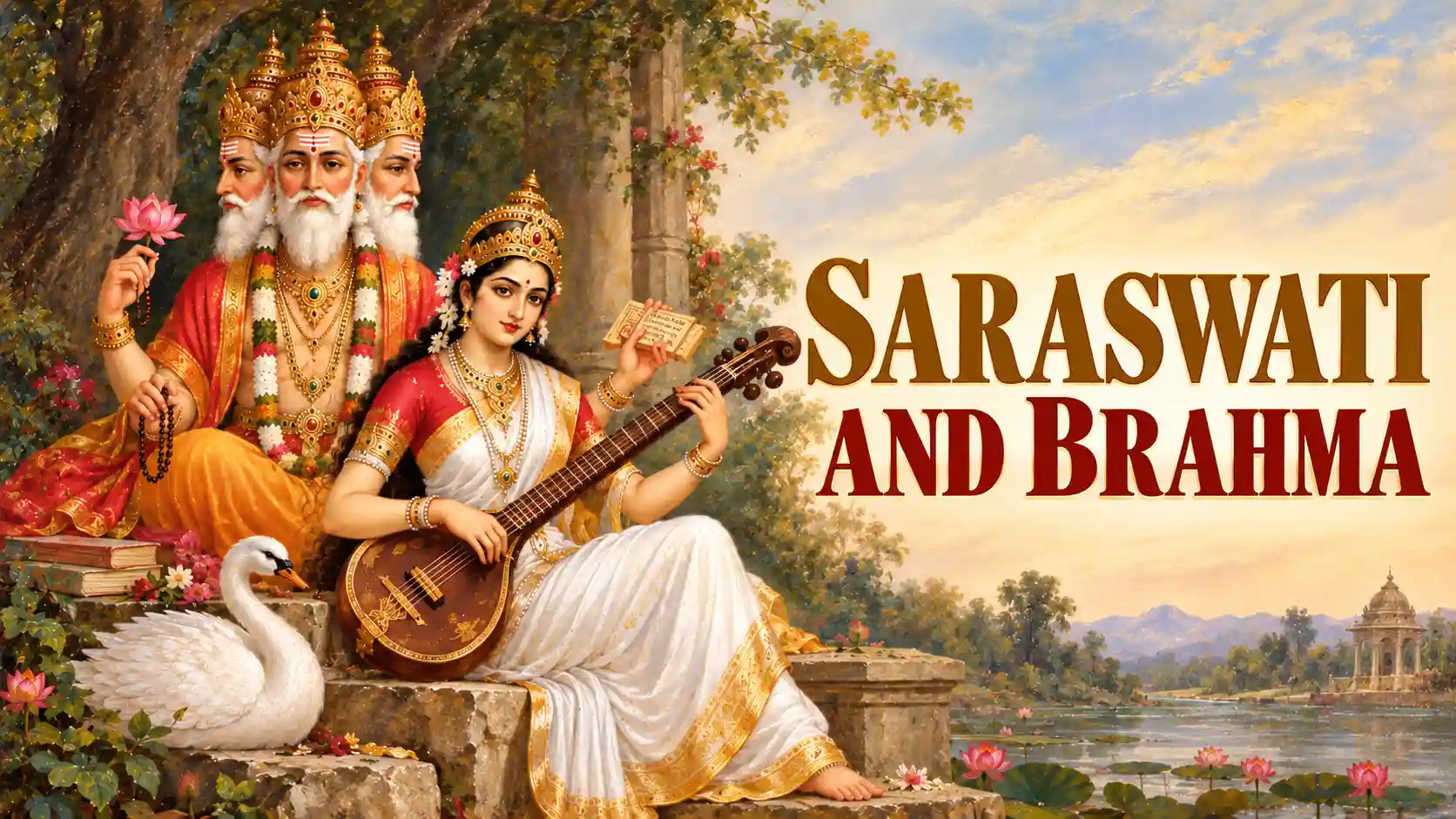
Saraswati’s objects usually point to music, learning and clarity, and Brahma’s four heads are often linked to the Vedas or the four directions. These are common readings, not fixed rules. Sources often describe the same image in different ways, so a symbol’s meaning depends on the tradition behind it.
| Symbol | Common reading | Qualification |
| Veena | Music and the arts | Readings about inner harmony are interpretive. |
| Book | Learning and sacred knowledge | Name the tradition when linking it to the Vedas. |
| Mala (rosary) | Prayer, repetition, contemplation | Meaning varies by context. |
| Lotus | Purity or spiritual significance | Not every depiction assigns the same meaning. |
| Swan | Her traditional vehicle; in some explanations, discernment | The milk-and-water idea is a traditional motif. |
| White clothing | Often purity, learning or simplicity | A common interpretation, not a rule. |
| Four arms | Sometimes the Vedas or aspects of knowledge | Some sources link them to Brahma’s four heads. |
| Brahma’s four heads | Commonly the four Vedas or four directions | Traditional accounts differ from later symbolic readings. |
A teacher might introduce the veena as an emblem of music and learning, then offer inner harmony as a personal reflection. Saying which part is tradition and which is reflection keeps both honest.
How does Saraswati connect to yoga?
Patanjali’s Yoga Sutras do not present Saraswati as a deity or give her a chakra. Her place in yoga comes through devotional traditions, mantra and chanting, study of sacred texts, and modern classroom teaching. Chakra links vary between teachers, so present them as one teacher’s view, not as settled ancient doctrine.
She is most often connected with sacred speech and sound. That is why teachers bring her into chanting and self-study (svādhyāya). A common devotional mantra is Oṃ Aiṃ Sarasvatyai Namaḥ.
Teachers disagree on chakras. Some link her with speech and the throat, while YogaVibes pairs her with the sacral chakra. Learn the pronunciation from a reliable teacher or recording, and understand the meaning before you chant.
Should you bring Saraswati into your practice or class?
A Saraswati invocation can work in a yoga class when the teacher understands its context, explains the meaning, and lets students join, listen or opt out. If the teacher cannot offer that, it is better to teach the related philosophy without requiring an invocation. Respect for students matters more than including the chant.
A quick decision framework:
- Can you explain the mantra’s meaning? If not, study it first.
- Can you pronounce it with help from a teacher or recording? If not, listen before leading.
- Can everyone opt out comfortably? If not, teach the philosophy without the chant.
| Potential value | What the teacher should consider |
| Introduces a religious and philosophical tradition | Explain the context without assuming shared beliefs. |
| Connects chanting with learning | Provide a reliable translation and pronunciation. |
| Opens the study of traditional symbolism | Separate the source’s meaning from your own interpretation. |
| Offers a devotional practice | Make participation voluntary. |
Checklist: translation ready · pronunciation checked · source named · opt-out stated · no promises about exams, health or luck.
Trainees who want to study this in depth can ask any school, including Yoga New Vision’s yoga teacher training in Bali, for its philosophy syllabus and reading list.
What is Saraswati Day in Bali?
Hari Raya Saraswati, when Balinese Hindus honor Saraswati as the source of knowledge, falls on 31 October 2026. It follows the 210-day Pawukon calendar, so it comes twice a year, with the next observance listed for 29 May 2027. It is separate from Vasant Panchami in India, which follows a different calendar.
Hari Pangredanan on 30 October is a day of spiritual preparation before Saraswati Day, and Banyu Pinaruh follows the next day. School ceremonies often have students in traditional dress bringing offerings for their books. Vasant Panchami falls on 23 January 2026 and 11 February 2027.
If you visit, dress modestly, ask before taking photos, and follow local guidance. Avoid describing Saraswati Day as simply the Balinese version of Vasant Panchami.
Frequently asked questions
The main questions have qualified answers: Saraswati is Brahma’s consort in some texts, and Vāk is his daughter in the Bhagavata Purana. Brahma’s limited worship has a traditional explanation, yoga’s link to Saraswati is devotional, and Bali’s festival follows its own calendar. Each answer below names the source or tradition it relies on.
-
Is Saraswati Brahma’s wife or daughter?
Texts differ. Some narratives present Saraswati as Brahma’s consort. The Bhagavata Purana, at 3.12.28, describes a daughter of Brahma named Vāk, and later retellings connect Vāk with Saraswati. Because the identities shift between sources, quote the specific text you rely on instead of giving one answer for all of Hinduism.
-
Why isn’t Brahma widely worshipped?
A popular story links it to a curse from Saraswati after a ritual at Pushkar. That is a traditional explanation, not a complete historical account. Devotional traditions have also centered on other deities, such as Vishnu, Shiva and the Goddess, so the curse should not be presented as the only reason.
-
Is Saraswati in the Yoga Sutras?
No. Patanjali’s Yoga Sutras do not present Saraswati as a deity or describe a Saraswati-specific practice. Her connection to yoga comes through devotional traditions, mantra and chanting, and modern teaching. A teacher who links her to a chakra is offering a modern interpretation, not a rule from the Sutras.
-
Can non-Hindus chant a Saraswati mantra?
There is no single answer for every tradition. Anyone interested should learn the mantra’s meaning, understand its devotional context, and seek guidance from a knowledgeable teacher. In a yoga class, chanting should be an invitation, not a requirement, so students can join, listen quietly or sit it out.
-
When is Saraswati Day in Bali?
Hari Raya Saraswati falls on 31 October 2026, with the next observance listed for 29 May 2027 under the 210-day Pawukon calendar. Banyu Pinaruh follows the day after. Because this is a date-specific observance, check a current Bali Hindu calendar before planning a visit or publishing dates.
-
Does a Bali yoga teacher training cover this?
It depends on the school. Many trainings include yoga philosophy, but not every one covers Hindu deities, mantra or local ceremonies. Before enrolling, ask for the written curriculum, the texts used, and who teaches the philosophy module, so you know what to expect instead of assuming it is included.