Chakra colors are symbolic colors associated with the seven main chakras in modern yoga traditions. They are used in meditation, visualization, and personal development practices. The most common system links red to the root chakra and violet to the crown chakra, although color associations vary across traditions. twentieth century. meditation and visualization practices for relaxation, though chakra-color systems themselves are primarily spiritual frameworks. claims.
What Are Chakra Colors?
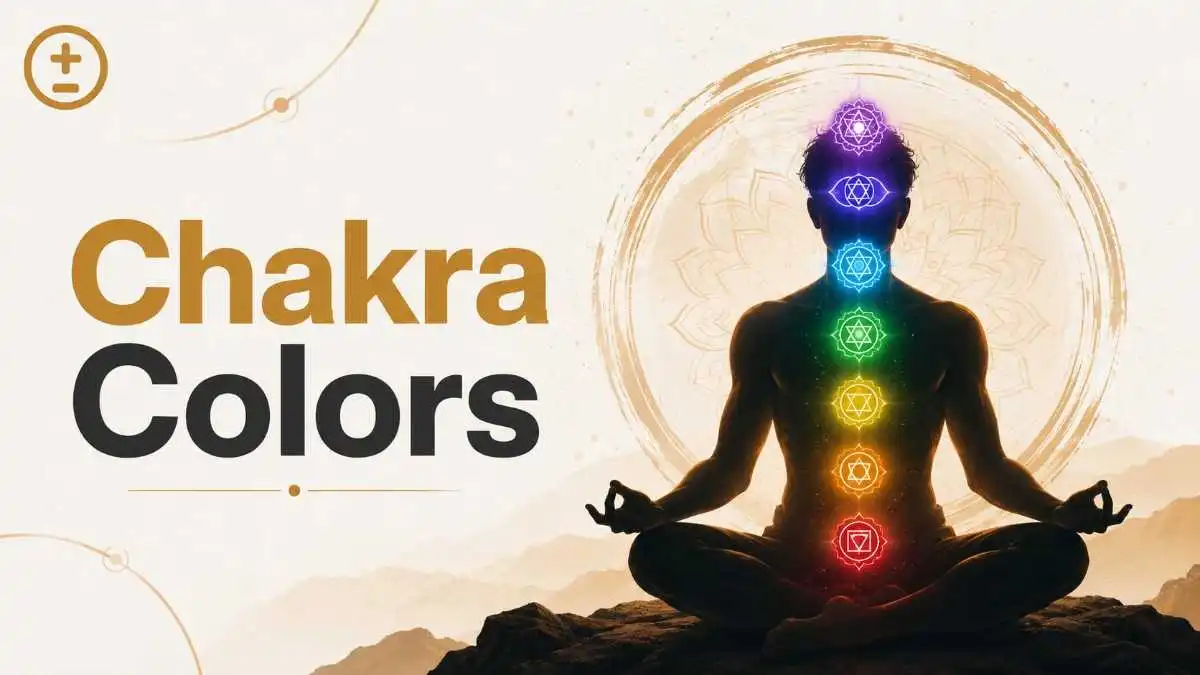
Chakras are energy centers along the spine, from the base to the crown of the head. Each one is linked to a color, a body area, and a theme such as safety, creativity, or self-expression. Yoga students use these colors as a focus point in meditation and as a simple way to remember what each chakra represents.
This system is not about literal light inside your body. It is a teaching tool, much like a map uses color to separate countries that have no real lines on the ground.
The History of Chakra Colors
Chakras are old. They appear in tantric texts going back centuries, including the Sat-Chakra-Nirupana, translated into English by Sir John Woodroffe in 1919 as “The Serpent Power.”
The rainbow color system, red for root through violet for crown, is much newer. It was shaped largely by Theosophist Charles Leadbeater in his 1927 book “The Chakras,” then popularized further by Christopher Hills in 1977.
So the chakras are ancient, but the rainbow color code is a 20th century addition, not a teaching from thousands of years ago. Earlier traditions used different colors, or none at all.
The 7 Chakra Colors and Their Meanings
Root Chakra (Muladhara)
Sanskrit Name: Muladhara. Location: Base of spine. Color: Red. Traditional Meaning: Grounding and a stable foundation for the body. Modern Interpretation: A symbol for security and feeling settled. Common Associations: Earth, family, basic needs. Daily Application: Wear red or try Mountain Pose when unsteady.
Sacral Chakra (Svadhisthana)
Sanskrit Name: Svadhisthana. Location: Lower abdomen. Color: Orange. Traditional Meaning: Creativity, pleasure, and emotional flow. Modern Interpretation: Room for joy without guilt. Common Associations: Water, emotion, sensuality. Daily Application: Try a hip-opening pose or a short creative task.
Solar Plexus Chakra (Manipura)
Sanskrit Name: Manipura. Location: Upper abdomen. Color: Yellow. Traditional Meaning: Personal power and willpower. Modern Interpretation: Confidence in making decisions. Common Associations: Fire, self-esteem, motivation. Daily Application: Wear yellow or practice Kapalabhati breath before a task.
Heart Chakra (Anahata)
Sanskrit Name: Anahata. Location: Center of chest. Color: Green, sometimes pink. Traditional Meaning: Love, compassion, and connection. Modern Interpretation: Self-compassion, not only love for others. Common Associations: Air, forgiveness, openness. Daily Application: Try a gentle backbend, then name one thing you forgive.
Throat Chakra (Vishuddha)
Sanskrit Name: Vishuddha. Location: Throat. Color: Blue. Traditional Meaning: Honest, clear communication. Modern Interpretation: Courage to say what you mean. Common Associations: Space, truth, expression. Daily Application: Hum for one minute before a hard conversation.
Third Eye Chakra (Ajna)
Sanskrit Name: Ajna. Location: Between the eyebrows. Color: Indigo. Traditional Meaning: Intuition and inner insight. Modern Interpretation: Trusting judgment over overthinking. Common Associations: Light, clarity, focus. Daily Application: Sit quietly two minutes before deciding.
Crown Chakra (Sahasrara)
Sanskrit Name: Sahasrara. Location: Top of the head. Color: Violet, sometimes white. Traditional Meaning: Connection beyond the individual self. Modern Interpretation: Purpose beyond daily tasks. Common Associations: Thought, stillness, perspective. Daily Application: Sit in silence for five minutes, phone away.
Table 1: The 7 Chakras Overview
| Chakra | Sanskrit Name | Color | Main Theme |
| Root | Muladhara | Red | Stability |
| Sacral | Svadhisthana | Orange | Creativity |
| Solar Plexus | Manipura | Yellow | Confidence |
| Heart | Anahata | Green | Compassion |
| Throat | Vishuddha | Blue | Honesty |
| Third Eye | Ajna | Indigo | Intuition |
| Crown | Sahasrara | Violet | Awareness |
Table 2: Chakra Colors and Meanings
| Color | Associated Chakra | Symbolism |
| Red | Root | Survival, grounding |
| Orange | Sacral | Creativity, emotion |
| Yellow | Solar Plexus | Power, confidence |
| Green | Heart | Love, balance |
| Blue | Throat | Truth, calm |
| Indigo | Third Eye | Insight, focus |
| Violet | Crown | Unity, stillness |
Chakra Colors vs Color Psychology
Color psychology is a separate, evidence-based field. Studies show red can raise alertness and blue can lower perceived stress. These findings involve mood and attention, not energy centers.
Chakra color traditions are symbolic, not measured. They come from spiritual teaching, not lab data. Both can be useful, as long as you know which one you are using.
Table 4: Chakra Colors vs Color Psychology
| Chakra Colors | Color Psychology | Focus | Application |
| Symbolic, spiritual | Measured, behavioral | Inner meaning | Meditation, ritual |
| Tied to energy centers | Tied to mood and attention | Self-reflection | Design, marketing |
| Rooted in tradition | Rooted in research | Personal practice | Everyday environment |
Chakra Colors for Each Day of the Week
Ancient astrology assigns a ruling planet to each day of the week. This system appears in both Western and Vedic astrology, since both trace back to a shared source.
The chakra color added to each day is a newer layer on top of that older system. You will see different chakra-day pairings on different sites because of this. None of them is the single correct answer.
Table 3: Weekly Chakra Colors
| Day | Color | Suggested Practice |
| Monday | White | Quiet reflection or journaling |
| Tuesday | Red | Grounding poses, short walk |
| Wednesday | Blue | A clear, honest conversation |
| Thursday | Yellow | One task that needs confidence |
| Friday | Green | Time with people you love |
| Saturday | Purple | Slow down, review your week |
| Sunday | Orange | A creative or playful activity |
How to Use Chakra Colors in Daily Life
You do not need a special setting to use chakra colors. Small, repeated choices work better than one big ritual.
Meditation: Picture one color filling its body area for two or three minutes. Clothing: Wear a color that matches how you want to feel that day. Journaling: Write three lines about what that color’s theme means to you. Visualization: Close your eyes and picture the color as light, not an object. Yoga Practice: Choose one pose linked to the chakra you are working with. Home Environment: Add one object in that color to your desk or altar. Intention Setting: Pick one color each morning and one intention to match it.
Common Misconceptions About Chakra Colors
Many people assume the rainbow color system is thousands of years old. It is closer to one hundred years old, while the chakras themselves are far older.
Some assume the heart chakra is always green. Several traditions use pink instead, especially for emotional healing work.
You do not need to believe in energy healing to benefit from this practice. Treating a color as a focus point works on its own, even for skeptical readers.
What I Tell Students About Chakra Colors
In my experience teaching yoga students, the first question is almost always whether this is real or symbolic. I tell them it is symbolic, and that this does not make it less useful.
One misconception I correct often is the idea that a single chakra system exists and every teacher agrees on it. Students are usually surprised by how much color assignments vary between books and teachers.
What I find most useful in class is treating color as a focus tool. A student does not need to believe in energy centers to benefit from picturing blue light before a hard conversation.
Frequently Asked Questions
-
What are chakra colors?
Chakra colors are seven colors, each linked to one of the body’s main energy centers. They run from red at the base of the spine to violet at the crown of the head. Teachers use them as a visual shorthand in meditation and yoga practice.
-
Are chakra colors thousands of years old?
The chakras themselves are old and appear in tantric and yogic texts written many centuries ago. The rainbow color system most people know today is much newer, shaped mainly in the 20th century by writers like Charles Leadbeater. Earlier texts described the chakras without this fixed color code.
-
Is there scientific proof chakra colors work?
There is no scientific proof for chakras as physical energy centers in the body. Color psychology, a separate and well-studied field, does show that colors can affect mood and attention in measurable ways. These two systems should not be confused, even though they sometimes overlap in practice.
-
What color is the heart chakra?
Green is the most common color used for the heart chakra in modern yoga teaching. Some traditions use pink instead, especially in work focused on self-compassion and emotional healing. Both colors are widely accepted today, and neither one is more correct than the other.
-
Why do weekly chakra colors differ between websites?
The pairing of a chakra color with each weekday is a modern addition, not part of the original chakra teachings. Different teachers and authors built their own versions of this system over the past century. Because there is no single original source, none of these versions can be called the correct one.
-
Can I use chakra colors if I am not spiritual?
Yes, you can use chakra colors without accepting any spiritual or energetic belief system. Treating a color as a simple focus point during meditation works as a mental tool on its own. Many students who describe themselves as skeptical still find the practice calming and useful.
-
How do I meditate using chakra colors?
Sit quietly and picture one color slowly filling the body area linked to that chakra. Breathe slowly and evenly for two or three minutes while holding this image gently in your mind. If your attention wanders, simply bring it back without judging yourself for losing focus.
-
What is the difference between indigo and violet?
Indigo is linked to the third eye chakra and represents intuition and inner insight. Violet is linked to the crown chakra and represents a broader sense of awareness. The two colors sit next to each other on the visible light spectrum, which is why they are often confused.
-
Can chakra colors help with anxiety?
Many students report feeling calmer after practicing color visualization for a few minutes. This is a personal observation shared by teachers and students, not a medical claim about treating anxiety. If anxiety is affecting your daily life, speak with a qualified healthcare professional as well.
-
What is the easiest chakra color to start with?
Most beginners start with the root chakra and the color red, since it is the easiest color to picture clearly. It also connects naturally to a simple daily action, such as a grounding standing pose. Starting here gives new students an early sense of how the practice feels.
About Deep Kumar
Deep Kumar is an Indian yoga teacher and the founder of Yoga New Vision. He trained in the Kaivalyadhama lineage and holds ERYT-500 status with Yoga Alliance, with years of teaching experience across India and abroad.
His teaching method, the YNV Method, blends classical yoga philosophy with the Alexander Technique, Bioenergetics, and Buteyko Breathing. He has led yoga teacher trainings and meditation courses for students from many countries, both at his school in India and at his program in Bali.
Deep focuses on practical, honest teaching rather than mystical claims. He encourages students to question what they read and test each practice for themselves before accepting it as true.
Conclusion
Chakra colors are a teaching tool, not a fixed scientific system. The chakras are old, the rainbow color code is recent, and both facts can sit comfortably together.
Use these colors with curiosity instead of certainty. Notice what shifts in your attention when you sit with a color for two minutes. That small habit, repeated often, matters more than memorizing every meaning in this guide.