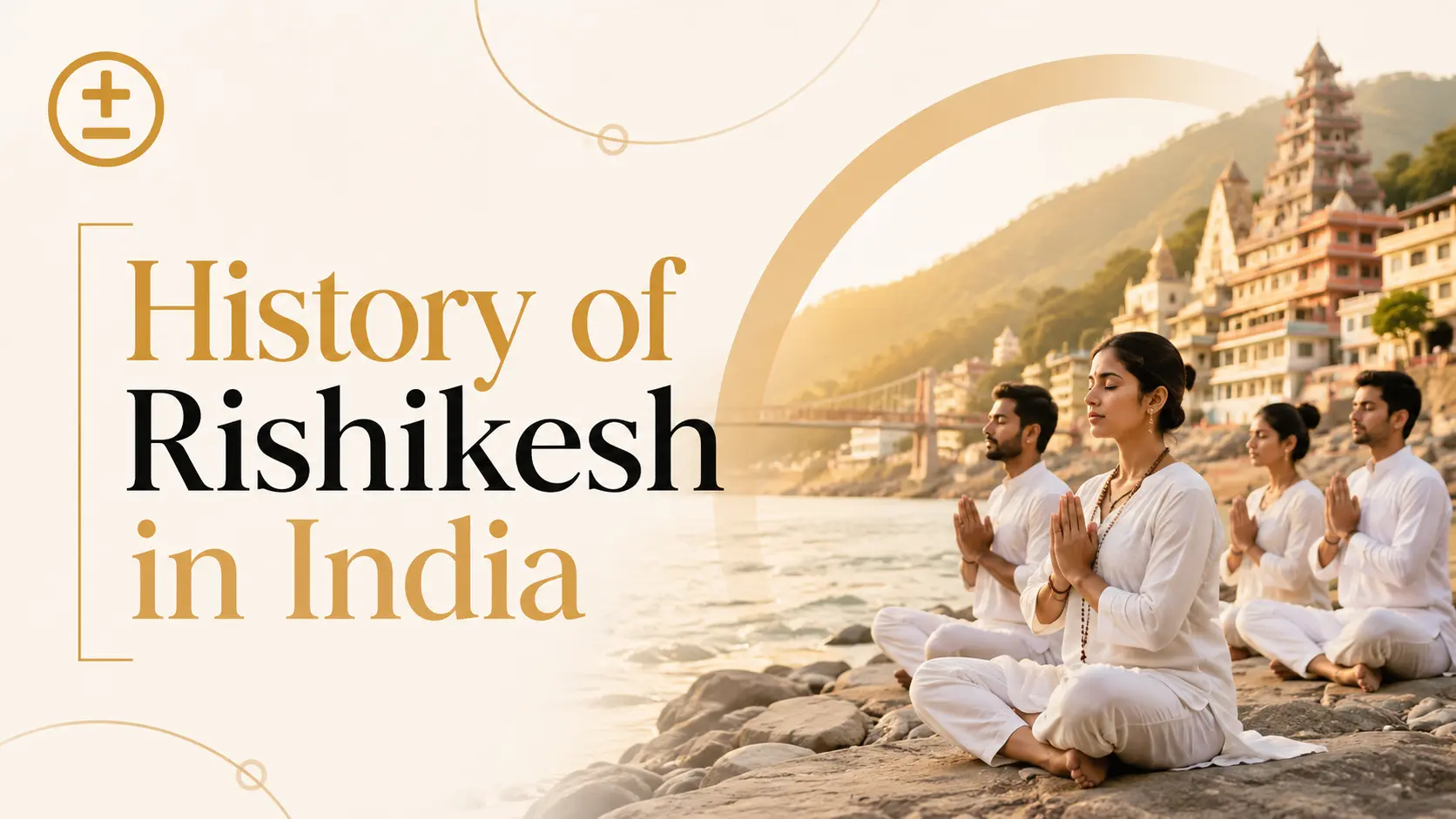
Rishikesh is a pilgrim town in Uttarakhand, India, on the bank of the Ganga in the foothills of the Himalayas. Known for centuries as a place of meditation and Hindu pilgrimage, it gained worldwide attention after the Beatles studied meditation there in 1968, and it is now widely called the Yoga Capital of the World.
What Is Rishikesh?
Rishikesh sits in the Dehradun district of Uttarakhand, on the right bank of the Ganga, where the river leaves the Himalayan foothills for the plains, surrounded by the Shivalik range and the Garhwal Himalayas. It holds deep spiritual significance for Hindus, with temples and ashrams drawing pilgrims for generations, and it is the starting point for the Char Dham Yatra to Yamunotri, Gangotri, Kedarnath, and Badrinath.
The Meaning Behind the Name Rishikesh
The Sanskrit Meaning
The name comes from hrishik, the senses, and ish, lord or master, forming Hrishikesh, “lord of the senses.” A second reading joins rishi, sage, with kesh, hair, referring to the matted locks of meditating ascetics.
The Traditional Legend of Sage Raibhya
According to tradition, not documented history, the sage Raibhya performed long penance on the Ganga at this spot. It is believed Lord Vishnu appeared before him and gave him the name Hrishikesh, and the town later took it. I share this with students as a devotional story, not a historical event.
The Ancient History of Rishikesh
References in Hindu Traditions
Hindu texts describe the wider region as Kedarkhand, a name found in the Skanda Purana, placing Rishikesh within an older sacred geography that reaches the Char Dham sites.
The Ramayana Connection
According to tradition, Lord Rama performed penance here after his battle with Ravana, and Lakshmana is said to have crossed the Ganga on a rope bridge where Lakshman Jhula now stands.
The Mahabharata Connection
The Mahabharata does not name Rishikesh as specifically as the Ramayana tradition does. Hindu belief places the wider Garhwal region within the epic’s sacred landscape, but I have not found a documented reference naming the town, and I prefer to say so honestly.
A Timeline of Rishikesh History
| Period | Event | Why It Matters |
| Ancient era | Skanda Purana names the region Kedarkhand; Ramayana tradition links it to Rama and Lakshmana | Places Rishikesh in sacred geography |
| 1889 | First Lakshman Jhula built | Connected pilgrims across the river |
| 1927 | Bridge rebuilt after flood damage | Restored pilgrim access |
| 1936 | Swami Sivananda founds the Divine Life Society | Start of Rishikesh’s yoga institutions |
| 1942 | Parmarth Niketan ashram founded | Became one of India’s largest ashrams |
| 1961 to 1963 | Maharishi Mahesh Yogi builds his meditation academy | Set the stage for 1968 |
| 1968 | The Beatles stay at the ashram | Brought global attention |
| 1999 | International Yoga Festival begins at Parmarth Niketan | Formalized an annual gathering |
| 2015 | Beatles Ashram reopens to the public | Renewed worldwide curiosity |
| Present day | More than 100 registered yoga schools | Known as the Yoga Capital of the World |
How Rishikesh Became the Yoga Capital of the World
Swami Sivananda and the Divine Life Society
Swami Sivananda, a physician before he became a monk, settled in Rishikesh in the 1920s and founded the Divine Life Society in 1936, teaching what he called the Yoga of Synthesis, decades before the world was paying attention.
The Beatles and Global Attention
The Beatles’ 1968 stay at Maharishi Mahesh Yogi’s ashram brought international attention to Rishikesh and helped popularize yoga and meditation globally. John Lennon, Paul McCartney, George Harrison, and Ringo Starr studied Transcendental Meditation there, and much of the White Album was written during that stay. Whenever I visit India, I am reminded how much of the West’s early exposure to Indian spiritual practice traces back to those few weeks.
The Rise of Yoga Teacher Training
As Western interest grew, Rishikesh’s ashram culture professionalized into the certified training model students recognize today, with Yoga Alliance registration becoming standard as schools multiplied through the 1990s and 2000s.
The International Yoga Festival
Established at Parmarth Niketan in 1999, the festival now draws teachers and students from dozens of countries each year, giving Rishikesh a recurring identity beyond a single moment.
Rishikesh Then vs Rishikesh Now
| Category | Then | Now |
| Tourism | Small numbers of pilgrims and sadhus | Over a million visitors a year |
| Transportation | Footbridges, ferries, narrow roads | Two bridges, rail access, a nearby airport |
| Yoga Schools | A handful of ashrams led by teachers like Sivananda | More than 100 registered Yoga Alliance schools |
| Lifestyle | Quiet, ashram centered, low population | Busy, residents and travelers sharing streets |
| Economy | Pilgrimage and ashram support | Wellness tourism, training, sports, cafes |
| Culture | Local Hindu pilgrimage, mostly Indian visitors | Same traditions, shared with an international community |
| Environment | Cleaner river, lighter footprint | Visible strain from waste and crowding |
Life in Rishikesh Today
Life for Local Residents
Many residents still build their day around the river, temple visits, and family routine, inside a town that remains legally vegetarian and alcohol-free.
Life for Yoga Students
Students typically follow an early practice, shared vegetarian meals, philosophy or anatomy classes, and an evening at the ghats, more structured than most newcomers expect.
Ashram Life
Ashram routines run stricter than a hotel-style retreat, with set meal times and group practice, which suits serious students and takes adjustment for casual travelers.
Digital Nomads and Cafes
A newer layer of long-stay visitors now works from Rishikesh’s cafes between practice sessions, a shift that has changed the town’s rhythm over the last decade.
Adventure Tourism
River rafting, bungee jumping, and trekking now sit alongside the spiritual side of town, which surprises visitors expecting only stillness.
What Most Articles Get Wrong About Rishikesh
Is Rishikesh the birthplace of yoga? This is a common claim, but it is not well documented. Yoga’s roots spread across India over a long period, and Rishikesh’s importance is more recent.
Did the Beatles discover yoga? No. Ashrams such as the Divine Life Society had trained students since 1936, more than thirty years before the Beatles arrived. What changed was global attention, not origin.
Is all yoga in Rishikesh traditional? Students often assume every school carries deep lineage. In practice, quality and depth vary widely between schools, the same as anywhere else.
Is Rishikesh only for spiritual people? No. Pilgrims, yoga students, adventure tourists, and casual travelers share the same small geography, often with little overlap.
What I Tell Students About Rishikesh
In my experience teaching yoga, students often arrive expecting instant transformation, as if the location alone will change them. I tell them Rishikesh matters because of its teachers and history, not magic in the water. Many students ask whether they need to go there to learn “real” yoga, and I do not think that is true. What Rishikesh offers is concentration, an unusual number of serious teachers and students in one place at once. What they should expect is discipline, simple food, and long days. What they should not expect is comfort or a guaranteed spiritual experience just for showing up. Depth comes from practice, not geography alone.
Rishikesh vs Bali for Yoga Teacher Training
| Factor | Rishikesh | Bali |
| Climate | Hot summers, cold winters, monsoon season | Warm and tropical year round |
| Culture | Hindu pilgrimage town, vegetarian and alcohol free by law | Balinese Hindu culture, more flexible |
| Lifestyle | Structured, ashram centered, fewer distractions | Relaxed, nature and beach focused |
| Learning Environment | Deep concentration of traditional Indian teachers | Strong international teaching community |
| Cost | Generally lower for tuition and stay | Mid-range, depending on school |
| Community | Mostly short-term, rotating student groups | Smaller, closer-knit batches |
Planning a Visit to Rishikesh
The most comfortable months are September to November and February to April, outside the summer heat and monsoon rains. Rishikesh is reachable by road from Delhi in about six hours, by rail to Rishikesh station, or by air through Dehradun’s Jolly Grant Airport, roughly 20 kilometers away. Uttarakhand Tourism has current travel details. Must-see places include Lakshman Jhula, Ram Jhula, Triveni Ghat for the evening Ganga Aarti, the Beatles Ashram, and the Divine Life Society. Beatles Ashram Resource is a useful starting point. Expect a town genuinely sacred to many residents and more layered than a single photograph suggests.
Frequently Asked Questions
-
Why is Rishikesh famous?
Rishikesh is famous as a Hindu pilgrimage town on the Ganga and as the place where the Beatles studied meditation in 1968, which brought global attention to a yoga culture that already existed there.
-
Why is Rishikesh called the Yoga Capital?
The title reflects its concentration of yoga schools and ashrams, built on the foundation Swami Sivananda laid in 1936 and reinforced by the International Yoga Festival since 1999.
-
Is Rishikesh mentioned in the Ramayana?
According to tradition, yes. Hindu belief holds that Lord Rama did penance near Rishikesh and that Lakshmana crossed the Ganga where Lakshman Jhula now stands. This is tradition, not a confirmed historical record.
-
What is the Beatles Ashram?
Also known as Chaurasi Kutia, it was built in the early 1960s by Maharishi Mahesh Yogi as a meditation academy. The Beatles stayed there in 1968, and the site reopened to the public in 2015.
-
What is the history of Lakshman Jhula?
The first bridge was built in 1889, was damaged by flooding, and was rebuilt in 1927. It later collapsed, and a stronger replacement has been planned, continuing a long history of connecting both banks.
-
Is Rishikesh a good place for yoga teacher training?
Yes, for students who want a structured, traditionally rooted environment with experienced Indian teachers. It suits people who prefer discipline over comfort.
-
What is daily life like in Rishikesh?
Daily life mixes pilgrim routine, ashram schedules, and a growing cafe and remote-work culture. Residents, students, and travelers share the same streets with very different rhythms.
-
What is the best time to visit?
September to November and February to April offer the most comfortable weather, avoiding the summer heat and the monsoon rains that run roughly June through September.
-
Is Rishikesh only for spiritual people?
No. Alongside pilgrims and yoga students, Rishikesh draws adventure tourists for rafting and trekking, and increasingly, remote workers who stay for weeks at a time.
-
How is Rishikesh different from Bali?
Rishikesh offers a structured, ashram-based environment rooted in Indian tradition, while Bali offers a relaxed, tropical setting with a strong international teaching community. Both lead to genuine training.
Conclusion
Rishikesh earned its place in the story of yoga through specific teachers, specific institutions, and a moment of global attention in 1968 none of them could have planned. Understanding that history is part of respecting where this practice comes from. History of Yoga in India and Top Yoga Gurus of India go further into that lineage. I encourage every student to stay curious about Rishikesh’s roots, whether or not their training happens there.
About Deep Kumar
Deep Kumar is an Indian yoga teacher and the founder of Yoga New Vision. Trained in traditional yoga education with roots in the Kaivalyadhama lineage, he holds ERYT-500 credentials with Yoga Alliance and has taught yoga philosophy for over a decade. His approach combines classical Yoga Philosophy Guide with practical anatomy and breathwork, shaped by years of study under Indian master teachers. He leads the 200 Hour Yoga Teacher Training Bali and the advanced 300-hour program, mentoring students in yoga as a lived practice.