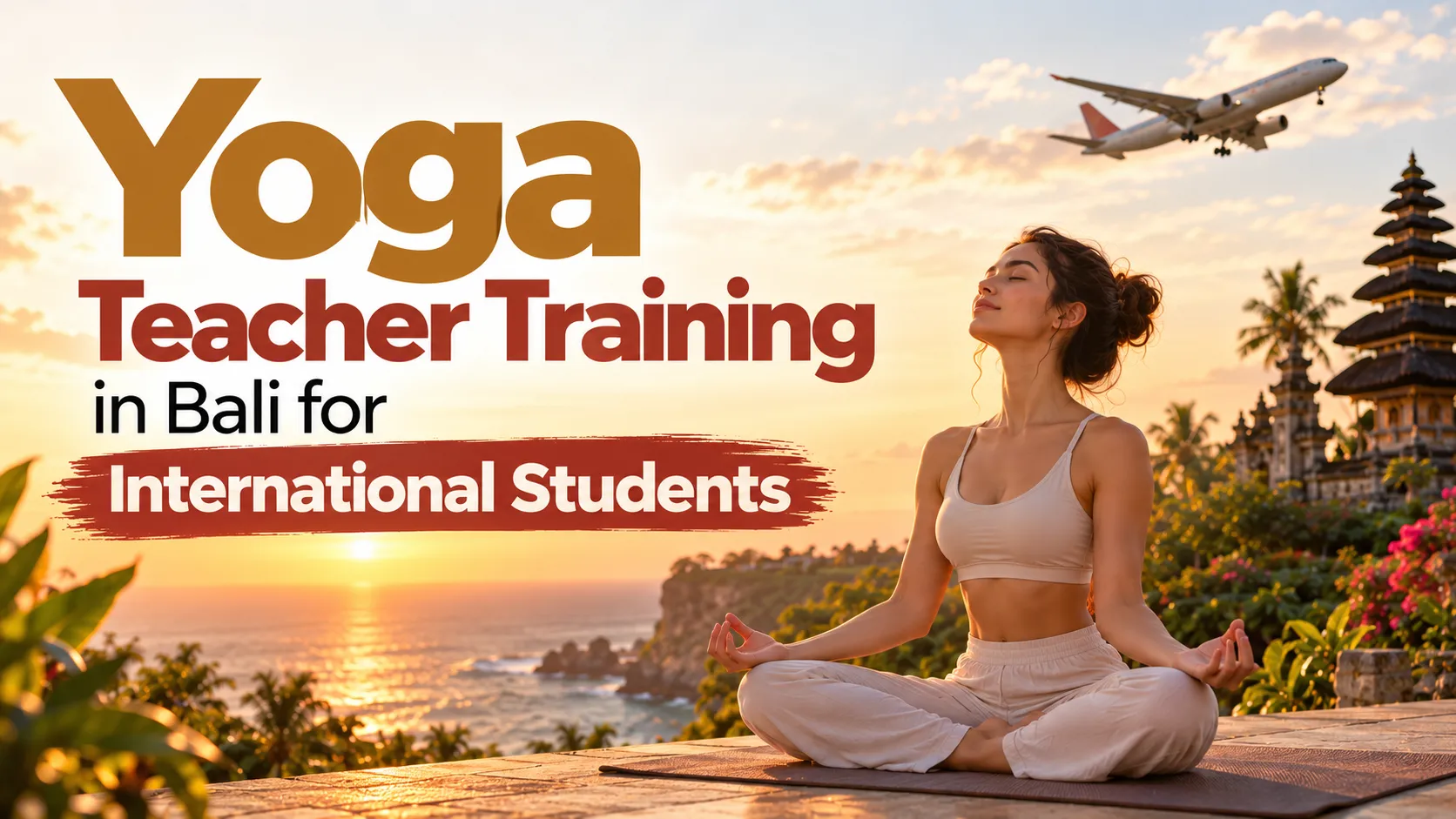
Bali is one of the most established destinations for international students completing a residential yoga teacher training. Programs vary widely in duration, price, teaching format, and certification pathway, so no single description fits every school. Before booking, confirm the school’s Yoga Alliance registration status, total cost, accommodation arrangements, and current Indonesian entry requirements for your passport. This guide walks through what actually differs between programs and what to check before you commit.
200-Hour YTT in Bali: What to Verify
Every Bali yoga school markets itself as international, certified, and beginner-friendly, but the details behind those claims differ a lot. Location, certification designation, teaching language, cost, and what’s included in the price all vary by school. Use the table below as a starting checklist, then confirm each row directly with any program you’re considering rather than assuming it matches every other listing.
| Detail | What to verify |
| Location | Ubud, Canggu, Uluwatu, or elsewhere in Bali |
| Duration | Exact number of training days |
| Certification | Whether the school is a current Yoga Alliance RYS, and which designation |
| Teaching language | English or another language |
| Tuition | Current published fee |
| Accommodation | Included, optional, or separate |
| Meals | Included or separate |
| Entry requirements | Current Indonesian immigration rules for your passport |
Why International Students Choose Bali
International students choose Bali mainly for practical reasons, not just the scenery. Ubud has one of the highest concentrations of yoga schools, wellness businesses, and international travelers in Southeast Asia, which makes it easier to build a daily training routine while still experiencing life outside the classroom. For someone traveling alone, arriving in a place already full of people doing something similar makes the transition less isolating than it might be elsewhere.
Deep Kumar, Yoga New Vision’s founder, trained in the Kaivalyadhama lineage and holds an ERYT-500 credential. He built the school’s outdoor practice schedule around a simple idea: real time on the mat, not just hours in a classroom.
Do You Need Experience to Join?
Most 200-hour programs accept students with no formal teaching background, including complete beginners, as long as they have some familiarity with basic postures. Schools expect consistency more than flexibility. Someone who practices regularly for a few months before arriving usually adjusts faster than someone who is naturally flexible but new to a mat. Confirm any specific prerequisites directly with your shortlisted school, since a few programs do require prior hours logged.
This suits you if you want a real teaching credential, want to deepen a personal practice, or are testing a possible career change. It’s a poor fit if you’re expecting a passive holiday. The days are physically active and built around a fixed schedule.
Certification, Explained Correctly
Yoga Alliance does not certify individual students directly. It registers schools under a specific training designation, such as RYS 200, based on the school’s curriculum and standards. Graduates of a Registered Yoga School then register themselves individually as a Registered Yoga Teacher, or RYT, once they complete the program. Understanding this two-step process helps you read any school’s marketing claims correctly instead of assuming certification happens automatically.
- RYS (Registered Yoga School): a school registered with Yoga Alliance under a specific training designation, such as RYS 200.
- RYT (Registered Yoga Teacher): the individual credential a graduate applies for after finishing training at an RYS.
- E-RYT: an RYT who has also logged a set number of teaching hours after graduating, which can’t be earned during the course itself.
A school that calls itself “Yoga Alliance certified” is usually describing its RYS status. You still register individually with Yoga Alliance after you graduate, using the completion documents the school provides. Yoga Alliance is a membership organization, not a government regulator. It sets training standards; it doesn’t grant legal authorization to teach in any specific country.
Visa Rules for International Students
Your entry permission depends on your passport, the length and nature of the training, and current Indonesian immigration rules, so there is no single visa answer that applies to every student. Don’t assume a tourist visa or visa-on-arrival automatically covers every type of course. Indonesia’s immigration system includes several visitor categories, and some short-course or training situations may fall under a different category than ordinary tourism.
Check the official Indonesian immigration website (imigrasi.go.id) for the current rules tied to your passport and your specific course before booking flights. Confirm with your chosen school which entry category their students typically use, since schools that host students regularly usually have current guidance.
Attending training as a paying participant is a different activity, legally, from working as a yoga teacher inside Indonesia. Teaching for pay generally requires a separate work permit and residency arrangement, regardless of where the payment originates. That rule governs people running or teaching the course, not students attending one, but the two situations get confused often enough to state clearly.
Confirm your visa category only after your training dates are locked in, since most entry permits have a fixed validity window tied to your travel dates.
A Typical Day During Training
Schedules vary by school, but a common structure includes an early asana practice, a mid-morning lecture block on anatomy or philosophy, a rest period, and an afternoon session that often includes practice-teaching. One day a week is usually kept free. The table below is an example only; ask your shortlisted school for their actual daily timetable before booking.
Example schedule only. Actual schedules vary by school.
| Time | Activity |
| 6:00–8:00 AM | Morning asana practice |
| 8:00–9:00 AM | Breakfast |
| 9:30 AM–12:30 PM | Anatomy, philosophy, or methodology |
| 1:00–3:00 PM | Rest or self-study |
| 3:30–6:00 PM | Practice teaching or second session |
What’s Included and What’s Not
What a course fee covers differs significantly between schools, so treat any “all-inclusive” claim as a starting point, not a guarantee. Tuition almost always covers instruction and course materials. Accommodation, meals, and Yoga Alliance paperwork support vary; some schools include all three, others include none. Ask for a written breakdown before paying a deposit, not just a verbal summary.
| Usually included | Often varies | Usually separate |
| Tuition and course manual | Accommodation type and quality | Flights |
| Basic instruction | Meals (full board vs. partial) | Visa fees |
| Completion paperwork | Yoga Alliance registration support | Travel insurance, personal spending |
The Real Cost, With a Method You Can Check
Tuition is only one part of the budget, and any total figure you see online depends on assumptions about flights, season, and spending habits that may not match yours. Rather than trusting a single quoted number, build your own estimate: published tuition, plus a round-trip flight quote for your actual dates, plus your passport’s current visa fee, plus a reasonable daily spending allowance.
| Component | How to estimate it |
| Tuition | Published fee from your shortlisted school |
| Flights | Search your actual travel dates, not a generic average |
| Visa | Confirm the current fee on the official Indonesian immigration site |
| Daily spending | Roughly $15 to $30 a day for food, transport, and extras outside the course |
As a rough anchor, published 200-hour tuition across Bali schools commonly falls between $1,500 and $3,900, though this changes by season and school, so confirm the current figure directly.
How to Compare Two Schools
Once you’ve narrowed your options to two or three schools, compare them against the same fixed criteria instead of relying on which website looks nicer. A school with a lower price but fewer practice-teaching hours may cost you more in the long run if you graduate underprepared. Ask every question below before paying a deposit, and get the answers in writing where possible.
- Is the school currently listed as an active Registered Yoga School with Yoga Alliance?
- How many practice-teaching hours are built into the schedule, separate from lecture hours?
- Who is the lead teacher, and what is their training background?
- What is the maximum group size, and is it enforced?
- What exactly is included in the price, in writing?
- Can you speak to a past graduate directly, not just read a testimonial?
- What is the refund and cancellation policy?
- What happens if a student can’t complete the required practicum or assessment?
Potential Advantages and Trade-Offs
Training in Bali comes with real advantages and real trade-offs, and neither should be oversold. Tuition is often lower than equivalent programs in the US, UK, or Australia, and the concentration of schools gives you more choice. At the same time, the flight is long for some regions, the daily schedule is demanding, and quality varies significantly from one school to the next.
Potential advantages: often lower tuition than Western countries, a large choice of styles and schools, an established international student community, warm year-round climate.
Potential trade-offs: long flights from some regions, visa steps you manage yourself, an intensive daily schedule, inconsistent quality between schools.
Common Mistakes International Students Make
The mistakes that cause the most regret are avoidable if you know to look for them before booking, not after arriving. Most come down to trusting a marketing claim instead of checking the underlying detail: the certification wording, the visa rule, or the actual hours spent practice-teaching versus sitting in lectures. None require expert knowledge, just a habit of asking one more question.
- Booking on price alone, without checking practice-teaching hours.
- Assuming Yoga Alliance certifies the course directly, instead of registering the school.
- Assuming every 200-hour program includes the same amount of teaching practice.
- Treating the tourist visa as a formality without checking current rules for your passport.
Yoga New Vision for International Students
Yoga New Vision runs its 200-hour training from Omham Retreats in Kedewatan, just outside Ubud, under founder Deep Kumar and co-founder Sadhana Om. Deep Kumar holds an ERYT-500 credential and trained in the Kaivalyadhama lineage. The school teaches a method it calls Meditative Hatha Vinyasa, combining stillness-based Hatha work with flowing Vinyasa sequencing and a structured meditation component throughout the course.
Yoga New Vision states it has trained more than 15,000 graduates from over 100 countries, with classes taught in English and group sizes kept deliberately small. These are the school’s own figures; ask for current verification, recent graduate contacts, or Yoga Alliance profile details directly if you’d like independent confirmation before booking. Confirm current dates, exact tuition, and what’s included directly with the school, since these change by season.
Your Next Steps
Once you understand the certification structure, visa distinction, and real cost, the remaining steps are mostly administrative. Work through them in order rather than booking flights before your visa question is settled, since that’s the step most likely to cause a costly mistake. None require more than a few emails or a short call with your shortlisted school.
- Shortlist two or three schools using the comparison checklist above.
- Confirm your passport’s current Indonesian entry rules on the official immigration site.
- Ask each school for their RYS status and practice-teaching hour count, in writing.
- Book flights only after your training dates and entry eligibility are confirmed.
- Build your budget using the cost method above, not a single quoted total.
FAQs
-
Do I need a visa to attend yoga teacher training in Bali?
It depends on your passport and the nature of the course. Don’t assume a tourist visa automatically covers every training situation. Check the official Indonesian immigration website for current rules tied to your passport, and confirm with your school which entry category their students typically use before booking flights.
-
Do I need prior yoga experience to join a 200-hour course?
Most programs accept beginners with some familiarity with basic postures, alongside experienced practitioners. Consistency in your practice beforehand helps more than flexibility does. A few schools set specific prerequisites, so confirm directly with your shortlisted program rather than assuming every 200-hour course has identical entry requirements.
-
Is a Bali-earned Yoga Alliance credential recognized where I live?
Yoga Alliance provides a standardized credential within its own system, but it isn’t a government body, so acceptance varies by employer, studio, and insurer. Most Western studios and gyms are familiar with RYT credentials, but confirm specific requirements with any organization where you plan to teach.
-
What’s the difference between RYS and RYT?
RYS is the school’s registration with Yoga Alliance under a specific training designation, such as RYS 200. RYT is the individual credential you apply for yourself after graduating from an RYS. A school being registered doesn’t automatically certify you; you still complete your own registration afterward.
-
How much does a 200-hour YTT in Bali actually cost?
Published tuition commonly falls between $1,500 and $3,900, though this varies by school, season, and what’s included. Add flights, your visa fee, and daily spending on top of tuition for a realistic total. Build your own estimate using current quotes rather than a single average figure.
-
Is the food vegetarian?
Many residential programs in Bali serve vegetarian or vegan meals as a default, but arrangements differ by school. Confirm dietary options, meal count, and whether special diets are accommodated directly with your chosen program before booking, especially if you have specific allergies or restrictions.
-
Is Bali safe for solo international students?
Ubud is widely visited by solo travelers, including women, and many report feeling comfortable there. Safety still depends on normal precautions, current conditions, and personal circumstances, so check your government’s current travel advisory for Indonesia before departure rather than relying on general reassurance alone.
-
What happens if I don’t pass the practical assessment?
Assessment policies vary by school, so ask directly what happens if you don’t complete the required practicum, assignments, or competency requirements. Yoga Alliance expects registered schools to confirm these are met before issuing your completion certificate, so an incomplete assessment can delay your RYT registration.
-
Can I teach online after certifying in Bali?
An RYT 200 credential can support an application to teach online, since most platforms recognize Yoga Alliance registration. Individual platforms set their own additional requirements, though, so check specific criteria with any platform you’re interested in rather than assuming automatic acceptance everywhere.
-
Should I go straight into a 300-hour program after my 200-hour?
You don’t have to move directly into 300-hour training. Many teachers choose to gain real teaching experience first, then pick an advanced program based on the specific areas they want to develop, rather than continuing straight through without a break to teach.