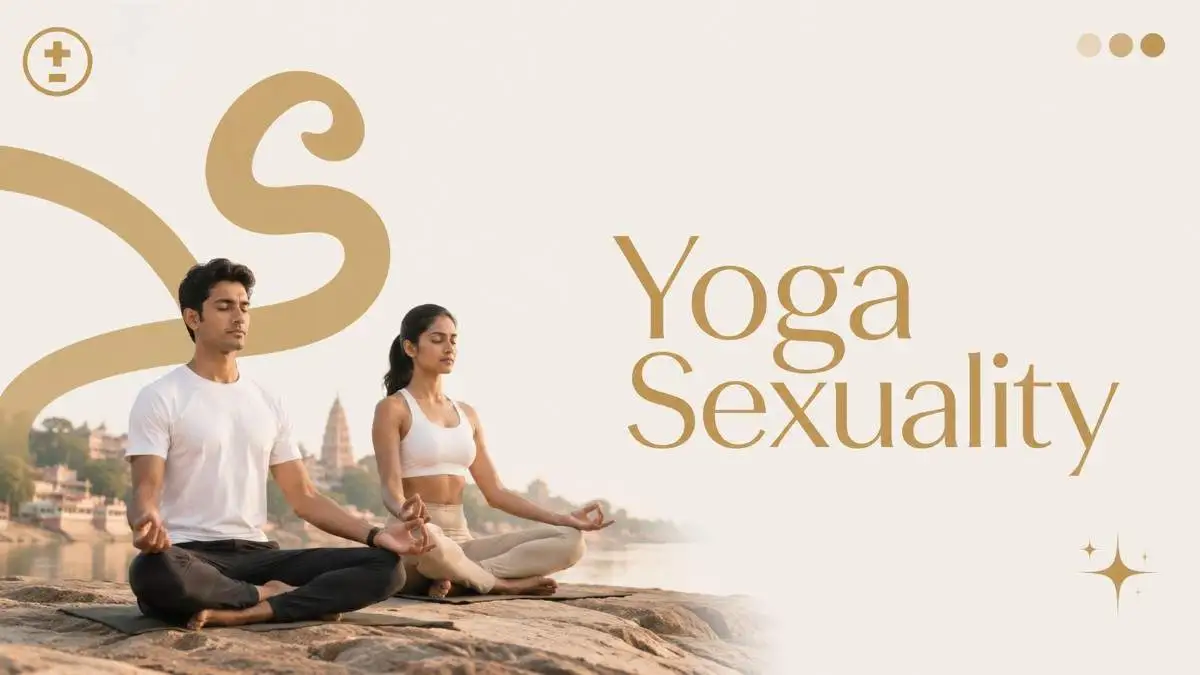
Yoga sexuality is the yogic view that sexual energy, intimacy, and self awareness are connected to overall wellbeing, not separate from it. It draws from ancient ideas like brahmacharya and kama, alongside modern research on stress, the nervous system, and body confidence. It is about connection, not performance.
What Is Yoga Sexuality?
I get asked about this topic more than almost anything else I teach. People expect a list of poses. What they actually want is permission to think about sex, intimacy, and their own body without shame.
Why Sexuality Is Bigger Than Sex
Sexuality is not just the act of sex. It includes how you feel in your body, how safe you feel with another person, and how connected you feel to your own desire. Yoga has always treated the body as sacred ground, and that includes this part of life.
The Difference Between Sexual Performance and Sexual Wellbeing
Performance asks how good you are at sex. Wellbeing asks how present, safe, and connected you feel during it. Yoga points toward wellbeing, not performance.
What Traditional Yoga Teaches About Sexuality
Yoga has never been silent on this subject. The Yoga Sutras address it directly, and so does the wider Yoga Philosophy behind the practice. It just does not talk about it the way modern culture does.
Patanjali and Brahmacharya
Patanjali listed brahmacharya as one of the five yamas in the Yoga Sutras. It is usually translated as celibacy, but that translation misses the point. Brahmacharya means the wise use of your vital energy, sexual energy included, rather than its total denial.
Understanding Kama Within Yoga Philosophy
Kama is one of the four aims of life in Indian philosophy, alongside dharma, artha, and moksha. It refers to pleasure and desire, and yoga never asked people to erase it. Yoga asked people to bring awareness to it instead of letting it run on autopilot.
Common Misconceptions About Yoga and Celibacy
Students often assume serious yoga practice means giving up sex entirely. That is one valid path, mostly for monastics who choose it deliberately. For a working adult raising a family or building a business, brahmacharya looks more like conscious, respectful intimacy than strict abstinence.
The Science Behind Yoga and Sexual Wellbeing
I am a yoga teacher, not a doctor, so I want to be careful here. Research on yoga and sexual wellbeing exists, but it is still early and limited. Here is what it actually shows, without exaggerating it.
What Current Research Says
A small 2009 study in the Journal of Sexual Medicine followed 40 women through a 12 week yoga program. Researchers measured sexual function using a standard clinical tool and found improvement across desire, arousal, lubrication, and satisfaction. Women over 45 showed the biggest gains, and a separate study found similar improvements in men.
Stress, Cortisol, and Sexual Satisfaction
Stress is one of the most common reasons people lose interest in sex. Yoga lowers cortisol, the body’s main stress hormone, through breath work and slow movement. When cortisol drops, the nervous system has more room for desire instead of survival mode.
Mindfulness and Body Awareness
Mindfulness research consistently links present moment awareness to better sexual satisfaction. This makes sense from a yoga perspective, since a distracted mind cannot fully feel anything, including pleasure. Practicing presence on the mat trains the same skill intimacy asks for.
Pelvic Floor Health and Sexual Function
The pelvic floor supports arousal, orgasm intensity, and continence for both men and women. Weak pelvic floor muscles are linked to erectile difficulty and reduced sensation. Certain yoga postures gently engage these muscles, the same way a physical therapist would use pelvic floor training for the same goal.
10 Yoga Practices That Support Healthy Sexuality
These are not bedroom tricks. They are practices I actually teach, mixing movement, breath, and mindfulness.
Cat Cow Flow: This gentle spinal movement builds awareness in the hips and pelvis. It helps anyone who feels disconnected from their lower body. Move slowly and notice sensation rather than rushing the repetitions.
Bridge Pose: Bridge pose activates the pelvic floor and glutes without strain. It suits beginners and anyone rebuilding strength after childbirth or injury. Hold for a few breaths, then release with control.
Alternate Nostril Breathing: This Pranayama practice calms the nervous system within minutes. It helps people who feel anxious or distracted before intimacy. Five minutes before bed is often enough to notice a difference.
Body Scan Meditation: A body scan builds the kind of somatic awareness that intimacy actually requires. It helps people who feel numb or checked out in their own body. Lie down, close your eyes, and slowly move attention through each part of the body.
Restorative Child’s Pose: This resting pose lowers nervous system activation, close to what polyvagal theory describes as a shift toward safety. It helps anyone carrying tension from a long day. Stay for two to five minutes with slow, even breathing.
Synchronized Partner Breathing: Sitting back to back with a partner and matching breath builds real nonverbal connection. It suits couples who feel distant or out of sync. Five minutes of shared breathing often says more than a conversation does.
Pelvic Floor Awareness Practice: A gentle, seated Mula Bandha awareness practice builds a felt sense of the pelvic floor. It helps anyone new to this part of their body. Practice without straining, just noticing what is already there.
Gratitude Journaling for the Body: Writing down what your body does well, rather than what it looks like, rebuilds a fractured relationship with the body. It helps people carrying body shame. Three honest sentences a night is enough to start shifting the pattern.
Eye Gazing Practice: Sitting and holding soft eye contact with a partner for one minute builds a level of intimacy most couples skip. It helps people who default to distraction instead of presence. Start with thirty seconds if a full minute feels too intense.
Loving Kindness Meditation: This practice extends compassion first to yourself, then to others. It helps anyone whose inner voice is harsher than they would ever be to a friend. Self compassion is often the missing piece in sexual confidence.
How Yoga Supports Emotional Intimacy
Physical practice is only part of this. The way yoga trains presence changes how people show up in relationships.
Presence
Intimacy requires being fully where you are, not mentally reviewing your day. Yoga trains this exact skill through breath and movement. The more present you become on the mat, the more present you become with another person.
Communication
Yoga teaches people to notice sensation and name it honestly, even something as simple as saying a stretch feels uncomfortable. That same honesty carries directly into talking about needs and boundaries with a partner. Small, consistent honesty builds trust over time.
Connection
Practices like partner breathing or Meditation done together build shared nervous system regulation, sometimes called co-regulation. Couples who breathe and move together often report feeling more attuned outside the studio too. This is connection built through repetition, not one breakthrough moment.
The Missing Conversation: Body Confidence and Sexual Self Esteem
Nobody talks about this enough in yoga spaces. How you feel about your body directly affects how present you can be during intimacy. Research on self objectification shows that people who constantly monitor how their body looks struggle more with both body satisfaction and sexual satisfaction.
Yoga classes that include a range of body types practicing together have been shown to support better body image, particularly for people who started with low body confidence. This is not really about flexibility or how a pose looks. It is about building a working relationship with your own body instead of a critical one.
A Balanced Perspective
Yoga can help you feel calmer, more present, and more at home in your body. It can support emotional regulation and communication with a partner. It cannot fix a relationship with deeper unresolved problems, and it is not a substitute for therapy or medical care.
If sex is painful, if desire has disappeared for months, or if past trauma is present, please see a doctor or a trauma informed therapist first. Yoga works well alongside professional support, not instead of it. Sexual wellbeing is shaped by hormones, relationships, mental health, and physical health all at once, and no single practice addresses everything.
My Personal Perspective As A Yoga Teacher
One thing I noticed while teaching hundreds of students in Bali is that nobody asks about sexuality on day one. By week two, the questions start appearing privately after class.
I do not think yoga fixes anyone’s sex life on its own. I have seen it help people feel less numb, less critical of themselves, and more able to stay present with a partner. That shift matters more than any pose ever could.
At our Yoga Teacher Training Bali program, we talk about this openly because avoiding it does not serve students. Sexuality is part of being human, and yoga has always been about the whole human, not just the parts that are easy to discuss.
Final Thoughts
Yoga sexuality is not about better sex. It is about a better relationship with your own body, your own energy, and the people you choose to be intimate with. The research is real but limited, and I have tried to represent it honestly rather than oversell it.
What I know from years of teaching is simpler. People who feel safe in their bodies show up differently, in relationships and in life. Start with your breath, start with awareness, and let the rest unfold at its own pace.
Frequently Asked Questions
What is yoga sexuality?
Yoga sexuality is the view that sexual energy and intimacy are part of overall wellbeing, not separate from it. It combines yoga philosophy like brahmacharya and kama with modern understanding of stress and body awareness. In my experience teaching, students respond best when this is framed as connection, not performance.
Can yoga improve intimacy?
Yoga can support intimacy by building presence, body awareness, and nervous system regulation, all of which help closeness with a partner. It does not guarantee a better relationship on its own. I have watched couples who practice breathing together report feeling more attuned, even outside the yoga room.
Does yoga help libido?
Yoga may help libido indirectly by lowering stress and cortisol, which are common causes of low sexual desire. It is not a direct libido booster, and results vary widely between people. In my classes, students usually notice more energy and interest in life generally before anything specific to libido.
What is brahmacharya?
Brahmacharya is one of Patanjali’s five yamas, often mistranslated as strict celibacy. It actually means the conscious, wise use of vital energy, sexual energy included. I teach it as a practice of awareness rather than restriction, since that fits most people living ordinary lives outside a monastery.
Does yoga require celibacy?
No, yoga does not require celibacy for most practitioners. Celibacy is one valid interpretation of brahmacharya, mainly followed by monastics on a specific spiritual path. For a working adult or a parent, brahmacharya usually means conscious, respectful intimacy rather than abstaining from sex completely.
Can yoga improve body confidence?
Yoga can support body confidence by shifting attention from how your body looks to how it feels and functions. Research on body image and yoga shows real, if modest, improvement, especially for people who start with low body satisfaction. I see this shift constantly in students who stay consistent.
What does science say about yoga and sexual wellbeing?
Research suggests yoga may support sexual wellbeing through reduced stress, better mood, mindfulness, and pelvic health. Some small studies report improved sexual satisfaction and function, but sample sizes are limited and results are not conclusive. I always tell students to treat this as promising, not proven.
What yoga practices support intimacy?
Breathing practices, restorative poses, body awareness meditation, and partner breathing exercises all support intimacy. These work by calming the nervous system and building presence rather than targeting sex directly. I recommend starting with breath work, since it requires no experience and shows quick results.
Can couples practice yoga together?
Yes, couples can practice yoga together, and simple shared practices like synchronized breathing often build more connection than complex partner poses. This works for any experience level, including complete beginners. I have seen couples reconnect through five minutes of shared breath more than through a full class.
Is tantra the same as yoga sexuality?
No, tantra and yoga sexuality are related but not identical. Tantra is a specific spiritual tradition that includes sexual energy as one part of a larger practice, while yoga sexuality is a broader lens on intimacy and wellbeing. I keep the two distinct in my own teaching to avoid confusion.