By Deep Kumar | Founder and Program Director, Yoga New Vision | ERYT 500, Yoga Alliance USA | Registered Master Teacher Trainer, International Yoga Federation, Europe
Yoga New Vision Training is a 22-day, Yoga Alliance certified teacher training program based in Kedewatan, Ubud, Bali. Founded in 2009 by ERYT 500 teacher Deep Kumar, it integrates classical Indian yogic science with Western anatomy and breath research. The 200-hour curriculum covers asana, pranayama, Yoga Sutra philosophy, anatomy, meditation, and teaching methodology. Over 15,000 graduates have completed YNV programs since the school began.
What Is Yoga New Vision Training?
People ask me this on almost every free call I hold. Is it a retreat? No. Is it a fitness certification? Also no.
Yoga New Vision training is an education in the complete system of yoga, from how the body moves to why the mind behaves the way it does under stress. We built this school in 2009 to stop the fragmentation of yoga into either pure physical performance or vague spiritual theater.
Why “Eastern Wisdom Meets Western Science” Is Not Marketing Language
The Indian yogic tradition gives us a deep map of how consciousness works: asana, pranayama, the Pancha Koshas, the Yoga Sutras, chakra anatomy, and nadi theory. Western science gives us peer-reviewed research on vagal tone, respiratory physiology, biomechanics, and the psychosocial roots of chronic illness.
Most schools claim to blend these two. At YNV, every module we teach has a specific reason it sits where it does in the sequence, informed by both frameworks simultaneously. That is a design decision, not a brand statement.
| Evaluation Metric | Generic Fitness-Based YTT | Yoga New Vision Training |
| Primary Curriculum Focus | Posture mechanics and aerobic sequencing | Applied mind-body medicine, pranic anatomy, and psychological integration |
| Faculty Specialization | Studio instructors and fitness trainers | Monks, swamis, medical doctors, and licensed physiotherapists from India |
| Breathwork Methodology | Standard modern breathwork cues | Classical Pranayama integrated with the Buteyko Breathing Technique |
| Post-Graduate Support | Certification delivered with no structural follow-up | Graduate community access, 50-hour Yin Yoga course, and continuing education tracks |
Who Teaches Here and Why That Matters
Our faculty is what sets us apart most concretely. This is the only teacher training in Bali where monks, swamis, medical doctors, and licensed physiotherapists from India teach together inside a single curriculum.
Sadhana Om leads the Bhakti and creative dimensions of the program. Dr. Sumit Sharma leads anatomy and physiology with a specificity rarely found in 200-hour programs. Swami Atma holds the philosophy sessions.
I lead the program as ERYT 500 and Registered Master Teacher Trainer with the International Yoga Federation in Europe. My specialization is mind-body medicine, specifically how psychosocial stressors like chronic pain, anxiety, and relational stress affect cardiopulmonary, gastroenterological, and immune function. That research comes directly into how I teach pranayama.
What the Curriculum Actually Covers
The curriculum runs across six primary knowledge areas. Each builds on the one before it physiologically, psychologically, and philosophically.
Asana: Why We Do Not Teach Aesthetic Yoga
I want to be direct about something the Western yoga industry will not say out loud: the mainstream obsession with complex shapes, hyper-mobility, and athletic sequencing is genuinely problematic.
When the body attempts acrobatic postures under time pressure or social comparison, the nervous system moves into mild sympathetic activation. That is a stress state. It is the physiological opposite of what yoga practice is supposed to produce.
Our Meditative Hatha Vinyasa method holds postures with sustained attention rather than continuous movement. We integrate breath retention deliberately to bring the body into a parasympathetic state. Physical practice becomes applied neuroscience at that point, not choreography.
Pranayama and the Buteyko Breathing Technique
In our November 2025 cohort, one student arrived managing chronic asthma. Within three days of applying the Buteyko Breathing method we teach inside our pranayama module, her resting respiratory rate had measurably stabilized. Her pulmonologist noted the change at her next appointment.
This is the level of precision we bring to breathwork. It is not about counting breath ratios. It is about understanding respiratory physiology and using the breath as a clinical-grade tool for nervous system regulation.
Philosophy, Anatomy, and Teaching Practicum
We study Patanjali’s Yoga Sutras as a living diagnostic framework, not as historical text. Sutra 2.33, Vitarka badhane pratipaksha bhavanam, becomes a practical tool when a student freezes before their first practicum class. I have used it in real time in the teaching room dozens of times.
Dr. Sumit Sharma teaches anatomy through fascial science, vagal tone, and the hormonal effects of specific asana sequences. Teaching methodology and structured practicum complete the curriculum. Graduates lead real classes and receive direct feedback before they leave.
The 200-Hour Certification Is Not What You Think It Is
Any school that tells you 22 days will produce a master yoga teacher is selling you something false. A 200-hour certification is the minimum safety standard for responsible yoga teaching. It is the baseline, not the summit.
What 22 days at YNV gives you is a structurally sound foundation, genuine knowledge of classical practice, the ability to teach safely to diverse bodies, and a clear picture of what you still need to learn. That last part is valuable. Many schools do not give you that picture honestly.
We see the 200-hour as the entry point to a lifelong teaching career. It is why we offer a structured 300-hour advanced program and why every graduate receives one year of free access to a 50-hour online Yin Yoga continuing education course.
This Training Is Not a Holiday From Your Mind
Kedewatan is extraordinary. Our shala at Omham Retreats sits above the Ayung River valley. At 6am during morning Sadhana, before the mist has lifted off the rice paddies, the sound from the valley below is something close to silence.
I say this because I also need to say something most yoga schools in Bali will not: if you are coming here to escape your life, this training is probably going to disappoint you. Authentic yoga practice is a mirrors-up confrontation with your own mental patterns. Svadhyaya, self-study, is built directly into our curriculum as one of the Niyamas from the Yoga Sutras.
In 2024, a corporate executive from Singapore joined us expecting rest. By day 12 she was sitting with thought patterns she had avoided for fifteen years. She is now teaching full-time. She sends voice messages occasionally and they are always worth listening to.
What You Earn and What You Take Home
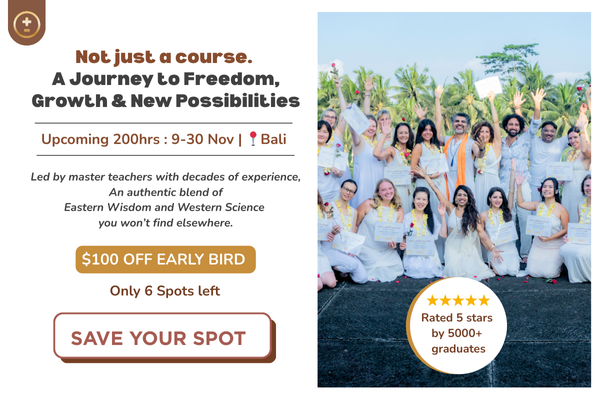
Completing the 22-day program earns you a Yoga Alliance RYT 200 certificate, internationally recognized and accepted by the vast majority of studios worldwide. Every graduate also receives one year of access to our 50-hour online Yin Yoga course for continued study after training.
Since 2011, YNV’s Yoga Alliance profile has carried only 5-star reviews. Global Gallivanting named us the Most Authentic YTT in Bali. Om Yoga Magazine in London agreed. We have since expanded into India, launching in Dharamshala from October 2025 for students seeking the Himalayan context of this practice.
Frequently Asked Questions About Yoga New Vision Training
1. Is Yoga New Vision certified by Yoga Alliance?
Yes. Yoga New Vision is a Registered Yoga School (RYS 200 and RYS 300) with Yoga Alliance USA, registered since 2011. Completing the 22-day program earns you an internationally recognized RYT 200 certificate. You can register globally as a certified yoga teacher at any studio or teaching platform with this credential.
2. What makes Meditative Hatha Vinyasa different from standard Vinyasa?
Standard Western Vinyasa prioritizes continuous movement and athletic sequencing, which activates a sympathetic nervous system stress response. Our Meditative Hatha Vinyasa holds postures longer and integrates breath retention to move the body into a parasympathetic state. We teach asana as applied mind-body medicine rather than performance or choreography.
3. Can beginners join the Yoga New Vision teacher training?
Yes. The curriculum assumes basic body awareness, not advanced flexibility or inversions. Our physiotherapy-trained faculty teach you how to adapt classical postures safely to your individual skeletal anatomy from day one. Prior yoga experience is helpful but it is not a prerequisite for acceptance into our program.
4. How long is the Yoga New Vision 200-hour training?
The 200-hour program runs for 22 days at Omham Retreats in Kedewatan, Ubud, Bali. Programs start from USD 1,999, which includes tuition, course material, and Yoga Alliance certification eligibility. The 300-hour advanced program is available for graduates seeking to deepen their practice and teaching further.
5. Who are the teachers at Yoga New Vision?
Our faculty includes monks, swamis, licensed medical doctors, and physiotherapists from India teaching together in one curriculum. This multi-disciplinary structure is unique to YNV in Bali. I lead the program as ERYT 500, and every faculty member has at minimum a decade of dedicated practice and formal teaching experience in their discipline.
6. What does a typical training day look like?
Days begin with morning Sadhana at 6am in the open-air shala. Sessions cover asana, pranayama, philosophy, anatomy, and teaching practicum throughout the day. Evenings close with Satsang, a group inquiry session where students examine their questions alongside teachers in a non-hierarchical, open space.
7. What if I arrive with a physical injury or health limitation?
Our physiotherapy-trained faculty assess each student individually and recommend asana modifications throughout the full curriculum. We have accommodated students managing chronic respiratory conditions, spinal limitations, and post-surgical recovery. Please disclose any health conditions before arrival so we can prepare the appropriate support from day one.
8. Is the training worth joining if I do not plan to teach professionally?
Yes. A substantial portion of YNV graduates join for personal transformation rather than a professional teaching career. The curriculum builds genuine body literacy, breath awareness, and psychological tools you carry into everyday life. Many graduates describe the 22 days as the most clarifying experience they have had as an adult.
9. What certification do I receive after completing the training?
You receive a Yoga Alliance RYT 200 certificate upon completing the full 22-day program. This is internationally recognized and allows you to register as a certified yoga teacher in any country. YNV has maintained a 5-star rating on the Yoga Alliance registry continuously since our initial registration in 2011.
10. How is Yoga New Vision different from other yoga teacher training schools in Ubud?
We are the only training in Bali where monks, swamis, medical doctors, and physiotherapists from India teach together in a single program. Our Meditative Hatha Vinyasa method is proprietary. YNV has trained over 15,000 graduates since 2009 and was named the Most Authentic YTT in Bali by Global Gallivanting and Om Yoga Magazine, London.