By Deep Kumar | Yoga New Vision
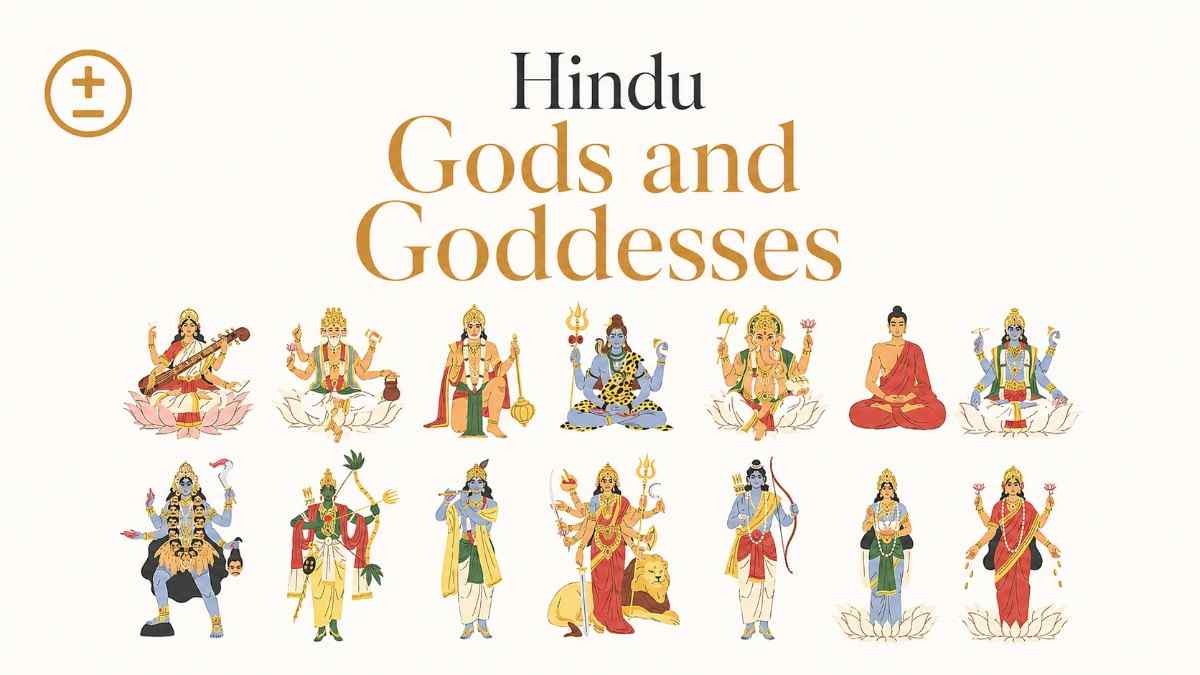
Hindu gods are symbolic representations of universal forces within one formless absolute reality called Brahman. There are 33 primary divine categories in the Vedas, a figure popular tradition expanded to 33 million. The most important deities for yoga practitioners are Shiva, Vishnu, Brahma, Ganesha, Hanuman, Lakshmi, Saraswati, Durga, Kali, Parvati, and Krishna.
What Are Hindu Gods?
Hindu gods are not separate supernatural beings competing for territory in the sky. They are personified representations of universal forces and qualities that exist within the one formless absolute reality called Brahman. Each deity gives a human face to something vast and otherwise invisible, so that the human mind can contemplate, meditate on, and consciously work with those qualities.
One question I hear often, especially from students who have just started their teacher training, is whether practicing yoga means you have to accept Hindu religious beliefs. The answer is no. But understanding these deities will still change the way you practice. When you learn what Shiva actually represents and why the pose Natarajasana carries his name, the posture ceases to be a physical challenge and becomes a philosophical statement.
The great saint Sri Ramakrishna said there can be as many Hindu gods as there are devotees to suit the moods, feelings, and backgrounds of different people. What he was pointing to is that the divine reveals itself in whatever form a particular seeker needs. The multiplicity is not chaos. It is an intelligent system designed to meet human beings exactly where they are.
From the Vedas to the Puranas: How Hindu Gods Evolved
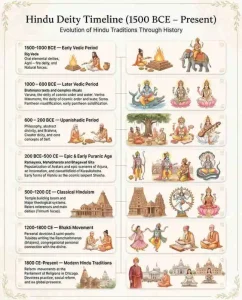
The Hindu deities you encounter in yoga studios today are largely Puranic deities whose stories were developed across the major Puranas. Most scholars date the composition and compilation of these texts over several centuries, broadly between the early centuries CE and the late first millennium CE. The earliest Hindu gods appear in the Rig Veda, which most scholars generally date to the late second millennium BCE, although the exact chronology remains debated. and they look quite different. Understanding this evolution is one of the most overlooked pieces of knowledge in modern yoga education.
The Vedic Period: Gods of Natural Force
The Vedic gods were elemental. Agni was the sacred fire, the intermediary between the human and divine realms who carried ritual offerings upward. Indra was the king of the gods, the wielder of lightning and the slayer of the drought demon Vritra. Varuna was the keeper of cosmic order, called Rita, and was connected to the breath, the waters, and ethical law.
These Vedic figures did not disappear. They were absorbed, transformed, and embedded into the later tradition. The concept of Agni lives in every pranayama practice that references inner fire and the purification of the energy body. Indra gave his name to indriya, the Sanskrit word for the sense organs, which appear throughout the Yoga Sutras of Patanjali.
The Puranic Shift and the Rise of the Trimurti
The Bhagavad Gita, which forms part of the Mahabharata traditionally part of the Mahabharata and generally placed by scholars within the late centuries BCE to early centuries CE. marks a significant transition. Here, the god Krishna delivers a complete philosophy of yoga, karma, dharma, and liberation. The personal, relatable deity speaking directly to the practitioner becomes central to Indian spirituality in a way the Vedic hymns had not emphasized.
By the time the major Puranas were compiled, Brahma, Vishnu, and Shiva had been organized into the Trimurti: the cosmic trinity of creation, preservation, and dissolution. The goddesses gained their full mythological identities in texts like the Devi Mahatmya, part of the Markandeya Purana. This is the framework that most yoga teacher training programs draw from today.
| Period | Primary Texts | Key Deities | Core Teaching |
| Early Vedic Period (generally placed in the second millennium BCE) | Rig Veda, Sama Veda, Yajur Veda, Atharva Veda | Agni, Indra, Varuna, Surya, Soma | Cosmic order through ritual, natural forces personified |
| Upanishadic Period (generally placed between the late Vedic period and the early classical era) | 108 Upanishads, especially the 13 principal | Brahman (formless), Atman | Inner reality, self-inquiry, Atman = Brahman |
| Epic Period (commonly dated between the last centuries BCE and the early centuries CE) | Mahabharata, Ramayana, Bhagavad Gita | Vishnu, Krishna, Rama, Shiva | Dharma, devotion, the avatar concept |
| Puranic Period (generally placed between the early centuries CE and the late first millennium CE) | 18 Major Puranas, Devi Mahatmya | Full Trimurti and Tridevi, Durga, Kali, Ganesha, Hanuman | Mythology, iconography, temple worship |
The Trimurti: Brahma, Vishnu, and Shiva
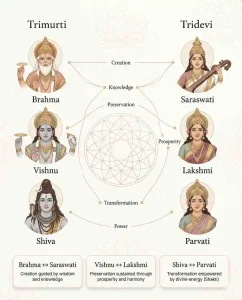
The Trimurti is Hinduism’s cosmic trinity. Brahma creates, Vishnu preserves, and Shiva dissolves. These three deities do not compete. They represent three inseparable phases of the one universal cycle that governs everything from the lifespan of a universe down to the duration of a single breath. You inhale (creation), you hold or sustain the breath (preservation), and you exhale (dissolution).
Brahma: The Creator Nobody Worships
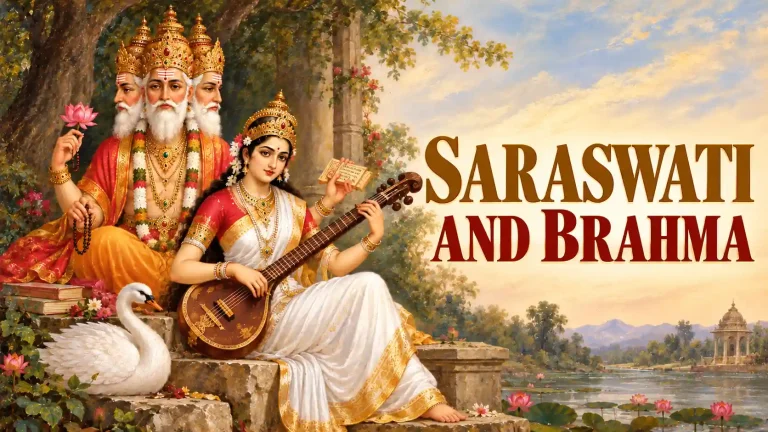
Brahma is the deity of creation, the source of the cosmic intellect, and the breath behind the four Vedas. He is depicted with four heads, each facing one of the four cardinal directions, symbolizing the four Vedas he brought into existence. His consort is Saraswati, the goddess of knowledge, and his vehicle is a swan or a goose.
Students are often surprised to learn that Brahma has very few temples primarily dedicated to him in India. Among them, the Brahma Temple at Pushkar in Rajasthan is by far the most famous and significant pilgrimage site. Many students wonder why one of Hinduism’s principal deities has comparatively few temples dedicated exclusively to him. The reason is philosophical. Creation has already happened. Brahma’s work is done. Vishnu sustains what was created, and Shiva will eventually dissolve it. One traditional explanation is that Brahma’s role as the creator is considered complete, while Vishnu is associated with preservation and Shiva with transformation. As a result, devotional traditions have historically focused more heavily on Vishnu, Shiva, and the Goddess, although interpretations vary across regions and traditions.
This also leads to the most important distinction in all of Hindu philosophy for yoga students: Brahma the four-headed creator deity is entirely different from Brahman, the formless ultimate reality. The similar names create enormous confusion. The table below shows exactly why this matters.
Several traditional stories explain this, including accounts found in the Puranas involving a curse from Savitri. Different regions preserve different versions of this tradition, reflecting the diversity of Hindu mythology rather than a single universally accepted narrative.
Vishnu: The Preserver and the God of Ten Avatars
Vishnu is the preserver of cosmic order, the deity who sustains the universe and descends into physical form whenever dharma is threatened. He is depicted with blue skin, four arms, and holds four objects: a conch (shankha) representing the sound of creation, a lotus (padma) for purity, a spinning disc (Sudarshana Chakra) symbolizing the mind’s control over time, and a mace (kaumodaki) for strength and knowledge.
Vishnu’s most significant contribution to yoga is the avatar tradition. When cosmic order is disturbed beyond what the existing order can repair, Vishnu descends (avatarati in Sanskrit) into a specific form to restore it. The Bhagavad Gita is spoken by Krishna, who is Vishnu’s eighth avatar. Rama, the protagonist of the Ramayana, is his seventh. The yoga poses Matsyasana and Kurmasana carry the names of his first and second avatars.
| Avatar | Form | Primary Text | Yoga Connection | Life Lesson |
| Matsya | Fish | Matsya Purana | Matsyasana | Sacrifice and protection of sacred knowledge |
| Kurma | Tortoise | Kurma Purana | Kurmasana | Patience and the steady foundation beneath all effort |
| Varaha | Boar | Varaha Purana | None direct | Recovering what is lost through relentless action |
| Narasimha | Half-lion, half-human | Vishnu Purana | None direct | Protection arising from unexpected forms |
| Vamana | Dwarf | Vamana Purana | None direct | Humility as the highest power |
| Parashurama | Warrior sage | Mahabharata | None direct | Righteous action without attachment to the result |
| Rama | Ideal king | Ramayana | Hanumanasana (indirect) | Dharma lived fully, regardless of personal cost |
| Krishna | Divine teacher | Bhagavad Gita | None direct, but Bhakti yoga connects | Action, love, and the path to liberation |
| Buddha | Enlightened teacher | Later Puranic additions | None direct | Compassion and the middle path |
| Kalki | Future warrior | Kalki Purana | None direct | Renewal after the completion of the current cosmic age |
Shiva: The First Yogi, the Cosmic Dancer, and the God Most Misunderstood
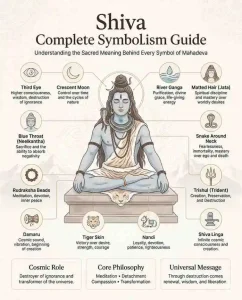
Shiva is simultaneously the destroyer of illusion, the supreme ascetic, the cosmic dancer Nataraja, and the first teacher of yoga. No other deity holds this range of identities within a single form. When I first began teaching outside India, I found that Western students often arrived with the idea that Shiva was “the Hindu god of death.” This is one of the most widespread misunderstandings in the yoga world.
Shiva does not bring death. He brings the dissolution of everything that is false, including your attachment to your ego, your fixed ideas about yourself, and the identities you have built up that prevent deeper awareness. The Hatha Yoga Pradipika, one of the foundational texts of physical yoga practice, states in its opening verse that Shiva revealed the science of Hatha Yoga as a ladder to Raja Yoga and liberation. Shiva is the reason yoga exists at all.
His iconography is a complete philosophy encoded in symbols. The third eye on his forehead represents the ability to perceive truth beyond the surface world of appearances. The crescent moon marks him as the lord of cyclical time. The river Ganga flows from his matted hair, showing his capacity to hold and release divine grace without being overwhelmed by it. The snake Vasuki coiled around his neck represents his mastery over the kundalini energy, the same primal force that practitioners work with in Kundalini and Tantric yoga traditions. His trishul, the three-pronged trident, represents the three gunas: tamas, rajas, and sattva.
The mantra Om Namah Shivaya is the panchakshara, the five-syllable mantra. Each of the five syllables, Na, Ma, Shi, Va, Ya, corresponds to one of the five elements: earth, water, fire, air, and space. Chanting this mantra is not a religious declaration. It is an alignment of the energy body with the five elemental forces that constitute physical reality.
The Tridevi: Saraswati, Lakshmi, and Parvati
The Tridevi are the three primary goddesses of Hindu tradition. Saraswati is the Shakti of Brahma, governing knowledge and creative expression. Lakshmi is the Shakti of Vishnu, governing abundance and spiritual grace. Parvati is the Shakti of Shiva, governing the primordial energy that makes all manifestation possible. In Hindu philosophy, Shakti (feminine energy) is what allows the male principle (consciousness) to act. Without Shakti, even the most powerful deity cannot move.
Saraswati: Why the Goddess of Knowledge Holds a Musical Instrument
Saraswati is the goddess of knowledge, language, music, and the creative intelligence that underlies all learning. She is depicted in pure white, seated on a white lotus or a white swan, holding a veena (a stringed instrument), a book of the Vedas, prayer beads, and a water vessel. Each object carries a precise meaning.
The veena represents the fact that true knowledge has rhythm, harmony, and flow. A teacher who merely recites facts is not expressing Saraswati’s energy. Saraswati is present when knowledge becomes alive, when it moves through a student and changes them. When I teach Sanskrit mantra for the first time, I ask students to notice how even mispronounced Sanskrit sounds produce a response in the body. That response is Saraswati at work.
Her vehicle is the swan, which in Hindu tradition represents viveka, the discriminative intelligence that separates truth from illusion, just as a swan is said to separate milk from water when they are mixed. That quality is precisely what every yoga student and teacher needs as they navigate the enormous and sometimes contradictory landscape of yoga information available today.
Lakshmi: The Four Dimensions of Abundance
Lakshmi is the goddess of abundance, purity, generosity, and spiritual grace. She stands on a fully bloomed lotus, with coins flowing from one hand, two hands holding lotus blossoms, and her fourth hand raised in the gesture of blessing. Her four hands do not only represent material wealth. They represent the four purusharthas, the four goals of human life recognized in Hindu philosophy.
| Hand | Purushartha | Meaning | Yoga Application |
| First (coins flowing) | Artha | Material well-being | The legitimate foundation of a stable life |
| Second (lotus) | Kama | Fulfillment of rightful desire | Living fully, not suppressing life energy |
| Third (lotus) | Dharma | Righteous action | Practice aligned with your deeper purpose |
| Fourth (blessing gesture) | Moksha | Liberation from the cycle of rebirth | The ultimate goal of all yogic effort |
Many students reduce Lakshmi to a symbol of money. This misses the essential teaching. Her mantra, Om Shrim Maha Lakshmiyai Namaha, is traditionally chanted to invite grace and abundance in all four dimensions simultaneously. A practitioner can be materially wealthy and spiritually impoverished and still not have received Lakshmi’s real blessing.
Parvati: The Student Who Became the Teacher’s Equal
Parvati is the mother goddess, the daughter of the Himalayas, and the consort of Shiva. She represents devoted spiritual practice (tapas), feminine strength, and the primal earth energy that sustains all life. Every major form of the fierce goddess, including Durga and Kali, is understood in Hindu tradition as an expression of Parvati’s energy when it takes a protective or transformative form.
The relationship between Shiva and Parvati is the origin of the Guru-shishya tradition in yoga. According to the Hatha Yoga Pradipika, Shiva first transmitted the science of yoga to Parvati. She is not a passive recipient. She is the questioning, intelligent student who draws the teaching out through her sincerity and persistence. Every yoga student who shows up to practice with genuine commitment is, in this sense, following in Parvati’s footsteps.
The Fierce Goddesses: Durga and Kali
Durga and Kali are expressions of the supreme divine feminine in her protective and transformative aspects. Durga destroys the external obstacles and ego structures that block spiritual progress. Kali destroys the deepest roots of illusion and the false self. Both arise from Parvati’s energy when ordinary measures are not sufficient. Understanding these goddesses requires releasing the idea that darkness equals evil.
Durga: Born from Combined Divine Power
Durga was created when the demon Mahishasura grew so powerful that even the combined force of Brahma, Vishnu, and Shiva could not defeat him. Each god channeled their divine energy, and from that unified force Durga arose, each deity’s signature weapon placed in one of her eight or ten arms. Her vehicle is a lion, representing the sovereign power and fearlessness she embodies.
Her story contains a teaching that goes well beyond mythology. The obstacles that block genuine spiritual growth are sometimes too deeply rooted for ordinary practices to remove. Durga’s energy is the integration of all your capacities, the moment when you stop fighting your obstacles with one part of yourself while another part holds back. Navaratri, the nine-night festival of Durga worship, falls twice a year and is one of the most widely practiced spiritual observances in India. [External Link: Devi Mahatmya source text]
Kali: What the Skull Necklace Actually Means
Kali is the goddess of time, transformation, and the liberation that comes through the total dissolution of the false self. She appears with dark blue or black skin, a garland of severed human heads, her tongue extended, and she stands on the body of Shiva. To a viewer without context, this image is disturbing. That reaction is exactly what the iconography is designed to provoke, because Kali forces you to face the thing you are most afraid to look at.
The garland of heads does not represent murder. Each skull represents a liberated human ego. She does not destroy people. She destroys the ego structures that keep people imprisoned. Standing on Shiva’s body teaches that even pure consciousness is activated and expressed only through her Shakti. Her name comes from the Sanskrit root Kala, meaning time. She is the force that shows you, with total clarity, that every form, every identity, and every fear you hold is impermanent. In Tantric yoga tradition, Kali is worshipped precisely to accelerate liberation, not to bring harm.
Ganesha and Hanuman: The Most Beloved Deities in Yoga
Ganesha and Hanuman appear in more yoga studios globally than any other Hindu deities. Ganesha is the elephant-headed son of Shiva and Parvati, the remover of obstacles, and the lord of all new beginnings. Hanuman is the monkey god of the Ramayana, the embodiment of devotion, strength, and selfless service. Both are beloved because their qualities are directly relevant to what yoga demands of a practitioner every single day.
Ganesha: The Philosophy Inside the Elephant Head
Ganesha is always invoked first before any Hindu ceremony, any new undertaking, and any yoga teaching session. His mantra, Om Gam Ganapataye Namaha, is the first sound a practitioner sends into the space before beginning. This is not superstition. It is the practice of setting clear, grounded intention before acting, the same principle that underlies every sankalpa practice in yoga.
There are multiple versions of the story explaining how Ganesha received his elephant head, which confuses many students who expect mythology to be consistent. This is one of the places where I explain to students that Hindu mythology was never designed to function as a single unchangeable narrative. Different regional traditions emphasized different stories to highlight different teachings. The core teaching remains the same across all versions: a great sacrifice was made, and from that sacrifice came extraordinary wisdom. That is the meaning of Ganesha’s form.
His broken tusk, according to the Mahabharata itself, was used to write that very text when the sage Vyasa dictated it. Ganesha sacrificed a part of himself to serve the transmission of sacred knowledge. His small mouse vehicle represents the ability to navigate the tightest spaces of the ego and find a way through. He is also the presiding deity of the Muladhara chakra, the root energy center at the base of the spine. When yoga teachers guide students through root chakra practices, they are working within Ganesha’s energetic domain.
Hanuman: What the Leap Really Means
Hanuman’s entire arc in the Ramayana is a lived demonstration of Bhakti yoga. He served Lord Rama with every capacity he possessed, his physical strength, his intelligence, his fearlessness, and his complete willingness to leap across an ocean when nothing less would serve his purpose. The yoga pose Hanumanasana, the full split, represents that leap, the moment when devotion overrides the calculation of what is physically possible.
The deeper teaching of Hanuman is that your greatest strength becomes available when you stop serving your own ego. Hanuman is described in the Valmiki Ramayana as a being of immense power who could have been an equal to the gods. He chose devotion and service as the highest expression of that power. Students who struggle with Hanumanasana are often told to work on flexibility. I would add: work on surrender. The pose opens when the ego stops negotiating.
Krishna, Rama, and the Avatar Tradition
An avatar is not the same as a god. A deity exists in a transcendent, eternal form. An avatar is a voluntary descent of divine consciousness into a specific physical form, at a specific moment in history, to restore dharma when it has broken down. The Bhagavad Gita, Chapter 4, verse 7, has Krishna state this principle directly in his own words: whenever dharma declines and its opposite rises, I send myself forth.
Rama is the seventh avatar of Vishnu and the protagonist of the Ramayana. He represents the ideal of dharma lived fully, regardless of personal cost. His story is not a simple tale of good versus evil. It is a sustained examination of what it means to act rightly when every option available involves some form of sacrifice.
Krishna is the eighth avatar and the teacher of the Bhagavad Gita. He does not teach yoga from a mountaintop in meditation. He teaches it on a battlefield, in the middle of a crisis, to a student who is paralyzed by grief and confusion. That context is deliberate. The Bhagavad Gita’s teaching is that yoga is not an escape from life. It is the practice of engaging with life fully while remaining connected to something that does not change.
Hindu Gods and Yoga Poses
Yoga poses are not named after Hindu deities by coincidence. Each name carries the full weight of the mythology behind it. When you understand what Virabhadra is, and why Shiva created him, the three Warrior poses become a completely different practice.
| Pose | Sanskrit Name | Deity or Figure | Mythology | Teaching |
| Cosmic Dancer | Natarajasana | Nataraja (Shiva) | Shiva’s dance of cosmic creation and dissolution | The universe is in constant motion; balance within that motion |
| Monkey Pose | Hanumanasana | Hanuman | Hanuman’s leap from India to Lanka | Devotion breaks the limits of what seems physically possible |
| Low Lunge | Anjaneyasana | Anjana (Hanuman’s mother) | Hanuman’s divine birth | Honoring the origin of sacred power |
| Warrior I, II, III | Virabhadrasana | Virabhadra | A fierce form Shiva created from his own grief and rage | Righteous power directed with discipline |
| Fish Pose | Matsyasana | Matsya avatar | Vishnu descended as a fish to save the Vedas from cosmic flood | Rescue what is sacred; knowledge is worth protecting |
| Eagle Pose | Garudasana | Garuda | Vishnu’s divine eagle vehicle, symbol of swift liberation | Rising above with focused, unwavering intention |
| Tortoise Pose | Kurmasana | Kurma avatar | Vishnu as a tortoise supporting the churning of the cosmic ocean | Stillness and stability beneath the effort of transformation |
| Seated Twist | Ardha Matsyendrasana | Sage Matsyendra | A historical sage who received yoga teachings while inside a fish | Receiving wisdom from unexpected places |
| Side Plank | Vasisthasana | Sage Vasistha | One of the seven great Vedic seers | Strength grounded in ancient wisdom |
| Lotus Pose | Padmasana | Brahma, Vishnu, Lakshmi | The lotus as symbol of purity arising from the cosmic waters | The capacity to bloom in full while rooted in what is murky |
Deity and Chakra Correspondences
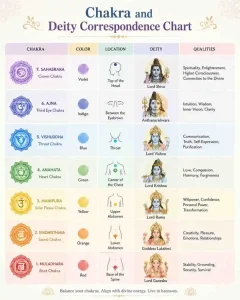
Each of the seven chakras in the yogic energy body has a presiding deity. These correspondences come primarily from tantric yogic texts and Puranic tradition. Knowing them allows a teacher to work with deity symbolism and chakra practice as one unified system rather than two separate topics.
| Chakra | Location | Presiding Deity | Element | Quality |
| Muladhara | Base of spine | Ganesha, Brahma | Earth | Stability, foundation, beginnings |
| Svadhisthana | Below navel | Vishnu, Rakini | Water | Creativity, fluidity, life force |
| Manipura | Navel | Rudra/Shiva, Lakini | Fire | Will, transformation, personal power |
| Anahata | Heart | Isha/Shiva, Krishna | Air | Love, compassion, devotion |
| Vishuddha | Throat | Sadashiva, Saraswati | Space/Ether | Truth, expression, sacred sound |
| Ajna | Between eyebrows | Shiva (Ardhanarishvara) | Light/Mind | Perception, intuition, clarity |
| Sahasrara | Crown | Shiva and Shakti in union | Beyond element | Pure consciousness, liberation |
Mantras of the Major Deities
| Deity | Mantra | Meaning | Primary Use |
| Shiva | Om Namah Shivaya | Salutation to Shiva, lord of the five elements | Transformation, inner clarity |
| Vishnu | Om Namo Narayanaya | Salutation to Narayana, the all-pervading | Peace, preservation, protection |
| Ganesha | Om Gam Ganapataye Namaha | Salutation to Ganapati, remover of obstacles | New beginnings, intention-setting |
| Lakshmi | Om Shrim Maha Lakshmiyai Namaha | Salutation to great Lakshmi | Abundance, grace in all four life domains |
| Saraswati | Om Aim Saraswatyai Namaha | Salutation to Saraswati | Learning, speech, creative wisdom |
| Durga | Om Dum Durgayai Namaha | Salutation to Durga | Protection, courage, fierce compassion |
| Hanuman | Shri Ram Jai Ram Jai Jai Ram | Victory to Rama | Devotion, strength, selfless action |
| Krishna | Om Namo Bhagavate Vasudevaya | Salutation to Vasudeva, the Krishna | Liberation through love and right action |
| Gayatri | Om Bhur Bhuvah Svaha… | Meditation on the divine solar light | Morning practice, purification, universal invocation |
Common Misconceptions About Hindu Gods
Misconception 1: Yoga Equals Hinduism
Yoga is a practical system for developing physical, mental, and spiritual well-being. Hinduism is a religion. They share the same cultural origin and many of the same texts, but they are not the same thing. A Hindu person does not automatically practice yoga. A yoga practitioner does not automatically become Hindu. You can engage deeply with yoga philosophy, including the study of Hindu deities, as an educational and spiritual practice without adopting Hindu religious identity.
Misconception 2: Shiva Is the God of Death
Shiva is the god of transformation and dissolution, which is not the same as death. He destroys illusion, ego, and the false structures that keep consciousness imprisoned. The Yoga Sutras of Patanjali, Book 1, describe the goal of yoga as the cessation of mental fluctuations. Shiva’s energy is precisely this force that dissolves unnecessary mental activity. He is not feared in India. He is the most approachable of the major deities for those walking a serious spiritual path.
Misconception 3: Kali Represents Evil
Kali represents the liberation that comes through confronting what you most fear. Her skull garland represents liberated egos, not victims. Her dark appearance represents the formlessness before creation, not malevolence. In Tantra, she is the most direct path to liberation precisely because she refuses to allow any comfortable illusion to remain intact.
Misconception 4: 33 Million Gods Means 33 Million Separate Beings
The original Vedic texts describe 33 primary divine categories, not 33 million individual beings. The figure of 33 million is a poetic expression of the idea that the divine is present in everything, meaning the sacred is unlimited in its capacity to reveal itself. It is a philosophical statement, not a theological headcount.
Misconception 5: Ganesha Is Only About Success and Money
Ganesha is the lord of all beginnings and the remover of obstacles, which includes the internal obstacles of fear, doubt, and confusion that block spiritual growth. He is the presiding deity of the Muladhara chakra and the principle of grounded, clear intention. In Indian tradition, he is invoked before study, travel, creative work, and spiritual practice, not only before financial ventures.
Misconception 6: Practicing With Hindu Deities Requires Becoming Hindu
The Hindu deity tradition has always been open to sincere seekers from any background. What is required is genuine respect, the effort to understand the symbolism, and a willingness to engage seriously rather than superficially. The deities are energetic principles. They respond to sincerity, not religious membership.
Comparison Tables
Brahma vs Brahman
| Brahma | Brahman | |
| What it is | A deity, one of the Trimurti | The formless absolute reality underlying all existence |
| Has a form | Yes, four heads, four arms | No form, no attributes |
| Can be worshipped | Yes, though rarely in practice | Cannot be worshipped directly, only realized |
| Role | Creator of the universe | The ultimate source of everything, including Brahma |
| Appears in | Puranas, Mahabharata | Upanishads, Bhagavad Gita, Yoga Sutras |
| Yoga relevance | Names root chakra associations | Foundation of all non-dual yoga philosophy |
| Most common confusion | Often mistaken as the same word | Students write Brahman and mean Brahma, and vice versa |
Shiva vs Vishnu
| Shiva | Vishnu | |
| Primary role | Dissolution of illusion, transformation | Preservation of cosmic order |
| Appearance | White ash, matted hair, crescent moon, snake | Blue skin, four arms, lotus, conch, mace, disc |
| Consort | Parvati (also Shakti) | Lakshmi |
| Vehicle | Bull (Nandi) | Eagle (Garuda) |
| Primary tradition | Shaivism | Vaishnavism |
| Most important text | Shiva Purana, Hatha Yoga Pradipika | Bhagavad Gita, Vishnu Purana, Srimad Bhagavatam |
| Yoga connection | Adiyogi, the source of all yoga | Avatar tradition, Bhakti yoga through Krishna and Rama |
| Primary mantra | Om Namah Shivaya | Om Namo Narayanaya |
Durga vs Kali
| Durga | Kali | |
| Primary quality | Protective warrior power | Transformative dissolution of the ego |
| Appearance | Beautiful, radiant, 8 to 10 arms, riding a lion | Dark blue or black, skull garland, tongue extended |
| Origin | Created from combined divine energy of Trimurti | Emerged from Durga’s forehead during battle |
| Destroys | External obstacles, demonic forces threatening dharma | The deepest roots of ego, illusion, and attachment to the body |
| Festival | Navaratri (nine nights, twice yearly) | Kali Puja (primarily in Bengal, Odisha) |
| Primary tradition | Shaktism (all branches) | Tantra, Shaktism (especially Kalikula) |
| Yoga connection | Courage, integration of power, fearless practice | Liberation, confronting impermanence, Kundalini tradition |
Vedic Gods vs Puranic Gods
| Vedic Gods | Puranic Gods | |
| Period | 1500 BCE and earlier | 300 CE to 1200 CE |
| Primary texts | Rig Veda, Sama Veda, Yajur Veda | 18 Major Puranas, Mahabharata, Ramayana |
| Character | Elemental and cosmic forces | Personal, relatable, with family relationships and stories |
| Most important | Agni, Indra, Varuna, Surya, Soma | Shiva, Vishnu, Brahma, Durga, Ganesha, Hanuman |
| Relationship to yoga | Foundational, mantra tradition, prana concepts | Bhakti yoga, deity meditation, yoga pose mythology |
| How they are approached | Through ritual and Vedic hymns | Through devotion, temple worship, mantra, and mythology |
Avatar vs Deity
| Avatar | Deity | |
| What it is | A voluntary descent of divine consciousness into physical form | A permanent divine being in a transcendent realm |
| Duration | Finite, purpose-specific | Eternal |
| Purpose | Restore dharma when it has broken down | Govern specific cosmic forces continuously |
| Examples | Rama, Krishna, Vamana | Shiva, Brahma, Saraswati, Ganesha |
| Primary text | Bhagavad Gita Ch 4, v 7 to 8 | Puranas |
| Yoga relevance | The avatar concept shows that the divine is not distant but responds to human conditions | Deities are the stable energetic principles available for practice |
Bhakti Yoga vs Jnana Yoga
| Bhakti Yoga | Jnana Yoga | |
| Path | Devotion and love directed toward a deity or the divine | Direct inquiry into the nature of the Self |
| Primary deity connection | Personal relationship with Ishvara or ishtadevata | Transcends personal deity toward formless Brahman |
| Primary text | Narada Bhakti Sutras, Bhagavad Gita Ch 12 | Upanishads, Ashtavakra Gita, Bhagavad Gita Ch 2 to 4 |
| Key figures | Hanuman, Mirabai, Chaitanya Mahaprabhu | Adi Shankaracharya, Ramana Maharshi |
| Practice | Mantra chanting, puja, kirtan, visualization | Self-inquiry, meditation, study of Vedanta |
| Yoga Sutras reference | Ishvara pranidhana, Book I sutra 23 | Viveka (discrimination) and vairagya (non-attachment) |
| Common misunderstanding | Seen as emotional and therefore less rigorous | Seen as intellectual and therefore cold |
Sanskrit Pronunciation Guide
| Sanskrit Term | Pronunciation | Meaning | Context |
| Brahman | BRAH-mun | Formless ultimate reality | Philosophy, Upanishads |
| Brahma | BRAH-mah | Creator deity of the Trimurti | Mythology, Puranas |
| Shiva | SHEE-vah | The auspicious one, destroyer-transformer | All yoga traditions |
| Vishnu | VISH-noo | The all-pervading one | Vaishnavism, Bhagavad Gita |
| Ganesha | guh-NAY-shah | Lord of the ganas (divine attendants) | All ceremonies, Muladhara |
| Hanuman | HUN-oo-maan | Having a prominent jaw, or one with broken jaw | Ramayana, Bhakti yoga |
| Lakshmi | LUHK-shmee | Auspicious mark or sign | Prosperity, Vaishnavism |
| Saraswati | suh-RUS-wuh-tee | She who flows, she who has truth | Knowledge, mantra, arts |
| Parvati | PAR-vuh-tee | Daughter of the mountain (Parvata) | Shakti tradition |
| Durga | DUR-gah | Invincible, the one difficult to approach | Shaktism, Navaratri |
| Kali | KAH-lee | She who is related to time (Kala) | Tantra, liberation |
| Chakra | CHUK-ruh | Wheel or circle | Energy body, yogic anatomy |
| Mantra | MUN-truh | Mind instrument, sound tool | Chanting, meditation |
| Dharma | DHUR-muh | Cosmic and personal law, righteous duty | Philosophy, ethics |
| Karma | KUR-muh | Action, the law of cause and effect | Ethics, Bhagavad Gita |
| Moksha | MOHK-shuh | Liberation from the cycle of rebirth | Goal of all yoga paths |
| Trimurti | tri-MOOR-tee | Three forms | Brahma, Vishnu, Shiva together |
| Tridevi | tri-DAY-vee | Three goddesses | Saraswati, Lakshmi, Parvati together |
| Avatar | UH-vuh-taar | Descent of divine consciousness | Vishnu tradition |
| Shakti | SHUHK-tee | Power, divine feminine energy | All Goddess traditions |
Glossary of Key Terms
Atman: The individual soul or true self within every living being, considered in Advaita Vedanta to be identical with Brahman, the universal consciousness. The realization of this identity is the goal of Jnana yoga.
Brahman: The formless, limitless, ultimate reality underlying all existence in Hindu philosophy. Not a deity with form, but the source from which all deities and all phenomena arise.
Avatar: A voluntary descent of divine consciousness into a specific physical form to restore dharma. Derived from the Sanskrit root avatarati, meaning to descend. Distinct from a deity, which is eternal and transcendent.
Dharma: Cosmic law, personal duty, and righteous action. Each person has a dharma connected to their nature, stage of life, and role in the larger order. Acting in alignment with dharma is central to Karma yoga.
Karma: Action and its inevitable consequence. In Hindu philosophy, karma operates across multiple lifetimes. In yoga, Karma yoga is the path of action performed without attachment to its results, as taught by Krishna in the Bhagavad Gita.
Moksha: Liberation from the cycle of death and rebirth (Samsara). The ultimate goal of all four major yoga paths. Different schools describe it differently: Advaita sees it as the realization of Atman as Brahman, Bhakti sees it as eternal union with the personal divine.
Shakti: The divine feminine energy or power that activates all of existence. Without Shakti, Hindu philosophy holds, even the most powerful male deity cannot act. Shakti is not separate from Shiva but is his dynamic nature in expression.
Murti: A sacred image or form of a deity used as an object of meditation and devotion. The murti is understood not as an idol but as a living form into which the deity’s presence is invoked through ritual.
Yantra: A sacred geometric diagram used in Tantric practice as a visual focal point for meditation, corresponding to a specific deity’s energy pattern. The Sri Yantra is associated with Lakshmi and the goddess tradition.
Mantra: A sacred sound formula used in meditation, chanting, and ritual. Mantras are not prayers in the Western sense. They are precise energetic tools that, when used correctly, produce specific effects on the practitioner’s consciousness.
Puja: Ritual worship offered to a deity through a structured sequence of offerings including flowers, incense, light (lamp), food, and water. Puja is the primary form of Bhakti practice in household Hindu tradition.
Prasad: Food or other offerings that have been blessed through puja and are then distributed to worshippers. Receiving prasad is an act of receiving the deity’s grace through a tangible form.
Guna: One of three fundamental qualities that constitute all matter and mental states: tamas (inertia, heaviness), rajas (activity, restlessness), and sattva (clarity, balance). The three gunas are central to Samkhya philosophy and appear throughout the Bhagavad Gita.
Lila: Divine play, the idea that creation and all its events are an expression of the divine’s spontaneous, joyful activity rather than a problem to be solved. Krishna’s mythology is saturated with the quality of lila.
Rita: Cosmic order or truth in the Vedic tradition, maintained by the deity Varuna and upheld through right action. Rita evolved into the concept of Dharma in later Hindu philosophy.
Samsara: The cycle of death and rebirth governed by karma. Samsara is not punishment. It is the natural continuation of action and desire across multiple lifetimes until the conditions for liberation ripen.
Tantra: A system of practice focused on the expansion of consciousness through the recognition of the divine in all experience, including the body, the senses, and the material world. Often misunderstood as primarily sexual, Tantra is a vast philosophical and practical tradition.
Bhakti: Devotion, the emotional and relational path toward the divine. In Bhakti yoga, the devotee cultivates a personal relationship with a chosen deity (ishtadevata) through love, service, and surrender.
Jnana: Direct knowledge or wisdom, specifically the experiential understanding of the non-dual nature of reality. Jnana yoga uses self-inquiry and Vedantic study as its primary tools.
Ishvara: The personal form of the divine as an object of meditation and devotion, referenced in Yoga Sutras Book I, sutra 23. Ishvara is not the same as the formless Brahman but is a usable, relatable form of the divine available to the practitioner in meditation.
Frequently Asked Questions
- What are Hindu gods, and why should yoga practitioners care about them?
Hindu gods are symbolic representations of universal forces and qualities within the one formless absolute reality called Brahman. Yoga practitioners should understand them because every major yoga pose name, mantra, philosophy text, and meditation tradition has direct roots in Hindu deity mythology. Understanding these roots transforms a physical practice into a complete philosophical and spiritual education.
- How many Hindu gods are there, really?
Vedic texts describe 33 primary divine categories, not 33 million individual beings. That larger figure is a poetic statement meaning the divine is present in everything. For yoga practitioners, the most relevant deities are the Trimurti (Brahma, Vishnu, Shiva), the Tridevi (Saraswati, Lakshmi, Parvati), and Ganesha, Hanuman, Durga, Kali, Krishna, and Rama.
- What is the difference between Brahma and Brahman?
Brahma is the four-headed creator deity, one of the Trimurti, depicted with form, attributes, and mythology. Brahman is the formless, limitless, absolute reality underlying all existence in Hindu philosophy. Brahma is a deity. Brahman is the infinite source from which Brahma, all deities, and all of existence arise. This is the most important distinction in Hindu philosophy for yoga students.
- Why is Shiva called the first yogi?
The Hatha Yoga Pradipika states in its opening verses that Shiva revealed the science of yoga as a ladder to Raja Yoga and liberation. Hindu tradition identifies Shiva as Adiyogi, the original teacher who transmitted yogic knowledge to the seven sages (Saptarishi). His meditative form, his mastery of the kundalini energy, and his role as the destroyer of illusion make him the central deity of all yogic lineages.
- Which yoga poses are named after Hindu gods?
Several major poses carry the direct names of Hindu deities. Natarajasana is named after Nataraja, the dancing form of Shiva. Hanumanasana represents Hanuman’s leap. The three Virabhadrasana poses are named after Virabhadra, a fierce form of Shiva. Matsyasana comes from Matsya, Vishnu’s fish avatar. Garudasana represents Garuda, Vishnu’s eagle vehicle. Kurmasana comes from Kurma, Vishnu’s tortoise avatar.
- What is the Trimurti, and why does it matter for yoga?
The Trimurti is the Hindu cosmic trinity of Brahma the creator, Vishnu the preserver, and Shiva the destroyer. These three deities represent three inseparable phases of the same universal cycle: creation, sustenance, and dissolution. Yoga teaches that every breath, every practice session, and every stage of personal growth follows this same three-phase pattern. Understanding the Trimurti gives yoga its cosmological framework.
- What is the difference between Durga and Kali?
Durga is the warrior goddess who destroys external obstacles and the ego structures that block spiritual progress. She is radiant, rides a lion, and carries weapons from each god. Kali is her fiercer expression, dissolving the deepest roots of ego and false identity through direct confrontation with impermanence. Both arise from Parvati’s energy and are expressions of the supreme divine feminine, Adi Shakti.
- What is Shakti and how does it relate to the male Hindu gods?
Shakti is the divine feminine energy or power that activates all of existence. In Hindu philosophy, the male deity represents pure consciousness (Purusha), while Shakti is the dynamic energy that brings consciousness into manifestation and action. Each major male deity has a Shakti counterpart: Saraswati for Brahma, Lakshmi for Vishnu, and Parvati for Shiva. Without Shakti, the male deity cannot act.
- What is an avatar, and how is it different from a Hindu god?
An avatar is a voluntary descent of divine consciousness into physical form to restore dharma when it has broken down. A deity is a permanent divine being governing specific cosmic forces. Krishna and Rama are avatars of Vishnu, meaning temporary physical manifestations for a specific purpose. Shiva, Saraswati, and Ganesha are deities who exist continuously in their transcendent forms and are not avatars.
- Can someone who is not Hindu work with Hindu deity mantras and iconography?
Yes, with genuine respect and understanding. Hindu deity practices in yoga are not locked behind religious membership. The deities represent universal energetic principles that respond to sincere practice. What is required is the effort to understand what the symbols actually mean, learn the stories behind the mantras, and bring respect rather than superficial cultural borrowing to the practice. Hinduism has always welcomed sincere seekers from all backgrounds.
Conclusion
When I first began teaching yoga internationally, I spent a lot of time watching how students related to deity images in the studio. Some would bow without knowing why. Some would avoid the Ganesha statue near the door as though they were not allowed to engage with it. Some would ask me, almost apologetically, if it was appropriate for them to chant Om Namah Shivaya given that they were not Hindu.
What I consistently saw was not disrespect. It was uncertainty born from incomplete information.
The deities covered in this guide are not distant religious figures guarding the borders of a tradition you must join to enter. They are precise, intelligent symbolic systems developed over three thousand years to help practitioners navigate the deepest questions of human experience: What is real? What should I do? How do I act rightly? What am I, underneath all the identities I have accumulated?
Understanding these symbols does not require religious conversion. It requires the same quality of attention and sincere curiosity that good yoga practice already demands of you. You already bring that to your mat. Bring it here as well.
Note: Dates for ancient Indian texts vary across scholarly traditions because they were preserved orally for centuries before being written down. The time periods mentioned in this guide reflect commonly accepted academic estimates rather than universally agreed historical dates.
About the Author
Deep Kumar is the co-founder of Yoga New Vision and a yoga teacher whose roots trace back to the living tradition of yoga as it is practiced in India, not as it has been translated for international consumption. Growing up in India, Deep Kumar experienced Hindu deity worship not as a subject of study but as an uninterrupted part of daily life, present in household puja, festival celebrations, temple visits, and the oral transmission of philosophy from teachers who carried genuine lineages.
He completed his foundational yoga training in India before expanding his teaching internationally. Over the course of more than a decade of teaching, he has led yoga philosophy sessions, Sanskrit mantra workshops, and teacher training programs for students from more than thirty countries. His focus is on preserving the depth and integrity of the yoga tradition while making its most important teachings accessible to practitioners whose entry point was a studio class rather than a gurukula.
He holds an advanced-level yoga teacher credential and teaches yoga philosophy, traditional asana, pranayama, Sanskrit mantra, and meditation. His particular area of focus is helping international yoga teachers understand the Indian philosophical foundations of the practices they already teach, so that their teaching carries the weight and authenticity the tradition deserves.
Recommended Reading
The following texts are directly referenced in this article. Every yoga student serious about understanding the tradition should explore them.
Bhagavad Gita | Attributed to Vyasa | Available in translations by Swami Prabhupada, Winthrop Sargeant, and Eknath Easwaran | The primary text for understanding Krishna, the avatar tradition, and the four yoga paths.
Hatha Yoga Pradipika | Swami Svatmarama, 15th century CE | Foundational text of Hatha yoga. Opening verses directly attribute the origin of yoga to Shiva.
Rig Veda | Oldest layer of Vedic literature | For understanding Agni, Indra, Varuna, and the Vedic cosmological framework that underlies all later Hindu tradition.
Devi Mahatmya | Part of the Markandeya Purana | The primary text on Durga and the divine feminine tradition. Essential for any teacher working with goddess symbolism.
Yoga Sutras of Patanjali | Scholars generally date the Yoga Sutras of Patanjali somewhere between the 2nd century BCE and the 4th century CE. | Book I, sutra 23 references Ishvara directly. Book II introduces tapas, svadhyaya, and Ishvara pranidhana as the three components of Kriya yoga.
Vishnu Purana | For the Dashavatara tradition and the avatar concept.
Shiva Purana | For Shiva’s mythology, his family relationships, and the Linga tradition.
The Upanishads | Especially the Chandogya, Brihadaranyaka, Katha, and Mundaka | For the Brahman-Atman philosophy underlying all non-dual yoga traditions. Translated by Swami Nikhilananda and Patrick Olivelle.
Published on Yoga New Vision | yoganewvision.com Last Updated: June 2026 Category: Yoga Philosophy